







Sweden’s Foreign Minister, Maria Malmer Stenergard, has stated that peace talks on Ukraine have shown that Moscow is not serious about ending the invasion. After meeting with her Ukrainian counterpart, Andrii Sybiha, in Abu Dhabi, she traveled to Brussels to take part in the meeting of the foreign ministers of the EU.
The meeting will focus on continued support for Ukraine and Europe’s relations with the Middle East. “Russia is not interested in peace,” Malmer Stenergard said, adding that focus should be on the issues that really matter. These include filling the budget gap for 2027 and restarting the debate on mobilizing frozen Russian assets.
According to her, she hopes the European Commission will work on a proposal that would make it possible to move the assets out of Belgium. This would share the risk fairly with Belgium and make member states ready for a new discussion if there is a concrete proposal.

This statement comes after representatives of the US, Ukraine and Russia met in the capital of the United Arab Emirates on November 10-11. The talks aimed to end the full-scale invasion, but there was no further progress beyond an agreement on a prisoner exchange.
Europeans have spent months trying to secure a place at the negotiating table and to guarantee that the continent’s interests are represented in any ceasefire talks. The biggest challenge has been the decision on who should take that place. Ukrainian President Volodymyr Zelenskyy had given allies a tentative deadline of November 19, coinciding with a meeting in Berlin of the Coalition of the Willing, to determine how Europe should be represented.
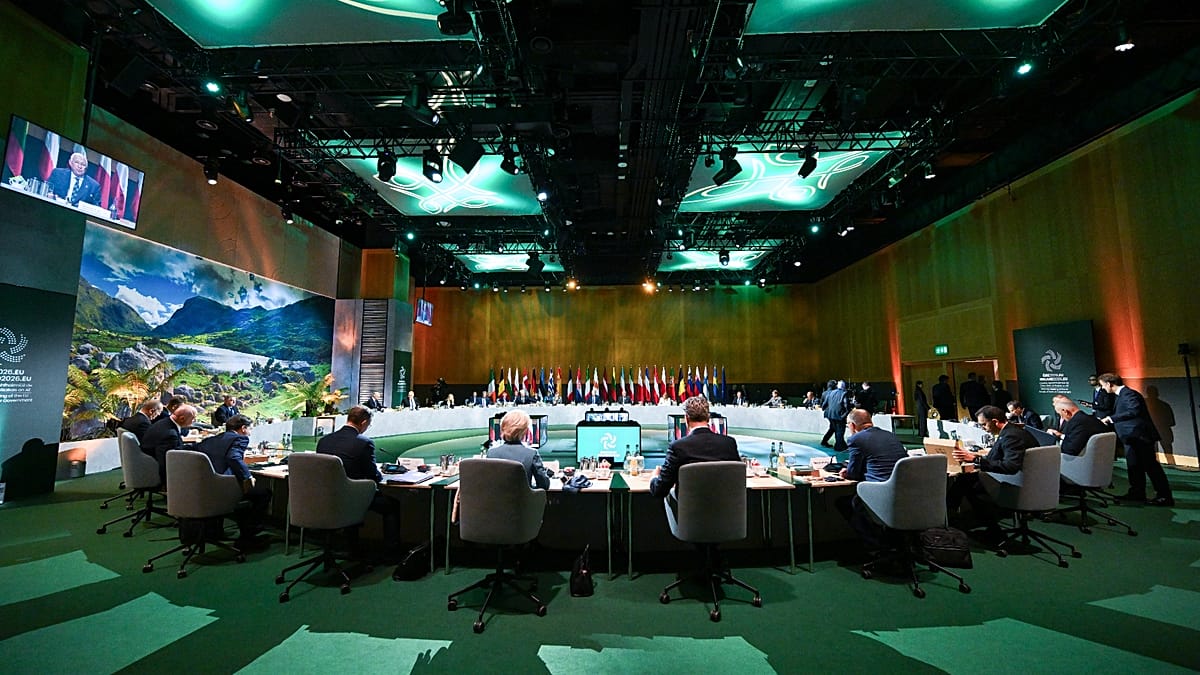
After the informal European Council summit on Friday in Dublin, leaders agreed that Europe would be represented by a seven-member team: France, Germany, the United Kingdom, Italy, Poland, the EU institutions and NATO. Latvian Prime Minister Andris Kulbergs told journalist Shona Murray after Friday’s meeting that the debate about a possible envoy seemed to distract from the bigger issue: Russia’s ongoing full-scale invasion of Ukraine.
According to him, Europe was falling into a trap set by Russian President Vladimir Putin, who, according to Kulbergs, wanted to divert attention from the war. “He wants us to talk about things that are not important,” Kulbergs said, adding that support for Ukraine should be discussed, finding ways to ensure it survives the winter, and how peace talks can benefit it.
“We are the ones who represent the future as Europe, guaranteeing its security,” he emphasized. In Brussels, questions have circulated about what Europeans want to achieve if they are included in negotiations. One ambassador said it is very important to focus on the message and not on the person representing Europe.
For Estonian Foreign Minister Margus Tsahkna, the meeting comes at a critical moment. An alleged sabotage attempt against the Estonian defense company Threod Systems, which Estonian authorities say was orchestrated by Russian military intelligence service GRU, has prompted plans to close road border crossings with Russia from December 1.
The incident underscores why Europe must continue to support Ukraine, both on the battlefield and in negotiations. “Almost five years later, Putin continues to make the same demands he made in 2021, seeking to dictate Europe’s security arrangements. We cannot allow him to win through peace negotiations what he has failed to win on the battlefield,” Tsahkna wrote in a statement posted on X. The Middle East is also on the agenda of the foreign ministers’ meeting.
A diplomatic source said France’s statement that Iran was behind cyberattacks targeting European refrigerators is expected to be discussed. The way European engagement can be increased in Syria to support the political transition after the fall of Bashar al-Assad’s 14-year regime will also be discussed.
Meanwhile, the European Commission’s Enlargement Forum officially starts today, after a noisy evening with Balkan bands. The packed list of events includes high-level figures from EU institutions, as well as prime ministers of candidate countries such as Ukraine, Albania, Montenegro and Moldova.
The big question mark concerns Serbia’s Student List, which will make its debut in Brussels in a public appearance. Many EU officials hope this could lead to an improvement in relations with Belgrade. However, the event did not go entirely without problems.
Kosovo’s Ambassador to Belgium, Agron Bajrami, wrote on social media that the opening concert included a “Serbian nationalist song” titled “Oh, Kosovo, Kosovo”. “The song conveys clear political claims over the territory of the Republic of Kosovo,” the ambassador said, adding that Pristina now expects an “immediate clarification” from the Commission and from Enlargement Commissioner Marta Kos on how the setlist was approved.
In another development, the European Commission is expected to present on Wednesday a proposal for a new support loan for Ukraine worth 45 billion euros. This amount covers two-thirds of the country’s 70 billion euro gap for next year. The EU budget will provide the guarantee and will be used to pay the annual interest, while Russian assets will not be part of the scheme.
The proposal has been drafted on the basis of all 27 member states, but at least four countries – Slovakia, Hungary, the Czech Republic and Bulgaria – want to withdraw from joint borrowing. Slovak Prime Minister Robert Fico has used the peace talks to insist on his position.
“I say a clear no to war, weapons and war loans and a yes to peace,” Fico said over the weekend. The Commission will begin consultations with member states on Tuesday to refine the 22nd package of sanctions against Russia, focusing on banks, cryptocurrencies, the shadow fleet and sanctions evasion. Brussels wants the package to be approved easily and without vetoes, so no major surprises are expected.