







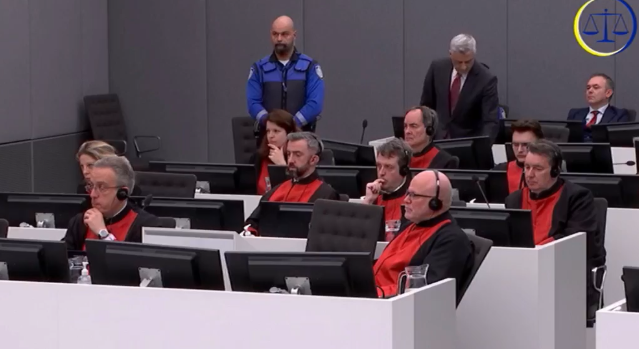
Vetëvendosje and PDK have agreed on the new legal initiative concerning the Specialized Chambers. Legal experts assess that these developments are closely linked to the judicial proceedings against former KLA leaders in The Hague.
The draft of the new law on the Specialized Chambers in The Hague is expected to be completed this week, to then be processed for a vote in the Assembly of Kosovo. Prime Minister Albin Kurti said that the experts, in whose hands the draft now lies, are expected to finish the work soon.
The two largest parties in Kosovo, the ruling Vetëvendosje Movement and the opposition Democratic Party of Kosovo (PDK), have already agreed on the new legal initiative related to the Special Court. This agreement came after weeks of uncertainty over the first law, which was approved in the Assembly on October 6 but returned for reconsideration after a veto by the President of Kosovo, Justina Shiroka Pula.

Initiatives to amend the law on the Specialized Chambers came after the war crimes convictions of former KLA leaders Hashim Thaçi, Kadri Veseli, Jakup Krasniqi and Rexhep Selimi. A week earlier, Hashim Thaçi was also convicted by another panel of the Court for obstruction of the administration of justice.
Political unity for the new legal initiative
Acting PDK chairwoman Vlora Çitaku, after a meeting with Prime Minister Albin Kurti, said that “there is political and civic unity for the new legal initiative for the Law on the Specialized Chambers of Kosovo.”
“The Vetëvendosje Movement was our political opponent on the day we processed the law and when we approved it, just as it is today. However, despite the large gap and deep political differences we have in governance, the KLA remains a value that unites us all,” Çitaku said. She added that the new legal initiative is not only the PDK’s, but now also bears the seal of Kosovo’s institutions.
After the first-instance conviction on September 16 by the Special Court in The Hague of four former KLA leaders, Kosovo’s state authorities have formed a working group to draft a strategy regarding appeal proceedings before the Specialized Chambers.
According to Prime Minister Albin Kurti, the state working group continues to believe that “the first-instance judgment of the Special Court is unjust, both legally and morally.” For this reason, “the Government is working to ensure the correction of this decision at the Appeals level before the Specialized Chambers.”
The working group is chaired by Kosovo’s Foreign Minister Glauk Konjufca, and representatives of the Assembly of Kosovo are also part of it. President Justina Shiroka-Pula has declared her support for this group, with the aim of coordinating institutional and diplomatic actions for documenting, defending and affirming the historical truth of Kosovo’s liberation war and the role of the Kosovo Liberation Army.
Legal debate on the legal changes
But how do legal experts assess the Kosovo Assembly’s effort to amend the law on the Specialized Chambers, at a time when the judicial process against former KLA leaders has not yet taken a final form?
Ehat Miftaraj, director of the Kosovo Institute for Justice (IKD), told DW earlier that the judgments against former KLA leaders constitute developments of great legal and political importance.
“The Special Court was established by the Republic of Kosovo itself, through constitutional amendments and the adoption of relevant legislation, with the legitimate expectation that justice would be administered in accordance with the highest international standards for a fair and impartial trial. However, the manner in which the judicial process has unfolded has created the impression that judges, prosecutors and certain international factors have treated not only the accused but also Kosovo itself with distrust, prejudice and often with a dismissive approach,” Miftaraj said.
According to him, the reactions and objections in Kosovo should also be understood in the historical and emotional context of the war, as well as the experience that Kosovo’s citizens went through during and after it.
The amendments approved in early October on the Specialized Chambers did not envisage closing the Court, but, among other things, limiting its jurisdiction, narrowing the time period and territory over which it can adjudicate, and reducing the maximum prison sentence to 15 years. The amendments also included the possibility that sentences be served in Kosovo.
On the other hand, senior European Union officials continue to express concern about initiatives aimed at amending the law on the Special Court. EU Enlargement Commissioner Marta Kos, at an earlier meeting of EU foreign ministers, sharply criticized the Kosovo Assembly’s decision to amend the law, describing it as “unacceptable and contrary to international rule of law norms”/DW/