







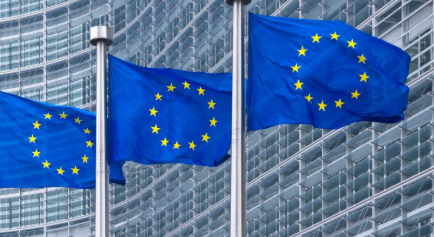
The European Union (EU) has responded to Russian warnings to the Western Balkan countries: their future lies in the EU.
This is the message Brussels conveys following a statement by Russian Foreign Ministry spokeswoman Maria Zakharova. In the middle of this month, she had “warned” the countries of the region that European integration is no longer just a matter of membership, but also implies accepting Brussels’ policy toward Moscow, according to a statement from the Russian Foreign Ministry.
Asked how it can protect countries seeking membership from the consequences of Russian warnings, the European Commission said that “the fight against foreign information manipulation, disinformation and other hybrid threats is an integral part of the accession process”.

“Protecting the process of European integration and the integrity of the media from disinformation and foreign information manipulation is of fundamental importance,” the European Commission’s response to Radio Free Europe (RFE) reads.
While Brussels stresses that the European Union is the Western Balkans’ main political, economic and strategic partner, RFE’s interlocutors assess that Moscow is increasingly presenting European integration as a choice between approaching the EU and maintaining relations with Russia.
A delegation of the Republika Srpska in Moscow, marking Victory Day on 9 May 2026.
Russian officials have for years criticized the expansion of NATO and the European Union in the Western Balkans.
The latest clash followed Podgorica’s decision to lift the visa-free regime for Russian citizens from November, a decision that the Russian Embassy in Montenegro described as an “act of hostility”.
Authorities in Podgorica say that EU membership remains the strategic goal of the country’s foreign policy and that Montenegro will continue to fully align with the EU’s common foreign and security policy.
“Moscow’s official positions on Montenegro’s NATO membership, as well as on its future EU membership, are well known and do not constitute news in our bilateral relations. However, they do not determine our strategic decisions, which we take independently, in line with national interests and the will of our citizens,” the Montenegrin Ministry of Foreign Affairs told RFE.
Montenegrin authorities add that the measures Podgorica takes within the framework of the EU’s foreign and security policy are not considered hostile actions against Russia, but part of the obligations arising from the country’s European path.
According to data from the Montenegrin Ministry of Foreign Affairs, over 80 percent of citizens support EU membership.
Meanwhile, Albania, North Macedonia and Kosovo have harmonized their foreign and security policies with those of the EU, including the sanctions imposed on Russia after the start of the full-scale invasion of Ukraine.
Bosnia and Herzegovina, due to its complex decision-making system, does not fully implement all of Brussels’ decisions, while Serbia is the only country in the region that has not imposed sanctions on Moscow.
The authorities of these countries did not respond to REL’s request to comment on Zakharova’s “warnings.”
Moscow’s message, aimed “mainly” at Serbia
Zakharova’s statement that European integration implies harmonization with the EU’s common foreign and security policy towards Russia, including sanctions against Moscow and support for Ukraine, may also be linked to the parliamentary elections in Serbia, which will be held on October 25.
This is how analysts with whom REL has spoken assess it; according to them, the message, in addition to reflecting Moscow’s stance on European integration, may also aim to influence voters.
“This is an attempt to discredit the Student List in advance before the elections in Serbia on October 25, by presenting the vote as a matter of immediately accepting EU sanctions against Russia,” says Kurt Bassuener, senior associate at the Democratization Policy Council.
Bassuener also assesses that this message shows Moscow is increasingly openly viewing the European Union as its “main adversary,” instead of what in Russia was previously called the “collective West.”
Dimitrije Milliq, from the “New Third Way” organization, also stresses that the statement by the Russian Foreign Ministry spokeswoman is aimed mainly at Serbia.
“Given that it is the only country that has not harmonized its foreign and security policy with the European Union, that is, that has not imposed sanctions on Russia,” says Milliq.
According to him, Moscow aims to link European integration with full support for the EU’s policy towards Russia and Ukraine, thereby blurring the distinction between pro-European and Euro-Atlantic orientation.
Bassuener and Milliq assess that Russian influence in the Western Balkans is weaker today than before, although Moscow still has opportunities to influence the region and to foster instability.
For this reason, Bassuener calls on the EU to strengthen its presence, especially through the EUFOR mission in Bosnia and Herzegovina.
Russia and the Balkans after 2022
Since the start of Russia’s invasion of Ukraine, the political map of Russian influence in the Western Balkans has changed significantly.
Albania, Montenegro and North Macedonia are fully aligned with the European Union’s common foreign and security policy and are NATO members.
Kosovo, which does not have the status of a candidate country for EU membership, also follows the EU’s foreign policy positions, including the sanctions imposed on Russia.
Russia has no bilateral relations with Kosovo, while Pristina considers Moscow one of Serbia’s main supporters in foreign policy.
In Bosnia and Herzegovina, Russian influence is mainly linked to political support for the authorities of Republika Srpska and close cooperation with Milorad Dodik. His party blocks the implementation of sanctions against Russia, as well as the introduction of visas for Russian citizens.
Serbia remains Russia’s closest political partner in the region.
Despite its status as a candidate country for EU membership, Belgrade has not imposed sanctions on Moscow since the start of the war in Ukraine.
At the same time, Serbia remains largely dependent on Russian gas, while efforts are underway to resolve the question of ownership of NIS (Serbian Oil Industry), between the Russian company Gazprom Neft and the Hungarian MOL.
Energy dependence on Russia is currently most pronounced in Serbia, while other countries in the region have, in recent years, intensified efforts to diversify gas supply sources and reduce dependence on Russian energy.
Nevertheless, the European Union remains by far the largest trading partner of all countries in the region, including Bosnia and Herzegovina and Serbia./REL/