







Uzbekistan produces about 26 million tonnes of fruit and vegetables a year. Agricultural products reach 92 international markets, according to the Minister of Agriculture, Ibrokhim Abubakirov. The government aims to raise food exports to $10 billion (about 8.6 billion euros) by 2030.
This target is directly linked to Uzbekistan’s food exports, which are expected to expand significantly over the next five years. It has declared the 2026–2030 period a priority for food security, with a focus on domestic production and reducing dependence on certain imports.
Agriculture remains an important sector of the economy. It faces pressure to increase productivity while managing limited land and water. The government is introducing new cultivation methods, irrigation systems and digital technologies to improve yields and help producers compete in international markets.

One of the government’s priorities is to increase agricultural production without relying solely on expanding the cultivated area. “We are paying particular attention to raising yields through scientific research and the introduction of new innovations. This is important, above all, for agriculture in Uzbekistan and for food security,” said Shamshod Ergashev, head of the Secretariat of the Minister of Agriculture.
According to him, in 2025 cotton was grown on about 875,600 hectares, compared with more than one million hectares in previous years, but production reached almost four million tonnes. Ergashev added that in 2026 Uzbekistan harvested 10 million tonnes of wheat, partly thanks to improved seed treatment and planting methods. ## Orchards and vineyards The country has about 572,600 hectares of orchards and vineyards, with plans to develop 172,000 hectares of modern high-yield orchards during the 2026–2030 period.
“Traditional orchards produced seven to ten tonnes of fruit per hectare. Now, with trees grown on low and medium rootstocks, we are reaching 7 to 10 tonnes of fruit per hectare. Now, with low and semi-low trees, we are reaching 30 to 35 tonnes, and in some cases even 50 to 60 tonnes,” said Abror Jo’rayev, head of the Republican Department for Horticulture Development.
In a 138-hectare orchard with apples, pears, plums, peaches and apricots, modern cultivation methods are already in use. The enterprise’s representative, Qahramon Ilhombekov, said the farm produces an average of 35 tonnes of apples per hectare. “We could produce 50 tonnes, but that puts a lot of pressure on the trees.
At 30 to 35 tonnes, we get fruit with the size, colour and quality we want,” he explained. To encourage investment, the government has introduced preferential loans of up to 120 million sum (about 8,873 euros) per hectare for orchard development, with a seven-year term, including a three-year period without payments.
Farmers may also receive maintenance subsidies of five million sum (about 370 euros) per hectare per year for three years, as well as support for irrigation equipment and planting materials. ## Water, technology and investment Water scarcity remains a key challenge for the agricultural sector, making irrigation efficiency an investment priority.
According to the World Bank, agriculture accounts for about 90 percent of water consumption in Uzbekistan. In May 2025, the bank approved a $200 million project (about 172 million euros) to modernise irrigation infrastructure in five regions. The aim is to reduce annual water losses by about 540 million cubic metres and improve irrigation services on 232,000 hectares of farmland.
At farm level, drip irrigation is helping farmers manage water use and fertiliser application more precisely. “Water scarcity is becoming a growing problem. With drip irrigation, the water reaches the tree itself and not the soil around it,” Jo’rayev explained.
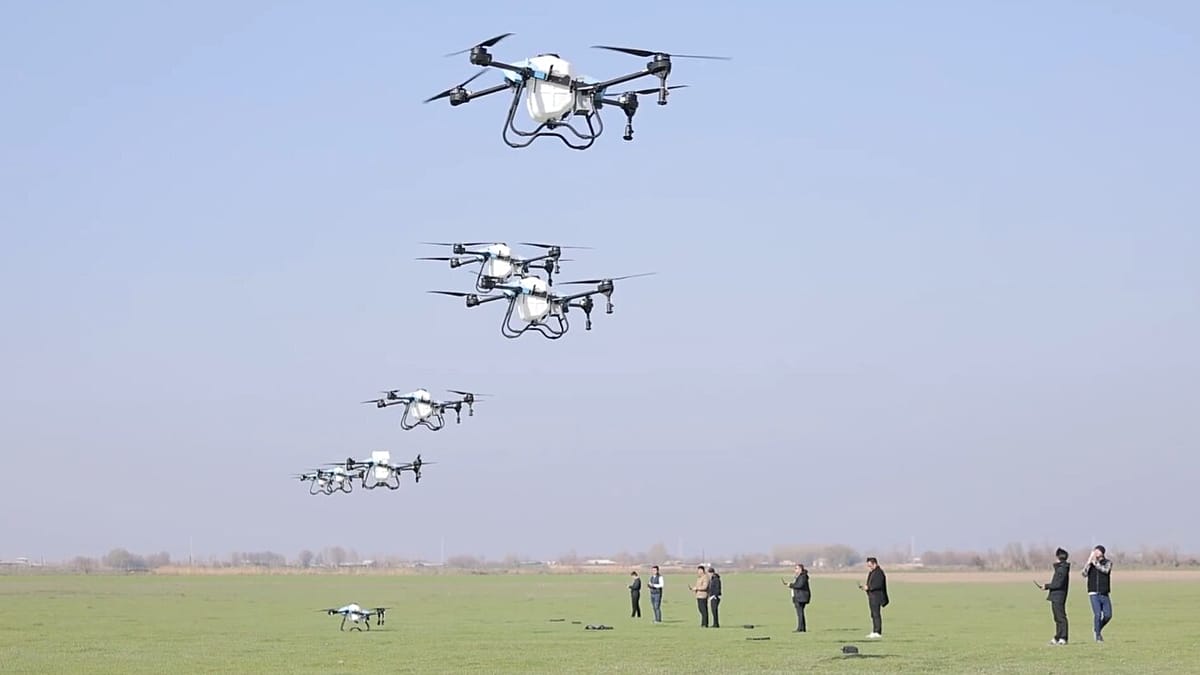
In 2026 the country received 100 agricultural drones manufactured in China, through an initiative involving the Ministry of Agriculture and with World Bank support. Half are intended for remote monitoring of farmland, while the others will be used for fertiliser application, pest control and other agricultural operations.
The government is also developing satellite crop monitoring, geographic information systems and artificial intelligence applications for yield forecasting and pest detection. The digital platforms Agroportal and Agrosubsidy aim to simplify subsidies and agricultural services by reducing administrative procedures.
Uzbekistan is also seeking investment in agricultural practices that better withstand environmental pressures. The Global Green Growth Institute (GGGI) has been involved in climate-smart agricultural projects, including initiatives in Karakalpakstan. “Our intervention was mainly about how to scale climate-smart solutions in agriculture, from pilots to larger investment projects,” said Bakhtiyar Radjabov, senior official for Green Growth Policy and Government Liaison at GGGI.
GGGI has supported Uzbek commercial banks in issuing green bonds on the London Stock Exchange to mobilise financing for environmental projects. Radjabov also mentioned an agri-food investment platform involving the European Bank for Reconstruction and Development (EBRD) and the Ministry of Agriculture, which aims to mobilise about $1.5 billion (about 1.3 billion euros) for the sector.
He stressed the need for stronger local expertise and the capacity of agricultural businesses to adopt new technologies, especially as water scarcity, soil salinisation and land degradation continue to affect the sector. Uzbekistan’s agricultural strategy combines plans to increase export revenues with efforts to strengthen domestic food supply.
The government is encouraging investment in food processing, packaging and higher-value agricultural production, to help local producers meet the requirements of international markets. However, the country remains dependent on imports for some essential food products, including vegetable oil and sugar.
“We are introducing new technologies in agriculture and horticulture, increasing productivity and expanding the geography of our fruit and vegetable exports to new countries,” said Ergashev. The long-term results will depend on whether these investments help farmers improve productivity, manage costs and expand market access, while facing water scarcity and climate pressures.