







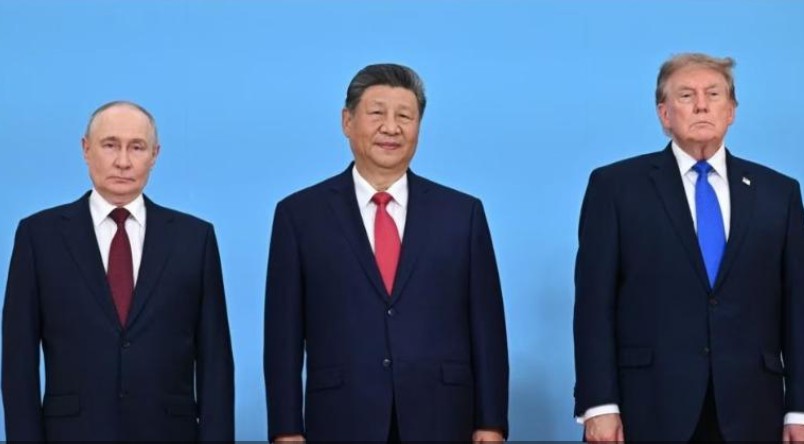
US President Donald Trump, Chinese leader Xi Jinping and Russian President Vladimir Putin held a historic meeting on the sidelines of the Asia-Pacific Economic Cooperation (APEC) summit in Shenzhen. The meeting brought limited benefits to the three leaders, but produced no agreements that would change the course of events.
The November 19 summit, which had particular political significance, was the first at which the current leaders of the world’s three largest nuclear powers met together, without the presence of other leaders. However, Putin and Xi had met about 50 times before.
Although the summit was characterized more by symbolism than by concrete content, it is significant for the foreign policies of the United States, China and Russia. The meeting highlighted the influence of these countries on the international stage, but also the limits of their power.

Below you can read the four conclusions drawn from the summit, based on interviews Radio Free Europe conducted with academics and analysts.
Putin benefited the most
Largely isolated in the international arena since Moscow launched its full-scale invasion of Ukraine in February 2022, Putin arrived at the APEC summit with lower expectations of success compared with the other two leaders. Merely by taking part in this event, for the first time since 2017, and speaking directly with Trump and Xi about global security, Putin emerged from diplomatic isolation.
“Putin benefited greatly from this meeting. He was its biggest winner,” Elizabeth Wishnick, an expert on China-Russia relations at CNA Corporation, a US defense research institute based in Virginia, told Radio Free Europe.
The Russian leader’s isolation “was reduced enormously in terms of image, but perhaps also in reality, because of the ‘joint peace statement’ after the meeting,” said Sari Arho Havren, an associate at the Royal United Services Institute (RUSI), a British security research organization.
The joint statement called for reducing nuclear risks and strengthening international stability, but contained few concrete commitments.
Havren noted that the three countries questioned the legitimacy of the International Criminal Court (ICC), which in March 2023 issued an arrest warrant for Putin on suspicion of war crimes in Ukraine.
In the statement, the three leaders stressed that “decisions of international institutions must respect the consent of states and the immunity of their officials.” They also “agreed that the International Criminal Court and similar institutions must not exceed or abuse their powers.”
During the public part of the meeting, Trump called the ICC an “uncontrolled globalist organization.”
The statement also made clear that the US, China and Russia aim to “increase the production and supply of refined petroleum products, for the benefit of all countries,” thereby effectively supporting Russia’s oil sector, which is facing difficulties.
Xi’s “well-orchestrated” summit brings benefits to China
Compared with Putin, Xi Jinping had less to gain from the trilateral summit. China does not face similar diplomatic or economic difficulties. Although there are tensions in relations with the United States, Xi has managed to define the direction of relations between the two countries through his framework for “constructive strategic stability.”
However, Xi had to demonstrate that China was able to organize a high-level meeting on the margins of Asia’s most important economic summit, without overshadowing the main event.
The summit was “high-level and well-orchestrated. You can call it a success” for China, Yun Sun, director of the China Program at the Washington-based Stimson Center, told Radio Free Europe.
She stressed that “it is not easy to negotiate a joint trilateral statement that all parties agree to. But the compromise is that the results do not include many details on the issues discussed.”
“I think Xi Jinping got exactly what he wanted, proving that he is the one setting the agenda on global issues,” Havren said.
According to the Chinese state news agency Xinhua, the Chinese leader described the meeting as “positive, constructive and fruitful.”
In particular, Xi accommodated Trump’s interest in discussing nuclear disarmament, without committing to any concrete action. With an arsenal of about 620 nuclear warheads compared with more than 5,000 each held by the US and Russia, Beijing believes that its participation in nuclear disarmament talks would be premature and potentially harmful to national security.
In the joint statement, Xi, Trump and Putin “reaffirmed that a nuclear war cannot be won and must never be fought.”
This is a standard formula that the Chinese leader has used for years.
Meanwhile, their commitment to “develop dialogue on reducing nuclear risks and preventing the proliferation of nuclear weapons” remains vague and lacks concrete commitments.
Trump met his own expectations
The American president had set modest expectations before the summit and managed to meet them, analysts assess.
“President Trump wanted to demonstrate publicly, at a time when the world’s attention is focused on him, that he is trying to reach arms control agreements with the other two major nuclear powers. And he achieved this,” Ross Darrell Feingold, a lawyer and political risk analyst based in Taipei, told Radio Free Europe.
As for the war with Iran, Trump had said before the summit that he wanted this issue to be discussed, but the conflict was not mentioned in the joint statement by the three leaders. Neither Putin nor Xi spoke publicly about the war with Iran during the APEC summit.
“China and Russia cannot and will not offer Trump any help in ending the conflict with Iran. Likewise, they will not encourage Iran to fight against the US,” Feingold said. “The safest approach for China and Russia, which they are consistently following, is to call for peace.”
Despite the lack of concrete diplomatic results, Trump could present the summit as a success, a former senior official at the U.S. Department of Commerce who had worked on issues related to China told Radio Free Europe.
Seeking to remain anonymous in order to speak candidly, he said that “Xi Jinping has managed to completely charm President Trump. He even greeted Trump at the airport with a hug. These are things Trump values highly.”
Trump described Xi’s hug as “a big win for us” and as a sign of “great respect.”
Friendly relations with Trump are a welcome change for Xi, after the tensions that characterized U.S.-China relations during Joe Biden’s presidency and Trump’s first term. Less pressure from Washington has given Beijing more room to fulfill its own strategic foreign policy goals.
“Xi must be quite pleased with the results, even though he knows this situation cannot last forever,” the official said.
Great-power diplomacy has its limits
In the end, according to analysts, the trilateral summit may be remembered not only for the striking images but also for the lack of concrete results.
When Putin first floated the idea of this summit last month, Ukraine and European countries expressed concern that the Russian leader might try to negotiate a peace deal without their participation.
However, such an outcome was never possible, given that Beijing does not want to damage its relations with Europe.
“China still needs Europe economically and has tried to present itself as a neutral power,” Havren said. She added that Beijing’s decision not to include Ukraine on the agenda was “a strategic choice.”
It was no coincidence that Ukraine launched drone and missile attacks on the Crimean Bridge, collapsing part of its road segment, shortly before the APEC summit, Wishnick said.
“This sends the message that world leaders cannot end this conflict without the involvement of Ukraine and European leaders,” she added.
Meanwhile, on November 18, Iran launched attacks on Gulf states. The drone and missile attacks on Bahrain and Kuwait were the first in about two months.
North Korean leader Kim Jong Un, who has offered Russia weapons and troops for the war in Ukraine, also left the APEC summit without meeting Trump. The U.S. president had said earlier that they might meet.
“Great powers have a lot of influence, but they cannot control events on the ground,” Wishnick said. “The time when leaders sat around a table and decided the fate of the world is over. To solve problems, they will need to engage more broadly with other countries as well.”/ REL