







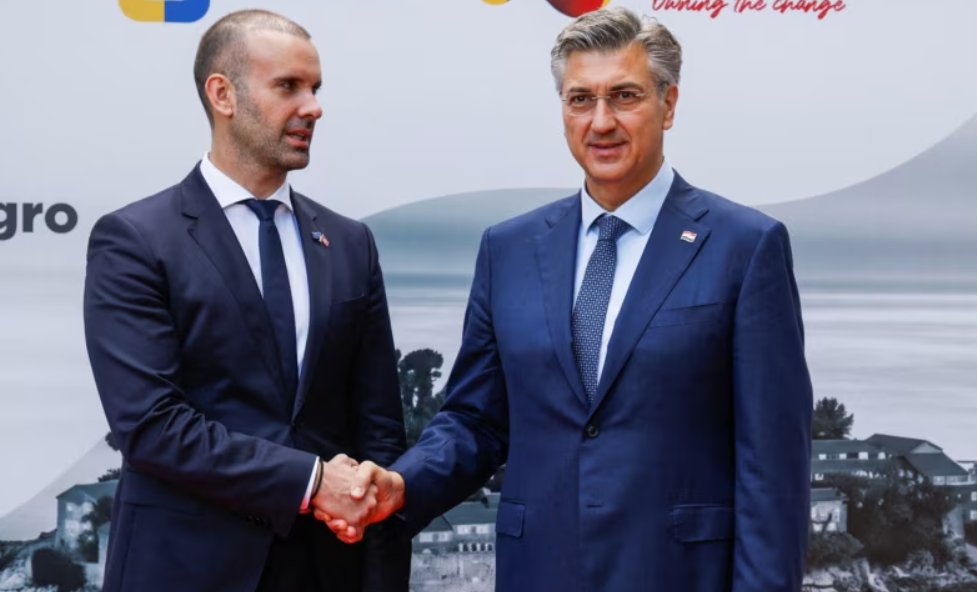
Croatia will not allow the closure of Chapter 31 in Montenegro’s European Union (EU) accession negotiations without the border issue being resolved, Croatian Prime Minister Andrej Plenković warned.
“I can say freely: Chapter 31 will not be closed until the demarcation issue on the land border is resolved. A clear message, which cannot be clearer, but also friendly. After all, if this is a problem, then we must hear it clearly,” Plenković said in Brussels.
“If we hear a clear message from the Montenegrin side, ‘we do not consider that there is a conflict at the point where the land border meets the sea,’ then we have a problem. And in that case we cannot sit at the same family table called the European Union. This is essential,” emphasized the head of the Croatian Government.
Chapter 31 covers foreign, security and defence policy. Croatia blocked it in 2024, immediately after the Parliament of Montenegro adopted the resolution on Jasenovac, which caused tensions between Podgorica and Zagreb.

Montenegrin President Jakov Milatović recalled on 25 November that Croatia, when it was admitted to the EU, also had not resolved its border issue with its neighbour Slovenia. Milatović expressed readiness, if no agreement is reached, to send the dispute to the International Court or to arbitration.
Plenković rejected this possibility, saying that Croatia does not believe in arbitration. He also reminded Montenegrin leaders that the two situations cannot be compared.
“The relationship between Croatia and Montenegro and the relationship between Croatia and Slovenia is not the same. Montenegro was part of the former Yugoslavia, which carried out armed aggression against Croatian territory. Prevlaka, Konavle, the destruction of Dubrovnik, practically reaching occupation up to Slano,” said Plenković.
He called on Montenegro to reach an agreement on the land border, which would resolve and ease relations between the two countries for a long time.
If official Zagreb remains in this position, the Montenegrin Government’s goal of completing accession negotiations by the end of this year, so that the Accession Treaty can be signed in the summer of 2027, could be called into question.
The European Commission has always considered this calendar realistic and achievable. However, every step in the accession negotiations requires the agreement of all member states, since each of them has the right of veto. Time is also not in Montenegro’s favour: by the end of the year there are about twenty working days left according to the EU calendar.
What is disputed in determining the border?
Croatia is asking Montenegro to give up arbitration over the land border and focus on the maritime border near Prevlaka, at the entrance to the Bay of Kotor.
“Any questioning of the land border, Croatia will interpret as a territorial claim by Montenegro against Croatia. I am speaking explicitly, I mean Prevlaka,” warned Plenković.
The border on the Prevlaka peninsula has been disputed since the break-up of Yugoslavia in the 1990s. The dispute involves three issues: land, sea and the seabed. For Montenegro, it is essential to retain control over the entrance to the Bay of Kotor. Croatia considers that the peninsula is Croatian territory and that the sea should be divided in accordance with international law.
Since 2002, the situation has been regulated by a temporary protocol. Under it, the land part of Prevlaka and the narrow maritime strip around Cape Oštro are under Croatian control. Part of the maritime area near the left coast of the peninsula has been declared “no man’s sea”, so Montenegro has retained control over the sea and the entrance to the bay. This arrangement was supposed to be temporary, but it has now been continuing for 24 years. The joint commission for resolving the dispute last met in 2015.
The border is one of eight Croatian requirements that Montenegro must fulfil before EU accession.
In addition to Chapter 31, Croatia is currently also blocking the temporary closure of Chapter 14, which concerns transport, and Chapter 15, which relates to energy. The blocking of Chapter 15 is also linked to the border, specifically to oil and gas exploration in part of the maritime area, since the two countries have not yet determined the maritime border.