







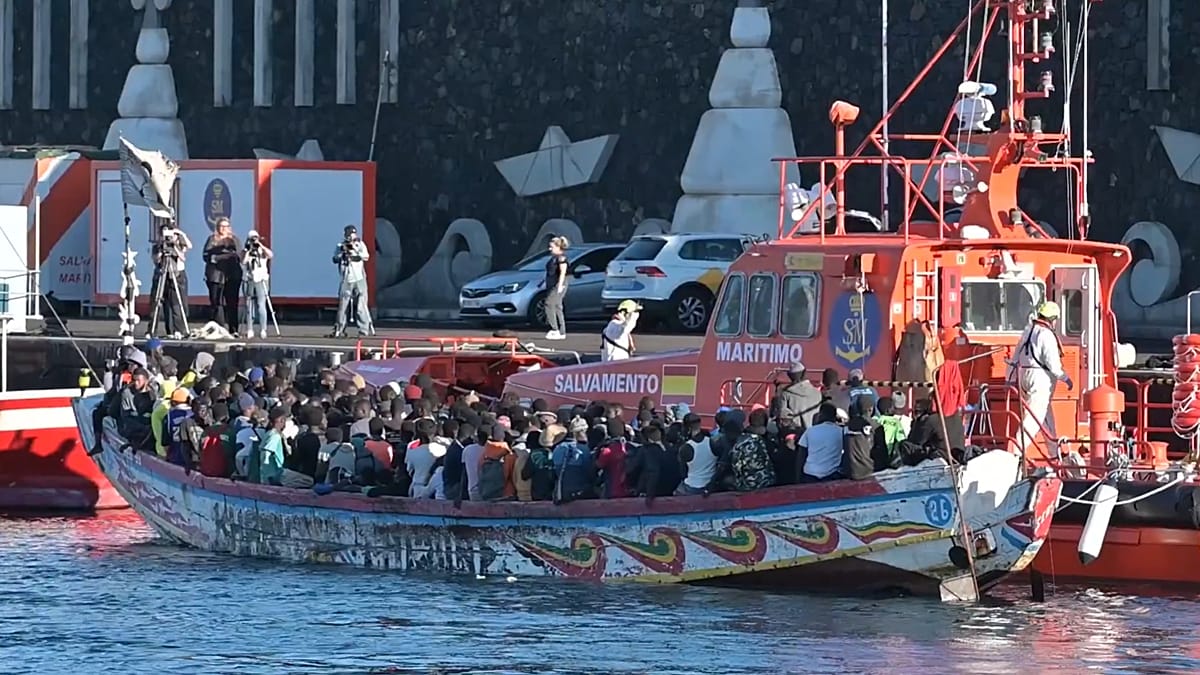
On Saturday, November 14, 12 large wooden boats arrived in El Hierro with 1,235 people. Meanwhile, 203 others were intercepted in a boat in Gran Canaria and 50 others arrived by a vessel in Tenerife. The total figure of 1,488 people constitutes a record for arrivals in the Canary Islands since November 7, 2020, when 33 small boats and large canoes brought 1,461 people, Euronews reports.
According to provisional data, among Saturday’s arrivals were 108 women and 167 minors. The figures do not include two rescue operations that were still ongoing and 122 people traveling in a large canoe that arrived in La Restinga at 23:55 on Friday. In total, 2,331 people in 22 boats were registered over the two days, Euronews writes.
Six Maritime Rescue vessels (and Civil Guard patrols) and two Civil Guard patrols (Río Tajo and Río Guadiato) were involved in the operation. By Saturday, 317 people were at the Temporary Reception Center for Foreigners (CATE) in El Hierro, not counting the latest arrivals, while 158 people were transferred to Tenerife by the regular ferry.

Eleven people from previous arrivals remain hospitalized at the island’s Nuestra Señora de los Reyes hospital. The President of the Canary Islands, Fernando Clavijo, stated that the continuous arrival of boats during this month has completely overwhelmed the island’s resources. The El Hierro island council had previously declared a social emergency after the arrival of more than 8,000 people within five weeks.
Clavijo has sent a letter to European Commissioner for Migration Magnus Brunner, requesting urgent action in the face of the increase in the flow along the Atlantic route. He announced that Pedro Sánchez has pledged to urgently convene the Interministerial Commission on Migration. The Minister for Territorial Policy, Ángel Víctor Torres, is expected to visit the port of La Restinga on Sunday.
The Interior Ministry recorded 6,194 arrivals in October, the month with the greatest migratory pressure on this route since 2023. Forecasts do not indicate a decline before December, when weather conditions change along the more than 1,000-kilometer route linking the Canary Islands with Senegal, Gambia and Mauritania.
The Canary Islands authorities attribute the increase to a loss of control by Senegalese security forces, which are engaged in organizing the Youth Olympic Games in Dakar. Thimma Samb, a Senegalese man who has lived in Spain for 20 years and a central figure in the documentary 'Los cayucos de Kayar', nominated for the Goya Awards, links the rise in migration to the weakening of Ousmane Sonko’s influence.
According to him, President Bassirou Diomaye Faye removed Sonko from the government several months ago, and the departure deepened the lack of hope caused by corruption and the lack of jobs. Samb, who reached Spain at the age of 17 on his fourth attempt, argues that safer channels must exist for migration from Africa to Europe.
Txema Santana, former migration adviser to the Canary Islands government, believes that the residents of El Hierro are not protesting against the migrants themselves, but against the slow response or lack thereof from the authorities. He calls for strengthening services without waiting for the high season and for moving people off the island as quickly as possible to prevent a collapse.