







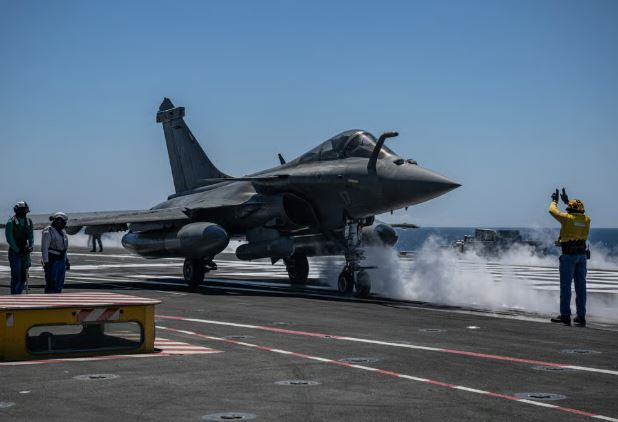
NATO’s air forces could face jet fuel shortages in a future conflict, as Europe’s shift away from fossil fuels and the shrinking of oil refining capacity have created dangerous vulnerabilities. This is the warning from a new study backed by the alliance, which was published in September and circulated at senior levels within NATO and across the alliance, according to NATO’s Centre of Excellence for Energy Security, based in Vilnius, Lithuania, which produced the research.
The study finds that if a major conflict involving European alliance members and North American reinforcements occurs in the coming decade, aircraft fuel demand could exceed available supplies. The report reflects the centre’s independent findings rather than NATO’s official policy, but the centre acts as a key research hub on energy security and provides the alliance’s members with strategic and operational insights.
The warnings come at a time when Russian hybrid warfare and sabotage campaigns in recent months have caused new fears of a direct conflict with Moscow. But while defence budgets of many billions of euros across the bloc are being spent on aircraft, tanks, missiles and drones, researchers say fuel constraints may be what hampers any future resistance.

“From a military readiness perspective, access to fuel… matters greatly,” a senior NATO military official said. “NATO needs a reliable energy supply to deter and defend, and sometimes these collective defence needs mean the military must take priority.”
NATO researchers partly blamed the decarbonisation policies of the EU and allied countries for the fuel shortages, which have created market incentives for renewable energy and prompted the closure of oil refineries on which the military relies for stockpiling, leaving NATO’s European members “short of diesel and jet fuel,” they said.
“The report has been circulated at a very high level within NATO and across the alliance,” said a spokesperson for NATO’s Centre of Excellence for Energy Security. “The urgency of this report and the modelling within it… is undoubtedly motivated by the current geopolitical landscape.”
Data from FuelsEurope and the European Commission show that roughly a quarter of the oil refineries on the continent have closed since 2009, eliminating millions of barrels per day of regional capacity and leaving Europe with around 70 operational refineries capable of supplying jet fuel for domestic aircraft.
What NATO can do to increase its refining capacity is “a good question” that remains unanswered, a senior European security official said, adding that this “was not a reason to abandon the green transition.” The new study also coincides with a Brussels-led effort to increase the bloc’s refining capacity, which has fallen by 10% over the past 20 years, with consequences for defence, as the EU energy chief, Dan Jørgensen, warned in public statements last month. ## Jet fuel shortages in the Article 5 scenario “The system reaches its limits in what we have modelled as a full-scale conflict in NATO Europe triggered by Article 5 with significant North American deployment,” the researchers wrote.
“In the reasonable worst case… no amount of civilian restrictions balances the system from the mid-2030s without intervention.” Article 5 is NATO’s collective defence pact and states that an attack against one NATO member is considered an attack against all. But even confiscating all the fuel available for civilian aircraft over the coming decade would not be sufficient, the study found.
“By 2035, full civilian supply demand still leaves 4.7 Mt of jet fuel unmet,” the researchers wrote, “rising to 50 Mt by 2050.” But the researchers argue that the crisis is avoidable and call for NATO to make urgent changes. They recommend that allied governments preserve refining capacity, expand strategic fuel reserves, accelerate the production of alternative aviation fuels, diversify imports and maximise military fuel consumption through greater efficiency.
“The good thing about the energy transition from a defence fuel security perspective is that distributing alternative fuels within Europe ensures what we call supply additionality,” said the centre’s spokesperson, who supported the bloc’s efforts to become energy self-sufficient.
“So, it is a new form of supply for the market that can grow domestically, so as to avoid that dependence on international crude oil supply chains.” NATO Secretary General Mark Rutte echoed the report’s concern on the sidelines of the United Nations General Assembly in New York, acknowledging that the alliance is worried about refineries in the event of a war with Russia.