







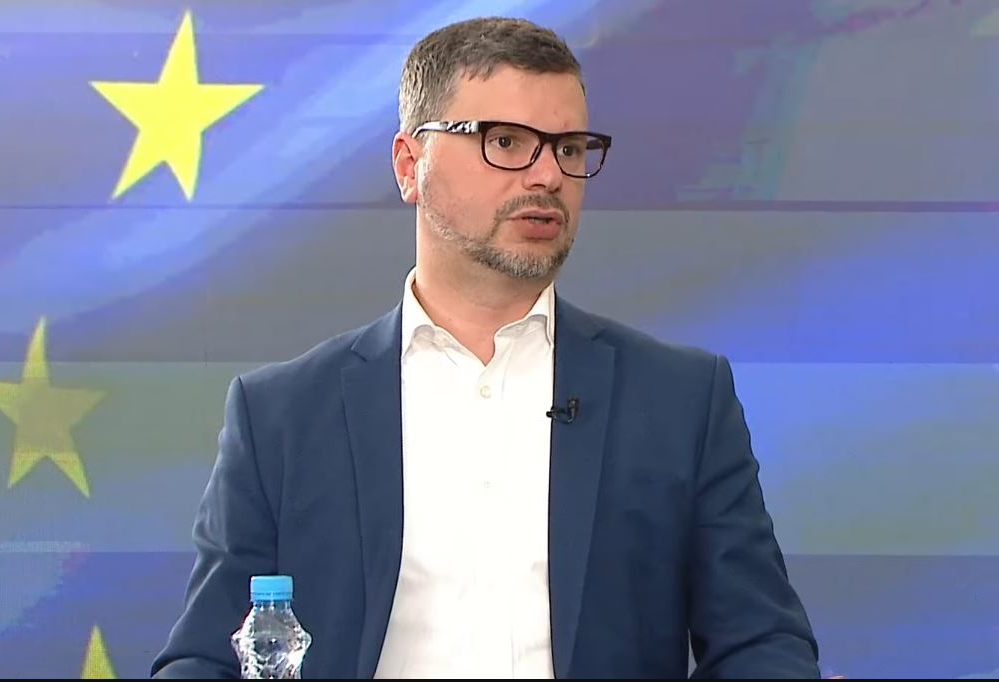
Albania is on the verge of closing three more chapters in the EU accession negotiations, relating to companies, fisheries and intellectual property. With their completion, the number of closed chapters would rise to seven. For Vizion Plus, the head of the European Movement in Albania, Gledis Gjipali, assessed that these chapters have a direct impact on citizens and businesses. Gjipali also addressed the most difficult issues in the negotiations, singling out the environment, product standards and the rule of law. He stressed that some negotiation points remain confidential, describing this as a shortcoming that hinders the involvement of interest groups.
Today we are talking about three more chapters concerning companies, fisheries and intellectual property. What is their importance?
Gledis Gjipali: We have begun entering important chapters that have a direct impact on citizens. Of course, these chapters are also among those where we have made the most progress and are close to closure. So they could be closed in the coming days or weeks, and they are important. This concerns the internal market, that is, trade and the economy, which are directly linked to businesses. Also fisheries, which has safety standards, as well as the trade part. So it is also an important chapter for a coastal country like Albania, where fisheries play an important role, and of course within the European Union it will play an even greater role with the support provided there. But what is important at this stage we are discussing are the standards, and all three of these chapters are important for advancing Albania closer to the European Union.
We recall that there are certainly 33 chapters in total that will need to be closed under the target Albania has set by the end of next year. Meanwhile, I recall that the Minister of State, Majlinda Dhuka, spoke a few days ago about 101 points that are under discussion or negotiation. There are certainly many of these points, but which are the most sensitive or delicate as far as Albania is concerned?

Gledis Gjipali: Mainly the most delicate ones, which other countries have also experienced, concern the protection of domestic products, the protection of business through transitional provisions, that is, in some cases where the country is given more time to prepare even after accession, because these are areas that require major financing that is impossible to achieve in the coming years. For example, environmental issues are also the most costly and the most difficult to achieve. But on the other hand, it must be said that all these points are not public, they are still confidential, and this is in fact a shortcoming of the process because it also hinders the involvement of interest groups, of the business that is directly affected, but also other categories of society, which should be better involved in the process.Meanwhile, can we talk about or is it known which chapters or issues Albania may be considered furthest behind on?
Gledis Gjipali: Yes, in the roadmap proposed by the European Commission just a few days ago, a breakdown has been made—let’s call it an optimistic forecast, I would say, but one that is possible for Albania—of which chapters it can close within this year, which in the first half and which in the second half of 2027. And in the second half are the most problematic ones. Of course, the fundamentals cluster relating to the rule of law, also due to the fact that the methodology places it at the end because of its importance. While the other chapters relate to the environment I mentioned, Chapter 1 concerning the free movement of goods, which is trade, meaning the standards of goods we buy and consume, and it is a very difficult chapter. It requires a combination not only of institutions but also of business and producers to reach those proper standards, and it relates directly to the country’s competitiveness. These are the main chapters where much more work is required to reach finalization.
Once Albania closes the negotiations, so let’s imagine ourselves a bit at the end of 2027 with the objective achieved—what does this mean? Would Albania be immediately ready to accede, or does the question mark always remain regarding each state’s position on Albania?
Gledis Gjipali: Yes, first of all there is a process that lasts several years until membership. And during this process the country is assessed on how it implements those reforms, that legislation undertaken. That is why the chapters are always called provisionally closed. You must continue to make progress. This is on our side, the Albanian side. On the European side, there is always the unknown of how the member states will decide. So unanimity will definitely be required. Let’s not forget, for example, that France is one of the most problematic countries, because it has requested that after Croatia’s accession every accession be subject to ratification in a popular referendum, which is very difficult to achieve; otherwise, three-fifths in their parliament would be needed to pass it without a referendum. But other countries too, of course, cannot be taken for granted, because we do not know how their domestic policies develop. Anti-enlargement forces may gain more power or may come to power in some important countries, which in fact jeopardizes the process of being finalized in a short period.