







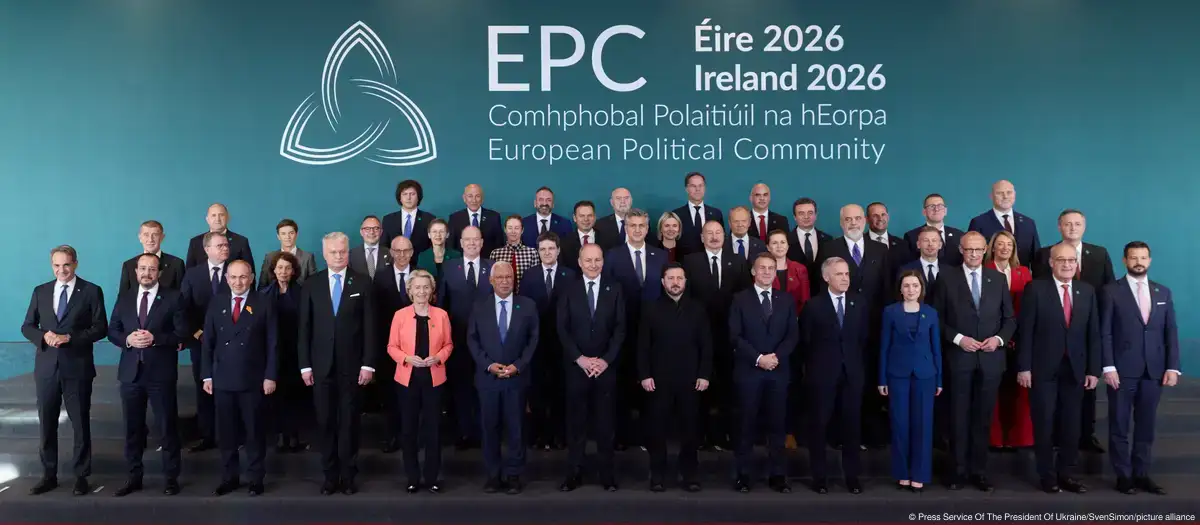
European heads of state and government agreed after lengthy discussions on the composition of the team that will represent Europe in the negotiations on Ukraine with Russia, to end the war. The President of the European Council, António Costa, announced after the informal EU summit in Dublin that the “European negotiating team for peace in Ukraine” will consist of the institutions of the European Union and the so-called E5 countries: Germany, the United Kingdom, France, Italy and Poland.
Thus, the negotiations on Ukraine will have a joint European team, according to Costa. EU institutions will be represented by the European Commission and the Council of the EU, clarified the President of the European Commission, Ursula von der Leyen. “We will support Ukraine and defend our interests,” she stressed.
The agreement was reached after it initially seemed unlikely that there would be agreement on who would represent Europe in negotiations for a peaceful settlement in Ukraine. According to Costa, the EU’s principles and position in the negotiations are known, and the European team will continue to operate in close coordination and with full unity.

Europe must “speak with a clear and united voice in all talks that determine Ukraine’s future and the security of our continent,” he stressed. For Costa, the EU plays “a central role in the talks on Ukraine’s European future, its reconstruction and its well-being.”
It remains unclear who will sit at the highest-level negotiating table with US President Donald Trump, Kremlin chief Vladimir Putin and Ukrainian President Volodymyr Zelensky. Discussion of European representation has intensified recently, against the backdrop of US-mediated talks between Ukraine and Russia.
The smaller member states and EU institutions supported the EU High Representative for Foreign Affairs, Kaja Kallas, or the President of the European Council, Costa, while countries such as Germany and Italy sought to send their own negotiators to the talks. The solution involving the E5 countries and the EU institutions appears to be an effort to reconcile these two demands.
Meanwhile, the Russian side is dampening European countries’ expectations. Russian Foreign Ministry spokeswoman Maria Zakharova stated that the ministry is not aware of any agreement providing for the future involvement of European states in the negotiations on Ukraine. “As far as the Russian Foreign Ministry is aware, this issue was not discussed during the talks with Steve Witkoff and Jared Kushner in Moscow,” she said, responding to a request to comment on a relevant announcement from Washington.
Earlier, US negotiator Jared Kushner, after an overnight meeting with Ukrainian President Volodymyr Zelensky, had made known that both sides in the war had agreed to the involvement of Europeans in the next round of negotiations. Before the meeting with Zelensky, Kushner and US special envoy Steve Witkoff had held talks with Russian President Vladimir Putin on Thursday, November 12, 2026.
According to the Russian news agency RIA Novosti, no Foreign Ministry representative took part in this meeting. The Russian president was accompanied only by his foreign policy adviser, Yuri Ushakov, Russia’s chief negotiator Vladimir Medinsky and negotiator Kirill Dmitriev. In Dublin, German Chancellor Friedrich Merz described the latest, seemingly contradictory statements from Moscow as “the usual game.”