







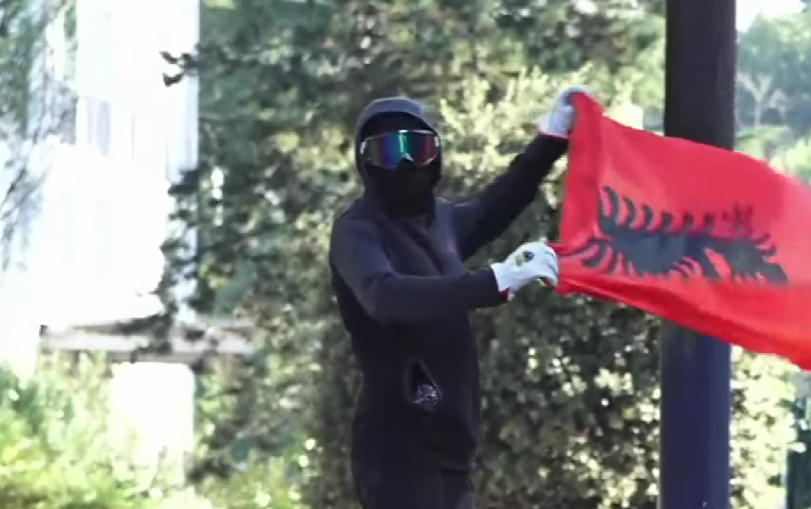
BBC has published an article on the protests in Albania, analysing their escalation and spread across several cities. The student protests, fuelled by high costs of education and living, have merged with the discontent of the “Flamingo” movement, which for months has been demanding the resignation of Prime Minister Edi Rama. Clashes with police, attacks on institutions and damage to businesses have raised concerns about the political situation and Albania’s path towards the European Union. The article stresses that young people’s dissatisfaction is also linked to corruption and the government’s lack of response to protesters’ demands.
Full article
Protesters and anti-riot police have clashed in Albania’s main cities, in scenes not seen for decades.

Government buildings and some private businesses have also been attacked.
So, what is happening?
How large and how unusual are these protests?
The capital, Tirana, has seen Flamingo anti-government protests for months, but what began on Tuesday of this week was of an entirely different scale.
Clashes have spread beyond Tirana, involving the main cities of Durrës, Shkodër, Lezhë and Vlorë in the west, Gjirokastër in the south and Korçë in the east.
The new demonstrations were announced as a student movement which, at least officially, demanded that the government take measures to help cope with the high costs of tuition fees and books, as well as rising living costs.
High school students also joined the protests, increasing the number of participants.
Very soon, masked protesters began throwing stones at police, who responded with water cannons, tear gas and rubber batons.
Many people were angered by footage of a young man being transported, his broken leg hanging, as he suffered from severe pain.
Authorities apologised, but this was not enough to calm the situation.
A floor of the Ministry of Education was engulfed by fire, while the flames also spread to other government institutions.
Every evening, throughout the summer, for around 135 days in a row, Albanians gathered in central Tirana, holding pictures of a pink flamingo and demanding that Prime Minister Edi Rama, now in his fourth term, resign.
The protests began over a giant tourism project on the Adriatic coast, linked to Jared Kushner, son-in-law of US President Donald Trump. Demonstrators said the flamingo would disappear from an island near the coastal city of Vlorë if plans to build a luxury complex were carried out.
Has the Flamingo movement radicalised?
Protesters from the Flamingo movement say they have no links to any political party. One of their slogans is: “Rama in prison, Berisha in prison.”
Rama is the prime minister, while Sali Berisha is the leading opposition figure in Albania, as well as a former prime minister and former president.
Young and old people, parents with children and sometimes even their grandparents took part in the Flamingo protests. Some of the participants took pride in the fact that after every evening of protest they cleaned up the place where they had gathered.
But after months of protests and an exceptionally hot summer, the number of participants fell, with no sign that the government was meeting their demands.
The current movement appears much more violent. Dozens of police officers have been injured, and Europe’s attention is now focused on developments in a country considered among the leading candidates for European Union membership.
Some young protesters told the BBC that what is happening now is a new phase, born out of the previous movement.
Five months of peaceful protests had been “met with humiliation, mockery and ridicule”, complained a young woman named Livia.
“This was a clear message from the government that our voice would not be allowed to be heard,” she said.
Another young woman, named Brunela, said she was worried about what might happen next.
“I am very frightened of what may happen, because the media and the government are reacting, especially now. It wasn’t just my voice, but the voice of Albanian youth,” she said.
There is a good chance that there was an overlap between the two protest movements, although the leaders of Flamingo have not publicly declared this and no representative of the student movement has come forward to speak on its behalf.
After all, their main concerns relate to corruption, which the prime minister says should be investigated by the justice system.
How is the government managing the unrest?
Rama has visited some of the damaged buildings and blamed Sali Berisha for inciting the chaos.
“All of this is the work of the same hand — the hand that has grabbed the Albanian opposition by the throat, the hand that has burned and destroyed Albania more than once and that is now ready to burn and destroy it again, to prevent any progress. It is a blind struggle, fuelled by the most irrational hatred,” he said on Friday.
The prime minister has ruled out resigning, promising that he will “listen, respond to legitimate concerns and keep Albania on the road to progress”.
Berisha’s Democratic Party has often tried to bring people onto the streets to topple Rama from power. However, the number of his loyal supporters, who have also been protesting for months and have occasionally clashed with police, has been small compared with the current turnout.
Therefore, there is some scepticism about Berisha’s ability to organise the unrest, although he may try to benefit politically from it.
On the other hand, Albanian media have put forward theories that foreign secret services could be involved.
Unfounded accusations have been made against Serbia, while some commentators have suggested that Belgrade is jealous that Albania is frequently mentioned as one of the countries that could be next to join the European Union.
Indeed, without naming names, Prime Minister Rama also referred to this hypothesis on Friday.
“These are foreign hands that do not want Albania to be at peace… They do not want Albania to become part of the united European family,” he said.
He added: “Do you think it is a coincidence that every time Albania gets another green light… or gets closer to that great ambition, that historic goal, suddenly the flames break out? It is not a coincidence at all! Nothing that is happening now is a coincidence!”
Is it safe to visit Albania?
Although street violence has occurred in many cities, for the moment it remains confined to certain areas.
The UK government has urged visitors to follow the media for the latest information, to stay away from “demonstrations, large gatherings of people or political rallies”, and to follow the instructions of local authorities.
Albania is a well-known tourist destination, and the government in Tirana has warned that violence damages the country’s image, affecting both tourism and its path towards European integration.