







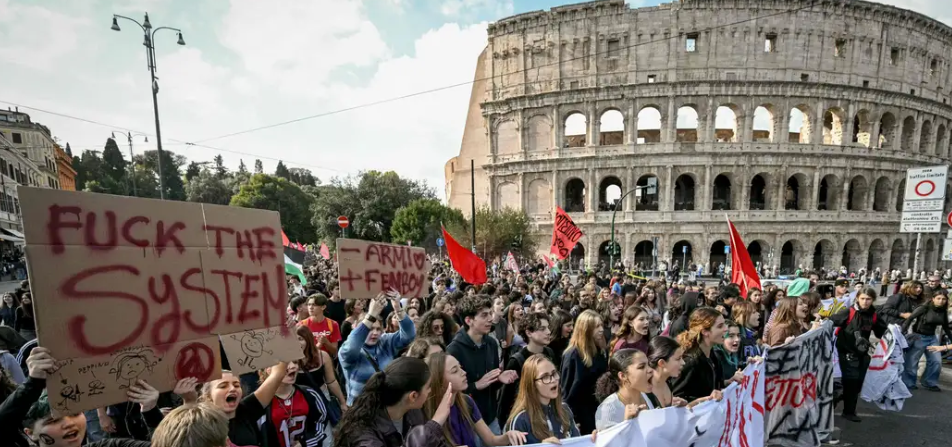
High cost of living, rising military spending and insufficient investment in education: In Italy, hundreds of thousands of people protested in several cities against the policies of Meloni’s government.
More than 200,000 people protested in Italy against the government of Prime Minister Giorgia Meloni. According to independent estimates, the largest gatherings on Friday (30.10.2026) took place in the capital Rome and in the university city of Bologna, with around 50,000 participants each. Tens of thousands of people also took to the streets in Milan, Naples and Turin.
The protests were joined, among others, by pupils, students, workers, farmers and pensioners. The USB union had called for a general strike. In total, protests were held in more than 50 cities. The union even stated that more than one million people had taken part across the country. However, this figure was not confirmed by the authorities.
Protest against low wages and rising costs
Demonstrators criticized the rising cost of living, high inflation, low wages and the government’s large spending on armaments. Placards read slogans such as: “Cut weapons, raise wages” and “No to the war economy”. Participants also demanded more funding for schools and universities.

The USB union also called for work stoppages in local public transport and long-distance transport, as well as in the healthcare sector. However, so far transport disruptions have been minimal, partly because Transport Minister Matteo Salvini had banned the strike ahead of the All Saints’ Day holiday.
Footage of looting, arson and acts of violence in Milan two weeks ago is still fresh. At that time 20 demonstrators and four police officers were injured, while more than 50 young people were arrested.
For this reason too, the latest protests were accompanied by a massive police presence. In many cities, controls and security measures were increased to prevent unrest. Police had urged protesters not to wear hoods or helmets during the demonstrations.
Protests mostly peaceful, but with isolated incidents
In Rome a large number of police forces were deployed, among other things to protect monuments such as the Colosseum and to prevent a repetition of violent acts.
Most protests passed peacefully until the evening. In Turin there were clashes between demonstrators and police. In Rome Molotov cocktails were thrown near the Colosseum. Isolated incidents also occurred in other cities, but their scale could not be compared with the demonstrations of two weeks earlier, when more than 200 security force members were injured in Milan alone.
In Genoa, in northwestern Italy, the first clashes between protesters and police also took place on Friday.
Meloni’s draft budget does not reassure protesters
On Wednesday (28.10.2026), Meloni presented her draft budget for 2027. One of the aims was also to calm protests in the country. In addition to tax relief for people with average incomes and self-employed entrepreneurs, the budget for the healthcare sector is also expected to increase.
A package of 175.2 million euros has also been planned for farmers, transport companies and the fishing sector, with the aim of easing the burden of high fuel costs. A one-time payment of 2,500 euros is planned for all employees under the age of 30.
The new budget is expected to be financed through higher taxes on banks and insurance companies. However, trade unions say these measures are not sufficient and are calling for further relief for citizens.