







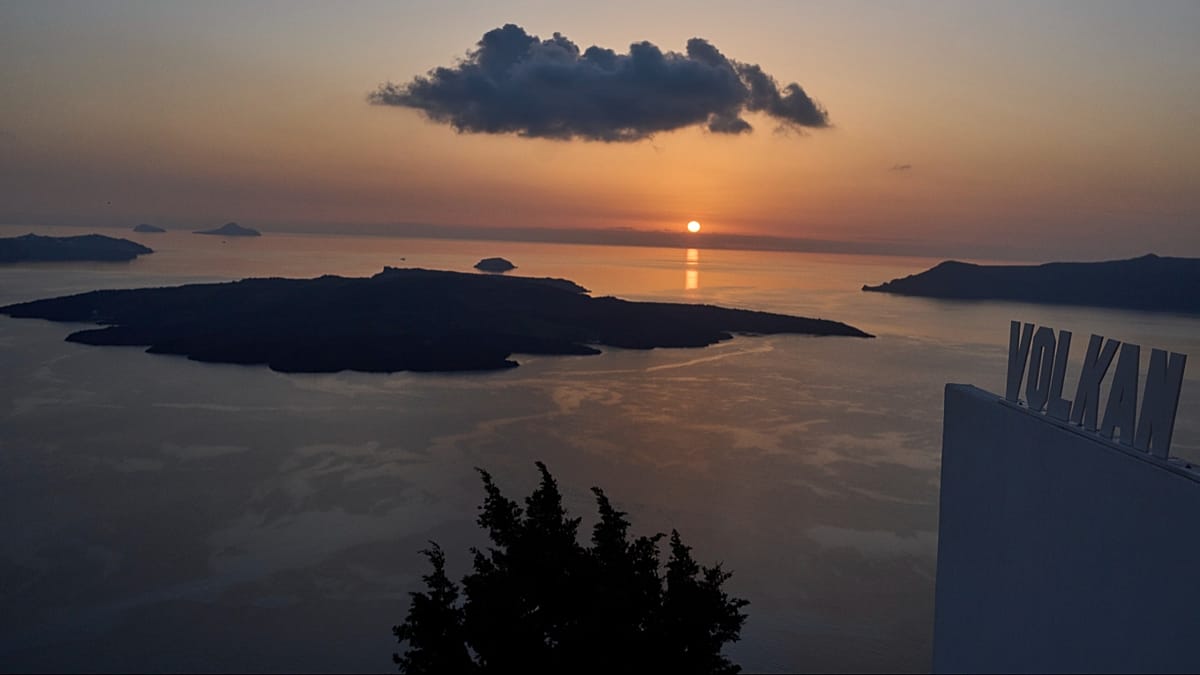
Santorini, the Greek island known for its volcanic caldera, white houses and sunsets in Oia, is trying to expand its tourism image beyond the summer season. A new digital campaign with 32 short videos will promote summer, gastronomy, and visits of cultural and religious interest.
These aspects often remain in the shadow of the famous sunsets and luxury accommodation. This is a step towards tourism in Santorini all year round, not only at the peak of summer. Hotelier Thomas Giannis says the island is not merely a summer destination for watching the sunset.
He also sees it as a gastronomic and cultural destination that can now offer tourism all year round. According to him, this is what most visitors are looking for, from the United States as well as Great Britain, Germany, France, Italy, Spain, Austria, the Netherlands, Poland, Belgium and Romania, the European countries from which most visitors come.

Tourists from Australia and Asian countries such as China, South Korea and Japan also often organize group trips to the island. Giannis stresses that Santorini is no longer the very expensive destination that those who have never visited imagine. “Santorini is for every budget.
It can afford anything. There are rooms from very cheap to very expensive”, he says, stressing that there are very good offers especially outside the high season. However, over the past two years hoteliers have complained that hotels are not filling up with tourists.
Giannis attributes the reasons to factors unrelated to the island: seismic activity in neighboring islands and then the war in the Gulf. “After the Covid pandemic we had intensive tourist activity on our island, but due to several unrelated events, one being seismic activity in neighboring islands and later the war in the Gulf, we experienced a decline in tourism”, he says.
“For me personally it was around 30 to 40 percent.” The largest decline was recorded in arrivals of tourists from the United States and, naturally, from Israel. American tourists, who tend to spend a lot at the destinations they visit and for this reason are especially sought after by those working in tourism, book holiday packages until early spring, that is, in periods that coincided with the seismic activity of 2025 and the start of the war with Iran this year.
Greece may have been far from the center of operations, but this is not immediately clear to the average American planning a holiday. Despite the decline, the situation improved after the summer, according to the mayor of Thira, Nikos Zorzos. “Tourism in Santorini started this year with a sense of stagnation, but then the situation stabilized.
September and October are strong tourist months and attract visitors with a special interest in the island”, the mayor says. Zorzos adds that the figures are almost the same and that Santorini receives 3.5 million visitors a year, including those arriving by cruise ships. However, residents have raised a counterargument with the Ministry of Tourism: due to the airport and direct flights from European destinations, a considerable number of those registered as arrivals and departures for Santorini in fact do not stay on the island, but on neighboring islands.
They use it simply as an entry and exit gateway to the country, which distorts the real figures. Although there is no doubt that Santorini has many tourists every year and for cruise ships a stop there is considered mandatory, cruise tourism is seen by many people as both a blessing and a curse at the same time.
On the one hand it increases the number of visitors, but on the other it does not bring money to the local population and is the main reason for the severe overcrowding often seen in the narrow streets, which at times becomes unbearable. Mayor Zorzos says the municipality has regulated cruise tourism.
“About 10 years ago, with a study we conducted with the University of the Aegean, we set the maximum number of visitors who can visit Santorini each day. As a result, there are no longer crowds in various parts of the island and movement is easier. So cruise tourism is no longer the problem it was in the past”, he says.
Now up to 8,000 tourists a day can disembark from cruise ships. Even so, it is estimated that about half of all tourists in Santorini each year come from the cruise sector. Local residents complain that this type of visitor does not spend money on the island, since they do not stay overnight and for the most part do not visit local shops.
In recent years another trend has also emerged: some do not set foot on land at all and enjoy the famous caldera sunset from the ship. “Of course, those who stay in hotels or other accommodation spend more money than visitors of short cruise stops”, the mayor of Thira admits.
According to a ministerial decision, since last year a “new increased cruise tax” has been in force, essentially a per-capita tax for each disembarkation. It is 20 euros per person in the summer period (1 June to 30 September), drops to 12 euros in April, May and October, and falls to 4 euros in the winter period (1 November to 31 March).
However, only a third of this money reaches the municipality’s coffers, while the rest is divided between the Ministry of Tourism and the Ministry of Maritime Transport. Meanwhile, Giannis notes that the decline in hotel occupancy compared with previous periods is also attributed to another factor: the continuous construction of new hotel units.
“The growth in the number of beds creates a problem with occupancy”, comments Mayor Zorzos, adding that he has called on the government to take measures to stop unregulated construction on the island. In Santorini, July in particular had a strong “Italian flavor”. Traffic to and from Italy reached 93,315 passengers, placing it first among foreign markets.
It is followed by Great Britain with 59,362 passengers and France with 35,158, while Germany recorded 17,746 passengers. Traffic with Spain was also considerable with 14,443 passengers, followed by Austria with 11,211 and Romania with 10,594.