







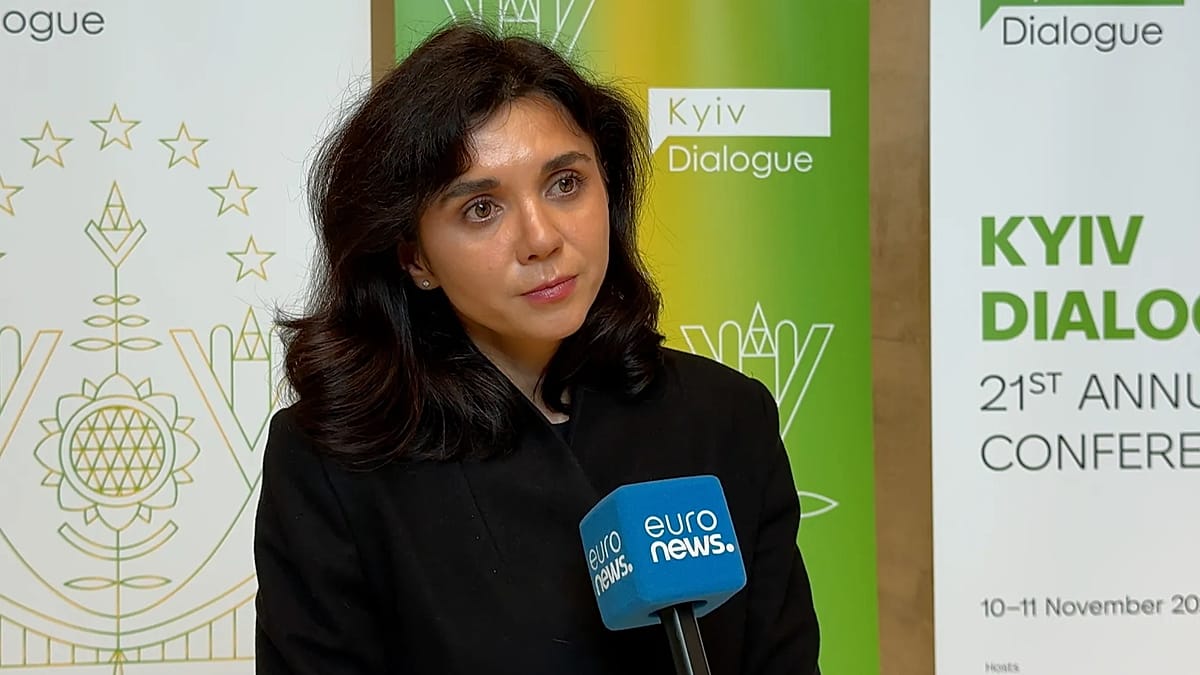
Regina Kharchenko, acting mayor of Zaporizhzhia since April 2024, said the city’s residents live in a state of constant fear because of ongoing Russian attacks. The city is located only 20 kilometers from the front line. According to her, this very short distance makes the impact of the war on civilians’ daily lives unavoidable.
Russian attacks on Zaporizhzhia have become part of everyday life, she added during an interview in Berlin, where she was representing her city at the 21st edition of the Kyiv Dialogue, a German-Ukrainian platform for cross-party dialogue that brings together politics, media and civil society.
She emphasized that, despite the physical distance, she remains involved in all operations carried out in the city and coordinates the work of municipal services from afar, always being reachable for her teams. A concrete example of this situation occurred on the day of the interview, when a residential building in the city was severely damaged and its structure risked collapsing, while one person was injured.
According to the mayor, all municipal services and emergency teams were immediately at the scene, demonstrating the continuous readiness of local institutions to respond to emergencies. This episode, as she described it, illustrates the reality of a city where attacks have become part of everyday life and where local authorities must act quickly even under the pressure of war.

Kharchenko stressed that the resilience of civil society is one of the main pillars that keep residents connected and able to endure the difficulties of this long period of conflict. She pointed out that every municipality must prepare for winter, guaranteeing the supply of heating and water, and try to control problems with the electricity supply, which are essential for the survival of the population.
In addition, socially vulnerable groups and internally displaced persons need additional support. More than 200,000 internally displaced people live in Zaporizhzhia, which poses a special challenge for local authorities. This large number of displaced persons in Zaporizhzhia highlights the additional burden the city carries in providing shelter, services and humanitarian assistance to those who have lost their homes because of the war.
Kharchenko described resilience as a multidimensional concept, encompassing winter preparedness, support for vulnerable groups and the maintenance of the city’s basic functions under extremely difficult conditions. She did not hide that the challenges are great, but stressed that the local community is doing everything possible to face them and to maintain a degree of normality in everyday life.
During the interview, she also spoke about systematic attacks on public transport, which have caused casualties and created insecurity for residents who use buses to get to work or to access essential services. Earlier this month, several glide bombs hit an underground school in the village of Komyshuvakha in the Zaporizhzhia region, where civilians had gathered for the distribution of humanitarian aid, and at least 50 people were killed in that attack.
This tragic incident is one of the most severe examples of the consequences Russian attacks have for the civilian population, also affecting facilities used for humanitarian aid and temporary shelter. In October, a Russian drone hit a minibus at a stop in the city center, injuring three people, according to the independent Ukrainian outlet Ukrainska Pravda, while four others were injured in another drone attack on a bus.
These attacks show that civilian targets, including public transport, are constantly being targeted, endangering the lives of ordinary residents who have no connection to the armed conflict. To protect against these threats, Kharchenko said the municipality is installing anti-drone tunnels and nets at key points in certain neighborhoods, as well as installing unbreakable film on vehicles so that people are not injured by fragments.
She stressed that every measure that can be taken at the municipal level is being implemented, but also emphasized that Ukrainian defense forces are doing extraordinary work to repel the numerous attacks with drones, missiles and Shaheds, and that only thanks to this superhuman work can the city continue a somewhat normal life.
This expression of gratitude to the Ukrainian army shows that local authorities see military defense as an essential factor for civilian safety and the functioning of public services. Regarding the fourth winter of the war, Kharchenko stressed that Ukraine is facing continuous attacks on critical infrastructure, which she called terrorism and terror against the peaceful civilian population.
She assessed that these attacks may be part of Russia’s strategy to break Ukraine and to show that it can take away people’s basic living conditions, comfort and ease. Despite this, the mayor stressed that the city is actively preparing by strengthening critical infrastructure and protecting the most important facilities, such as substations, heating plants and pumping stations.
She expressed gratitude to her teams who are working nonstop for this purpose, but acknowledged that the enemy is treacherous and that the scale of future attacks is unknown, so the city does what it can and moves forward. This winter preparation includes concrete measures to ensure that essential services are not interrupted even in the event of unexpected attacks, given that the electricity supply has failed 16 times this year alone. ## The risk from the Zaporizhzhia nuclear power plant Kharchenko also spoke about the risk posed by the Zaporizhzhia nuclear power plant, which has been under Russian control since March 2022.
She called this situation a tragedy and expressed hope that some trace of common sense remains even in Russia, a terrorist state, because playing with attacks on such facilities means destroying people in the 21st century and doing everything to cause the peaceful civilian population to die.
She called for a response from all European Union countries, the United States and all responsible politicians to prevent this catastrophe in Ukraine, especially since it would occur in the immediate vicinity of Zaporizhzhia. This call for international action reflects the concern of local authorities about the possible consequences of a nuclear incident, which would affect not only the city but also the wider region.
Regarding financial aid to Ukraine, which is being widely and controversially debated, Kharchenko stressed that Ukraine is fighting for values that are taken for granted in Europe, such as human life, freedom, freedom of choice and state sovereignty. She said these are norms in the European Union, but unfortunately Ukraine is now fighting simply to continue to exist on the map of the world, and every Ukrainian knows that their state is in great danger.
She expressed gratitude for all the assistance provided to Ukraine, its municipalities and especially Zaporizhzhia, and hoped that this support would never diminish, but would include more projects to supply military equipment to Ukraine. According to her, even if a just peace is achieved and, as part of negotiations and ongoing political processes, a ceasefire is reached, Ukraine must remain strong and resilient, with effective defensive forces, so that this war never happens again.
This emphasis on strengthening defense after a possible ceasefire shows that local authorities see long-term security as a necessary condition for reconstruction and a return to normality. When asked what a possible ceasefire along the current front line would mean for Zaporizhzhia, Kharchenko replied that it would mean a continuous life in fear, because 20 kilometers is a very short distance and the enemy attacks extremely often.
She expressed hope that people will simply be able to live normally again if an agreement for a temporary ceasefire or some form of de-escalation is reached, but stressed that they must still remain very strong, institutionally and in terms of infrastructure, and must continue to protect their city.
This answer sums up the dilemma of a city that hopes for peace but knows that its security depends on continued defense and international support. Asked about the possibility of ceding territories currently occupied by Russia in exchange for peace, Kharchenko said that, to be honest, she does not have the expertise to give a well-founded answer on this issue, leaving open a topic that remains at the center of political and diplomatic debates about Ukraine’s future.
This statement shows her care not to become involved in decisions that exceed the competencies of a local mayor, while her attention remains focused on the immediate needs of Zaporizhzhia’s residents.