







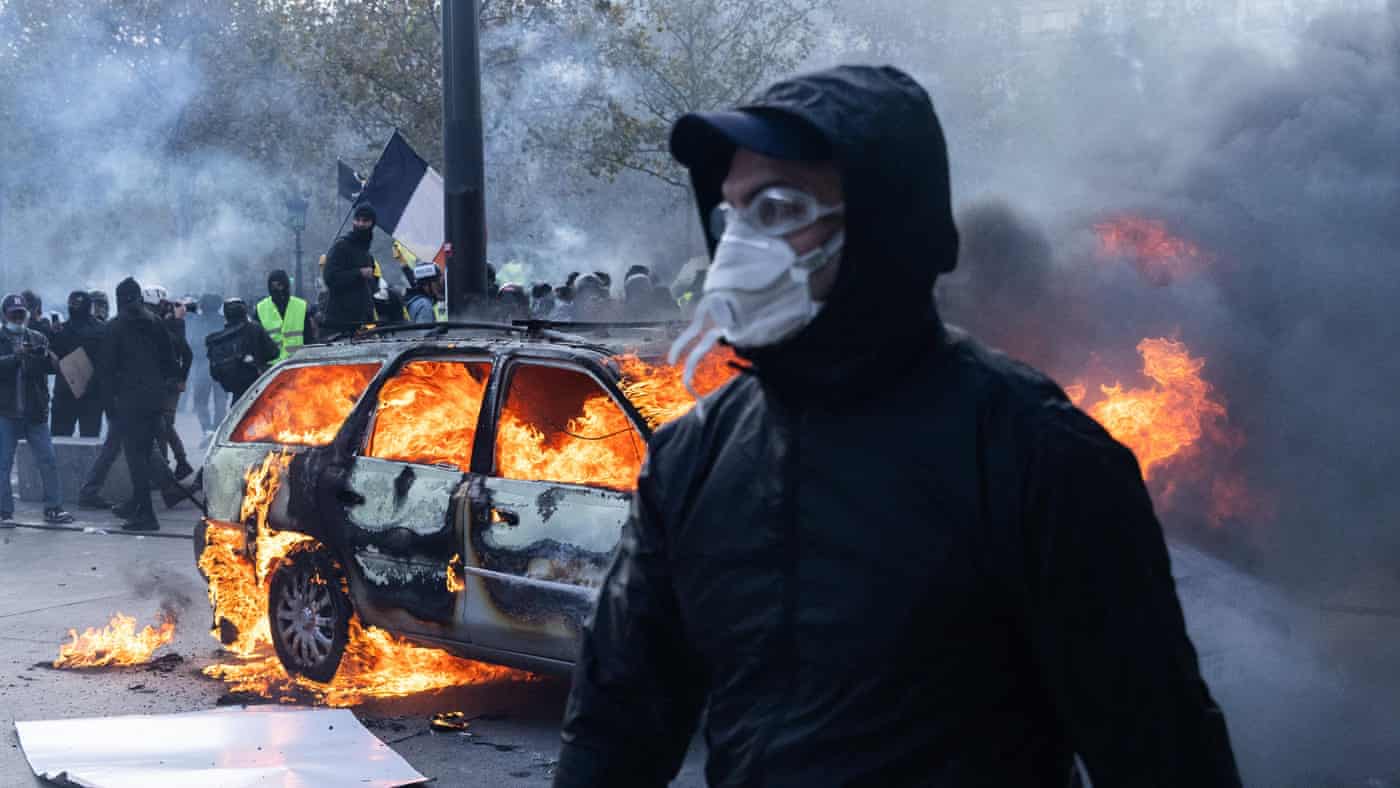
More than 400 people were arrested in France on Saturday after protesters supporting the complaints of high school students clashed with police. Police used tear gas against demonstrators, while nationwide protests were reinforced by other groups angered by high prices and the weakening of the social welfare system. Hundreds of thousands of people took to the streets across the country, and tensions erupted on the fringes of the national demonstrations, fueled by teacher shortages, dilapidated school buildings and police violence.
Interior Minister Laurent Nuñez said late on Saturday that 400 arrests had been carried out and that most of those detained were adults, not part of the high school protests. He stressed that the official demonstration had been “hijacked” by “casseurs” – “opportunistic delinquents who saw an opportunity to loot and rob”. Nuñez pledged that they would be found and dealt with firmly. He added that the state was not planning to declare a state of emergency, but strongly condemned the violence that had been witnessed.
In Marseille, protesters attacked the city hall, battering the door with security barriers removed from the road. They briefly managed to enter the municipal building, where one protester spray-painted an “A” for anarchy on a wall before police drove them out. Around the Place de la République in central Paris, a peaceful march turned violent, with police firing tear gas at rioters dressed in black and masked, who threw fireworks and cobblestones, attacked a bank and looted a sports shop. A truck was set on fire and the flames spread to a nearby building.

Along the Boulevard de Magenta, one of the main north-south axes north of the Place de la République, passing through a mostly working-class area, dozens of shops were smashed and looted. Residents of the surrounding streets were forced to close windows and doors as huge clouds of tear gas rose to rooftop level. Saturday’s mobilization followed calls on social media to revive the “yellow vest” (gilets jaunes) movement, which emerged in 2018 against social injustice.
The protests began last month in schools in the poor northern suburbs of Paris, where anger over teacher shortages and poor conditions quickly turned into a nationwide movement against inequality, low public spending and declining standards. Saturday’s protests called on teachers and students, workers, pensioners and farmers to join the movement. French authorities reported 140 protests with 32,800 people outside Paris by midday, blaming the unrest and violence on what they called the “ultra-left”. The CGT, one of France’s largest trade unions, also backed the protests, calling for “higher wages and pensions, lower prices and protection of public services that meet people’s needs”. Around 45% of French people are worried about rising living costs and inflation.
Both the far left and the far right in France tried to benefit from the protest movement, with the left positioning itself on the side of the protesters and the right backing the police. Jean-Luc Mélenchon, leader of the far-left party “France Unbowed”, marched in one demonstration and expressed support for the protesting students. President Emmanuel Macron, who is entering the final phase of his presidency, called for calm and respect for people and property, condemning as “unacceptable” the presence of people “solely to cause damage and create disorder”.
A heavy police presence was visible in central Paris, particularly near landmarks such as the Avenue des Champs-Élysées and the Arc de Triomphe, which were excluded from the routes of the two official demonstrations. In recent weeks, thousands of arrests have been recorded, hundreds injured and schools burned, as the new school year has been plunged into nationwide student protests that are affecting the country’s presidential election campaign and drawing international attention. The police oversight body is investigating at least two dozen allegations of police violence, while the French prime minister said more than 900 police officers had been injured. Laurent Nuñez suspended the use of a type of police stun grenade against young demonstrators after a 15-year-old lost a hand, but said they could be used on Saturday. Climate and social justice activist Greta Thunberg joined students at a school in the Paris suburb of Saint-Denis.
Taken from The Guardian