







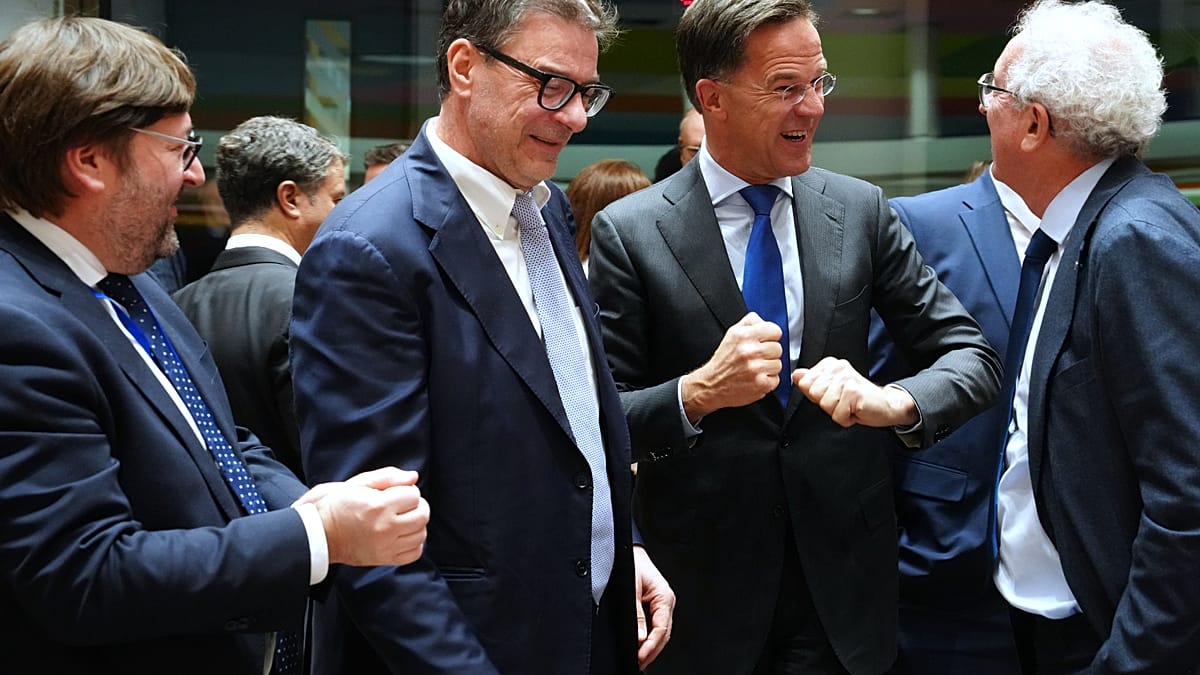
Italy’s Minister of Economy and Finance, Giancarlo Giorgetti, has not yet signed the 13th aid package for Ukraine. It was presented on Tuesday, November 10, to the Parliamentary Committee for the Security of the Republic (Copasir) by Defence Minister Guido Crosetto. Without Giorgetti’s signature, which comes from the League (Lega), the decree cannot be published.
The aid, both military and civilian, cannot be sent. The procedure requires that the classified document be signed personally, not electronically. Foreign Minister Antonio Tajani clarified this, and together with Crosetto he has downplayed the incident by pointing to Giorgetti’s absence.
On Monday he was in Brussels for Ecofin. Tajani stressed that, since the document is classified, it must be signed personally and cannot be signed electronically. Crosetto has expressed confidence that Giorgetti will sign the package as soon as he returns from Brussels.

He defended the need to continue supporting Kyiv and stressed the necessity for Europe to maintain a common position, as Prime Minister Giorgia Meloni has called for. He repeated that “excluding a physical presence of European troops in Ukraine has always been our condition”.
Sources close to Palazzo Chigi reaffirmed the same position even after talks began in Abu Dhabi: “Europe must speak with one voice and be equipped with a clear and common mandate”. Deputy Prime Minister and Minister of Infrastructure Matteo Salvini has repeatedly expressed reservations about military aid to Ukraine.
However, Meloni, together with Forza Italia, has remained steadfast in its position of supporting Kyiv “for as long as necessary”. This line has hardened after the League’s congress, which reconfirmed Salvini as secretary. League senator Claudio Borghi has increased the pressure on the social network X. He called the 13th aid package for Ukraine “the decree that does not exist (because an act that requires joint approval from several ministers does not exist until they have signed it)”.
Without the signature of the League minister, Giorgetti, the decree is not published and the aid does not move. This risks opening a sensitive battle within the governing majority, which could turn into a clash with hard-to-predict consequences. The list of measures in the decree, classified like all the previous ones, is expected to include not only aid for Ukrainian civilians, such as generators, but possibly also air defence weapons.
Since the Franco-Italian SAMP/T battery was supplied earlier, there may be a shipment of Aster missiles to arm the system. Within the majority, many are convinced that the minister will sign in the end. This is because otherwise the experience of the centre-right government would dangerously approach its end, a scenario that could prove catastrophic, not only for European balances. ## Italian government in the middle of the budget session The Italian government finds itself in the middle of the budget session, and a crisis at this moment risks toppling the budget plan as well.
Moreover, the framework decree-law that serves as the “basis” for this mechanism expires at the end of the year. It provides for a ministerial decree with joint approval from Defence, Farnesina and the Ministry of Economy and Finance. This scheme was introduced by the Draghi government in 2022 and has been renewed four times with minor changes, regardless of the governing majority.
After approval by the Council of Ministers, these framework decrees have been converted into law by the chambers of Parliament. Thus, over four years, twelve aid packages for the military have been sent through as many inter-ministerial measures, for which only an informative briefing to the Parliamentary Committee for the Security of the Republic is required.
The latest aid package for Kyiv was sent at the end of 2025. A few days after last year’s Christmas, that is, eleven months ago, the government approved a new framework decree. It authorises the dispatch of supplies, both military and civilian, to Ukraine for the whole of 2026.