







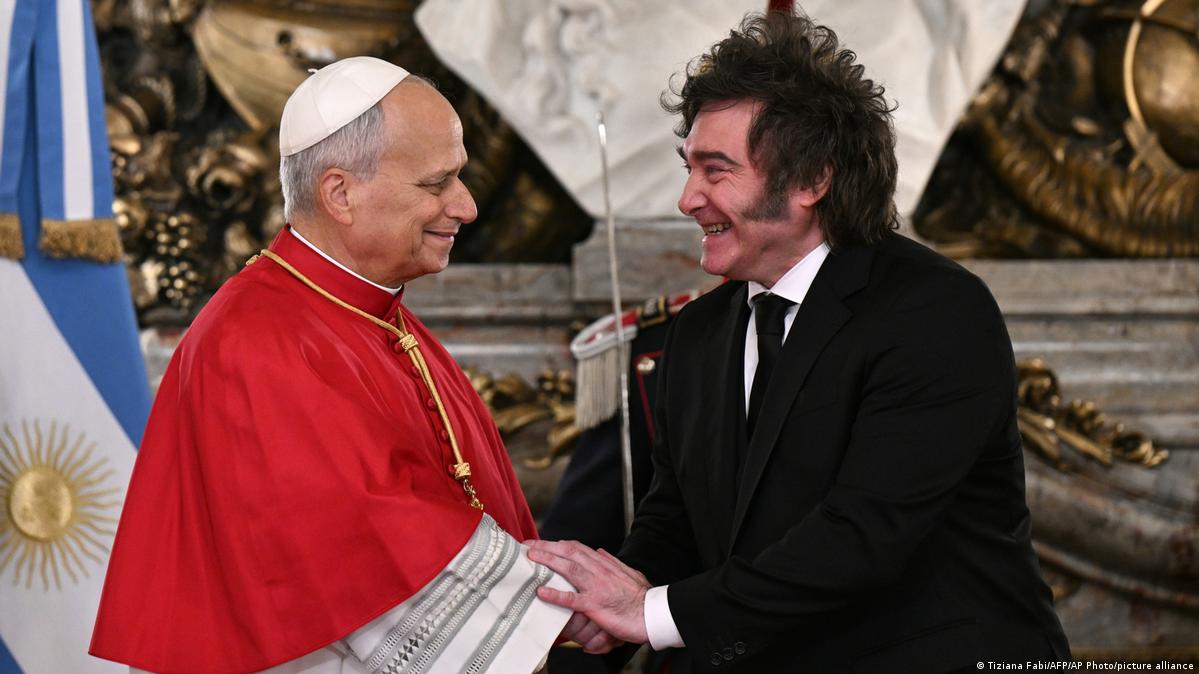
Pope Leo XIV arrived in Argentina on Sunday, calling for the protection of democracy and ensuring that economic growth brings benefits to the poor. The Pope’s remarks were followed closely, as they were interpreted as criticism of the harsh austerity programs and cuts by President Javier Milei, which have affected social services. Although Leo did not directly address the government’s policies, he stressed that “the economy must serve the people, and not the people serve the economy.” During his conversation with Milei and other government officials, he pointed to the difficult situation of those who, “despite tireless work, still struggle to meet the needs of their families.”
The visit to Buenos Aires marks the second stage of the Pope’s tour of South America and is the first papal visit to Argentina in nearly 40 years. The 71-year-old pontiff, who underwent surgery for lung cancer less than a month ago, arrived from Uruguay and is scheduled to visit several cities in the predominantly Catholic country before traveling on to Peru on Wednesday. The visit also brings renewed attention to the legacy of Pope Francis, the first Argentine pope, who died in April 2025 without returning to his homeland during his 12-year papacy.
Milei’s policies have in the past drawn strong criticism from the Catholic Church of Argentina, particularly cuts affecting social services, pensions, assistance for people with disabilities and public universities. The Argentine leader, a close ally of former U.S. President Donald Trump, has defended his aggressive spending cuts as necessary to stabilize the country’s ailing economy and curb inflation. Under his administration, annual inflation has fallen from more than 200% to around 33%, but families continue to face financial pressure, and there has been anger over layoffs in the public sector and business closures.

In the past, Milei had rejected criticism from the Catholic Church harshly, going so far as to call Leo’s predecessor, Pope Francis, an “imbecile.” However, he later softened his tone and met with Francis in Rome. On Sunday, Milei adopted a markedly more conciliatory stance, praising Francis as an “extraordinary figure” and the “most important Argentine in history.” This change in tone reflects an effort to improve relations with the religious institution.
Pope Leo also stressed the need to preserve democracy in the country. He stated that “those who exercise authority have a duty to act with prudence, to recognize the limits of the power entrusted to them, and to direct their decisions toward the good of the whole community.” The Pope’s words carry particular significance ahead of Argentina’s 2027 presidential elections, in which Milei has said he will seek another term. The president’s aggressive rhetoric and frequent attacks on journalists and political opponents are widely seen as part of a growing political polarization in the country. Leo told Milei that strengthening democracy required “a readiness to listen” and “careful use of words,” underlining the importance of dialogue and respect in public discourse.
Source: Deutsche Welle