







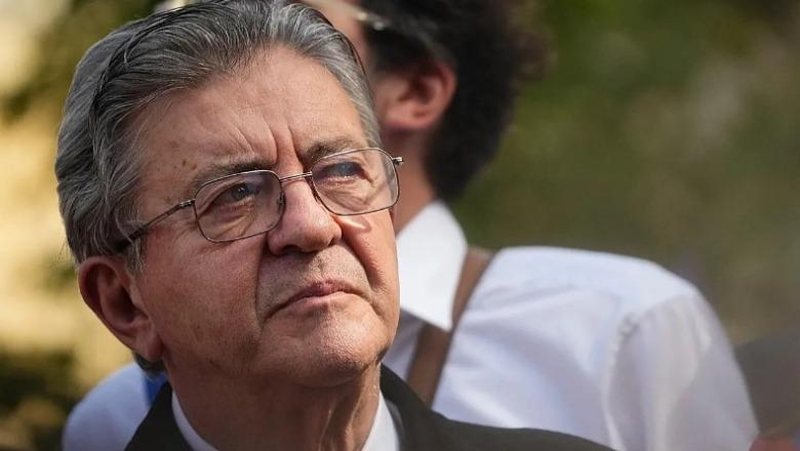
Jean-Luc Mélenchon, leader of the radical left party “France Unbowed” (LFI), presented his presidential programme at a large rally in Le Bourget, north of Paris, on Saturday. The presentation took place as protests and social discontent continue in France.
The message with which he summed up his proposal was: “We must change everything.” This is Mélenchon’s presidential programme, which calls for a profound political and economic change for the country, including a Sixth Republic and lowering the voting age to 16, according to what he stated at the rally.
Mélenchon’s presidential programme also includes promises on the minimum wage and pensions, which he presented as part of his vision for France. In his speech, he called for a Sixth Republic and for lowering the voting age to 16, urging his supporters toward a profound political and economic change.
He opened his speech with a minute of silence in memory of 26-year-old Pengo Bossio Wangi, a victim of a racist attack in Trappes. Mélenchon, who has run for the French presidency four times, urged his supporters toward a profound political and economic change, proposing among other things lowering the voting age to 16 and creating a Sixth Republic.

He then called for a “cultural liberation” of France in the face of what he called “fascist culture”. According to him, racism and the “abandonment of the people by liberal policies” threaten national unity. He called for the declaration of a “state of social emergency”, referring to protests by secondary school students, which in recent weeks have expanded with demands against the high cost of living and in defence of public services.
One of his proposals is granting the right to vote from the age of 16. According to Mélenchon, this would force the government to pay closer attention to what happens in secondary schools. In the programme titled “L’Avenir en commun” (“The Common Future”), Mélenchon promises to raise the minimum wage to 1,700 euros a month and to gradually lower the legal retirement age to 60 for people who have paid contributions for 40 years.
He also proposes creating a “new ecological state”, based on planning and a mixed economy that gives priority to environmental demands. His party calls for replacing today’s administrative regions with “eco-regions”, organised according to the management of water resources, as well as strengthening environmental protection in the Constitution.
Mélenchon also supports the gradual phase-out of nuclear energy, although the target for reaching 100% renewable energy has been pushed back from 2050 to 2060. The programme was published without a detailed financial calculation. The party’s leaders say it will be supplemented by around 50 documents that will explain the proposed measures.
In October, Mélenchon and Éric Coquerel, chair of the finance committee in the National Assembly, presented a revised draft budget for 2027, in case of victory. It projects around 100 billion euros in additional tax revenue and 80 billion euros in additional spending.
According to polls cited, Mélenchon ranks second with around 18% support, while the far-right candidate Marine Le Pen leads with 35–37%. In recent days, his candidacy has received the official backing of most communist deputies and those from overseas territories in the National Assembly, even though the head of the French Communist Party, Fabien Roussel, is also a candidate.
Meanwhile, the Greens are expected to decide by mid-December whether they will form an alliance with Mélenchon’s party. A few hours before the rally, he also published his campaign poster, in which he appears in front of a landscape of Gergovie, with the slogan “Liberty, equality, solidarity”. On social media, some users compared the poster to that of François Mitterrand in 1981, when the Socialist candidate used the slogan “The quiet force”.
In foreign policy, Mélenchon’s programme continues to focus on the war in Gaza and the activity of Israeli settlements in the West Bank. His party proposes suspending the Association Agreement between Israel and the European Union. On Ukraine, the document calls for a ceasefire but offers few details on military support for Kyiv.
He also proposes creating a new European security framework that would include Russia. Mélenchon’s programme has drawn objections from his political rivals. Marine Le Pen described it in a post on the social network X as a “plan to dismantle France”.
“He is taking to its end the process of dismantling that Emmanuel Macron began when he came to power,” Le Pen wrote. Former prime minister Édouard Philippe, who is running for the presidency, also criticised the programme during an event near Marseille on Saturday. He opposed what he called Mélenchon’s “communitarian vision” and his model of a “managed economy”.
Philippe said he saw “many points in common” between Le Pen and Mélenchon, citing their opposition to European integration and their desire, in his words, to leave NATO.