







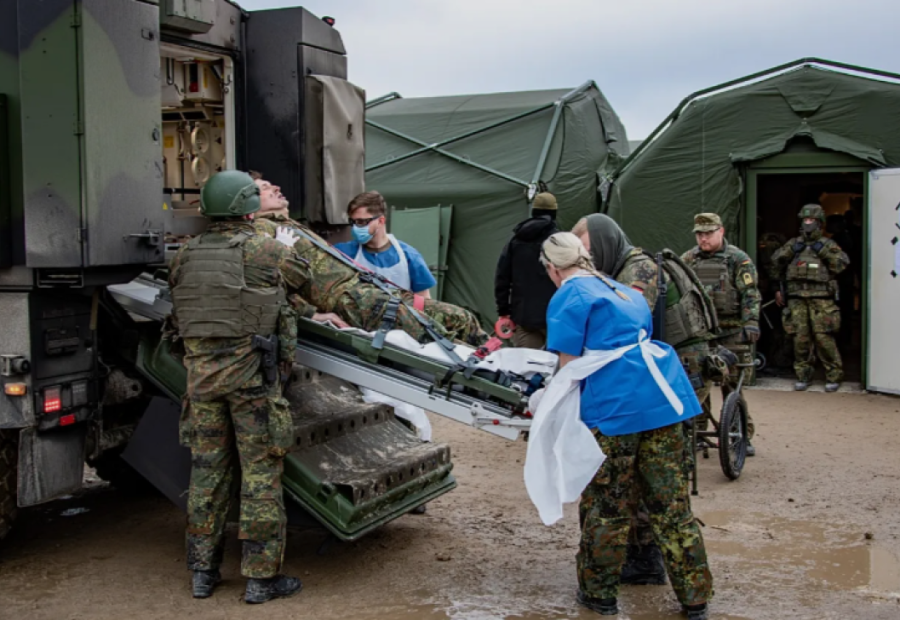
Hospitals in Europe are preparing for war, and it is not only militaries being put on standby but also health systems. Missile attacks, chemical and biological weapons, and the risk of viruses created with artificial intelligence are increasing the concern of NATO experts. Meanwhile, European governments are increasing military spending and strengthening the alliance’s eastern flank.
According to them, preparation for war cannot be limited to militaries alone. A major conflict could cause a massive number of casualties and put hospitals, medicine supplies and medical personnel under unprecedented pressure. Hospitals, doctors and health infrastructure are facing the need to prepare for extreme scenarios, from missile and drone attacks to the use of chemical, biological and nuclear weapons, Newsmax Balkans reports.
In this context, Brigadier General Petter Iversen, chief surgeon of the Norwegian Armed Forces and chair of NATO’s Committee of Chiefs of Military Medical Services, assesses that a prepared health system is an essential part of national security. “A healthy society is a resilient society.

If you are resilient, you can withstand pressures from adversaries,” Iversen told Euronews. Preparation, according to him, means not only the ability to treat the wounded but also securing medical supplies, training personnel and adapting hospitals to handle several emergencies at once.
One of the biggest concerns for European security relates to the development of artificial intelligence and the possibility that it could be used to create dangerous biological agents. Although this technology can accelerate the development of new medicines and treatments, experts warn that it could also be exploited by malicious actors to develop modified viruses and biological weapons.
Laurent Muschel, director and deputy head of the EU Health Emergency Preparedness and Response Authority, warns that future threats may be difficult to predict. “You don’t know what you are dealing with, because it could be a virus created with artificial intelligence or a state developing a new virus,” he said.
Muschel stressed that biosecurity will be one of the main priorities, underlining the need for rules and oversight systems that control the use of artificial intelligence in this field. “It is a fantastic technology for developing new medicines, but it can also help bad actors create very powerful tools,” he warned.
Iversen also considers the combination of synthetic biology, bioinformatics and artificial intelligence a risk that NATO structures take very seriously. According to him, the use of weapons of mass destruction, whether chemical, nuclear or biological, constitutes one of the most serious threats to public health.
To prepare for these scenarios, European authorities are working on the development of broad-spectrum treatments, which can be used even before the type of biological agent is precisely identified. Among them are broad-spectrum antivirals and monoclonal antibodies, which can provide initial protection against various threats.
Despite growing awareness of the risks, the preparedness of European health systems remains uneven. Countries bordering Russia and states on NATO’s eastern flank are more aware of the threat and are taking concrete steps. Iversen mentioned Germany, Norway and the Baltic and Nordic countries as states investing in increasing hospital capacity, adding beds and expanding health services.
However, according to him, building hospitals and adding equipment are not enough. Medical personnel must be trained to work in unusual conditions, while health systems must be more flexible. In peacetime, medical services are highly specialized, but in the event of war it may be necessary for personnel and institutions to take on broader tasks to cope with the sudden influx of patients.
Another weak point is the supply of medicines and medical equipment. Iversen argues that Europe must combine strategic reserves with expanding domestic production capacities, so as not to depend solely on external supplies during a crisis. The experience of the war in Ukraine has served as a concrete warning of what European health systems could face in the event of a major conflict.
Hospitals and ambulances have been targeted in attacks, while medical personnel have been forced to work in dangerous conditions. In addition to treating emergencies, the war has created major needs for rehabilitation and mental health services. Jarno Habicht, former head of the World Health Organization office in Ukraine, told Euronews that the conflict has significantly increased the need for specialized trauma treatment and rehabilitation.
“We have thousands more amputations than we would have had without the war,” he said, referring to the severe physical consequences of the conflict. Another major problem is mental health, both for the population affected by the war and for doctors and nurses working under constant pressure.
Habicht stressed that preparation should not focus only on buildings and equipment, but above all on the people who keep the health system running. “You need a good building and a safe space. But in the end, everything depends on whether the nurses are there, whether the doctors are there and whether support staff are present,” he said.