







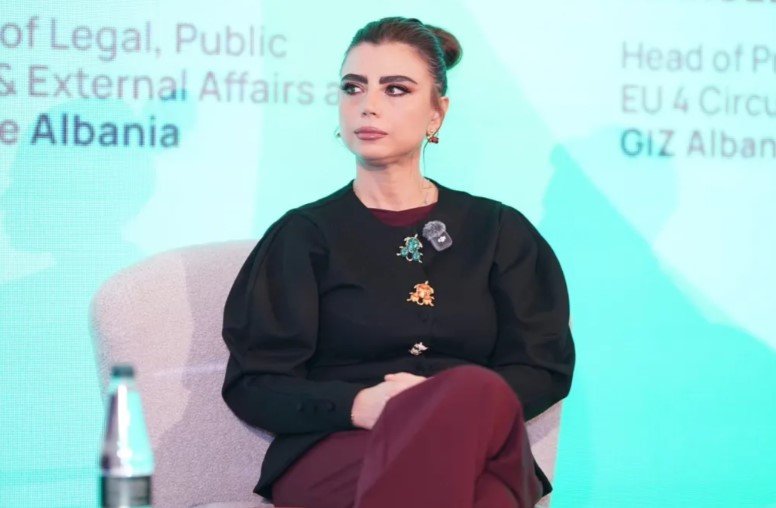
Jonida Lakuriqi, Director of Legal Affairs, Public Policy and External Relations at Vodafone Albania, emphasized the need for Albania to move from isolated smart city projects toward an integrated national strategy. This approach would enable the use of technology across the entire territory, increasing the efficiency of public services and creating new investment opportunities. The statement was made during the panel “From Smart Cities to a Smart Nation” (From smart cities to a smart nation), part of the Energy, Construction and Green Economy Fair, on November 20, 2026.
Lakuriqi noted that the main challenge for the country is the fragmentation of digital initiatives and emphasized the importance of coordination at the national level. With 61 municipalities, developing separate systems by each of them generates additional costs, limits economies of scale and hinders the spread of innovation. She illustrated this issue with examples such as Tirana building an intelligent transport system, Durrës a platform for waste management and Elbasan an intelligent lighting system; if these operate in isolation, the country loses the benefits of shared solutions.
The Vodafone Albania representative also shared the company’s experience in digital services, mentioning the “Tirana Ime” app developed in 2016 with the Municipality of Tirana, which facilitated traffic monitoring, parking payment and communication with the municipality. Another example was “Komisariati Dixhital” for anonymous reporting of incidents. Referring to Vodafone Group’s international experience in the Internet of Things (IoT), she presented models such as that of Valladolid in Spain, where sensors connect public buildings across many municipalities, or Ibiza, where technology monitors beaches and air and water quality, a model applicable to the Albanian Riviera as well. Other examples included support for the digital transition on the Greek island of Chalki, identifying water leaks in the United Kingdom and collecting waste on demand in the Netherlands.

A significant part of the discussion was devoted to artificial intelligence (AI) and its impact on energy efficiency and sustainable development. Lakuriqi emphasized that combining IoT with AI is transforming cities, moving from data collection to predicting problems and automatic infrastructure response. She mentioned the use of “digital twins” to test urban changes before implementation. Vodafone Albania is testing in Tirana an AI-powered robotic antenna, which changes its physical position to optimize coverage according to demand, as well as the “zero bit, zero watt” concept to reduce network energy consumption. However, she warned that digitalization does not automatically guarantee green development, since AI itself requires energy.
Lakuriqi suggested that Albania’s relatively small size could become a competitive advantage for technological development, since in an innovation-based economy, speed of adaptation matters more than size. She emphasized the democratization of access to AI, citing examples such as family businesses in Përmet that use advanced analytical tools, students in Kukës who benefit from personalized education, and pensioners who access public services simply by communicating in Albanian. The use of AI with autonomous agents could revolutionize citizen-administration interaction.
However, this transformation must be accompanied by personal data protection, human oversight and the possibility of assistance from institutional staff. In conclusion, the Vodafone Albania representative emphasized that the democratization of artificial intelligence should not be seen only as a social responsibility, but as a national strategy for increasing competitiveness, avoiding the creation of a new digital divide.