







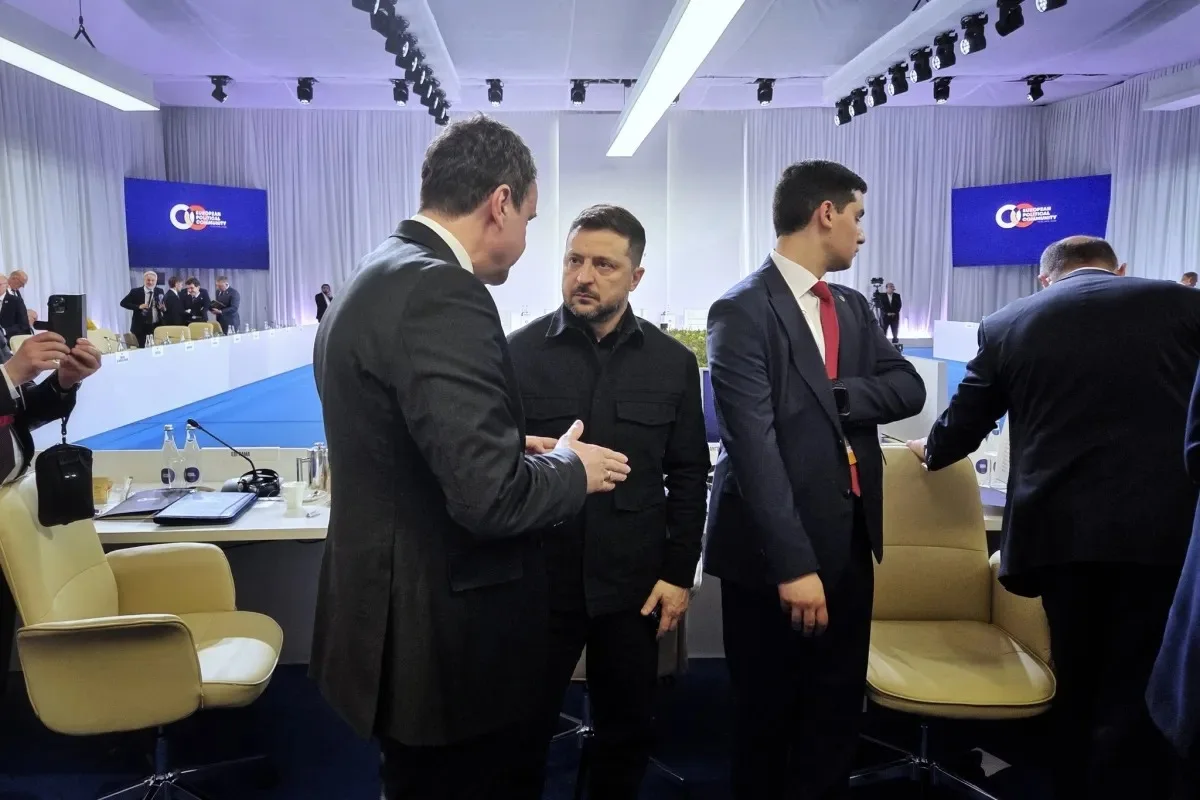
The Prime Minister of Kosovo, Albin Kurti, has called on the President of Ukraine, Volodymyr Zelensky, to recognize Kosovo’s independence. According to Kurti, Kosovo’s case is fundamentally different from Russia’s annexation of Crimea. Such recognition, according to him, would expose the bluff of Russian President Vladimir Putin, who uses Kosovo to justify the annexation of Crimea.
Thus, Kurti asks Zelensky to recognize Kosovo as an act in support of the international order, not as a favor to Kosovo. The call was made in an opinion piece by Kurti for the Ukrainian media outlet “Kyiv Post.” According to him, recognition of Kosovo by Ukraine would not be a favor to Kosovo.
It would be an action in support of the international order that Ukraine itself is defending against Russian aggression. “President Zelensky should recognize Kosovo not as a favor to us, but because such an action would strengthen precisely the international order that Ukraine has spent years defending; an order in which history is not a license for invasion, borders are not changed by force, and small states are not denied a future by larger states,” Kurti wrote.

He assessed that both countries share a common orientation toward membership in the European Union and NATO. Recognition of Kosovo would strengthen this perspective. “Crimea is Ukraine.
And Kosovo is Kosovo,” Kurti wrote. In his opinion piece, Kurti criticized Ukraine’s position to date of not recognizing Kosovo. He recalled that Zelensky had repeated this position during a statement in Belgrade in August of this year.
“Last August, President Volodymyr Zelensky stated that Ukraine’s position on Kosovo, namely its non-recognition, remains unchanged. What stood out was the fact that this statement was made in Belgrade, the capital of Serbia, one of Russia’s closest allies,” Kurti wrote.
He recalled that Kosovo has consistently supported Ukraine against Russian aggression. It has condemned Moscow’s attacks, aligned itself with the sanctions of the United States and the European Union, and offered shelter to Ukrainian journalists as well as aid and military training. “Kosovo, for its part, has also maintained its position toward Ukraine: that of support.
We have condemned Moscow’s aggression, aligned ourselves with the sanctions of the United States and the European Union, sheltered Ukrainian journalists, and contributed with aid and military training,” Kurti wrote. Kurti rejected the claims of Russian President Vladimir Putin, who uses Kosovo’s case to justify the annexation of Crimea.
According to him, such a comparison aims to discredit the West and present completely different cases as equivalent. “The mistake lies in treating all claims to self-determination as if they were interchangeable from a legal and political standpoint. They are not.
Recognition of Kosovo does not create an automatic rule for every other territorial dispute. Each case must be assessed on the basis of its own history, its own facts and, crucially, the concrete actions of the states involved,” he said. He argued that Kosovo’s independence was the result of a long process.
This process included the oppression of Albanians, war, ethnic cleansing, NATO intervention and international negotiations. In this context, he also recalled the 2010 advisory opinion of the International Court of Justice. According to this opinion, Kosovo’s declaration of independence had not violated international law.
Starting from these premises, Kurti said that recognition of Kosovo by Ukraine would mean exposing Putin’s bluff. “Recognition would refute Putin’s claim that Kosovo is evidence that Western democracies do not respect the law. It would reject his attempt to put different cases into the same mold, to serve a convenient argument for him,” Kurti further stated.
Kurti: invasion is not self-determination Kurti emphasized that changing borders through military force cannot be equated with a people’s self-determination. This matters, as Kurti writes, not only for Ukraine but for every country that hesitates to recognize Kosovo because of its own territorial disputes.
“Changing borders through the tanks of a great power is not the same as a status achieved after a liberation war, international administration and diplomacy. Invasion is not self-determination. Annexation is not independence.
Referendum ballot boxes should not be carried by soldiers of a neighboring state, as Russian soldiers did in Crimea. Self-determination is a people’s right to decide for itself, an act of liberation in pursuit of equality and freedom, emancipatory democracy and true independence, not the expansion or extension of another state in service of its hegemonic ambitions.
This matters not only for Ukraine but for every country that hesitates to recognize Kosovo out of fear of what this might mean for its own territorial disputes,” Kurti continued.