







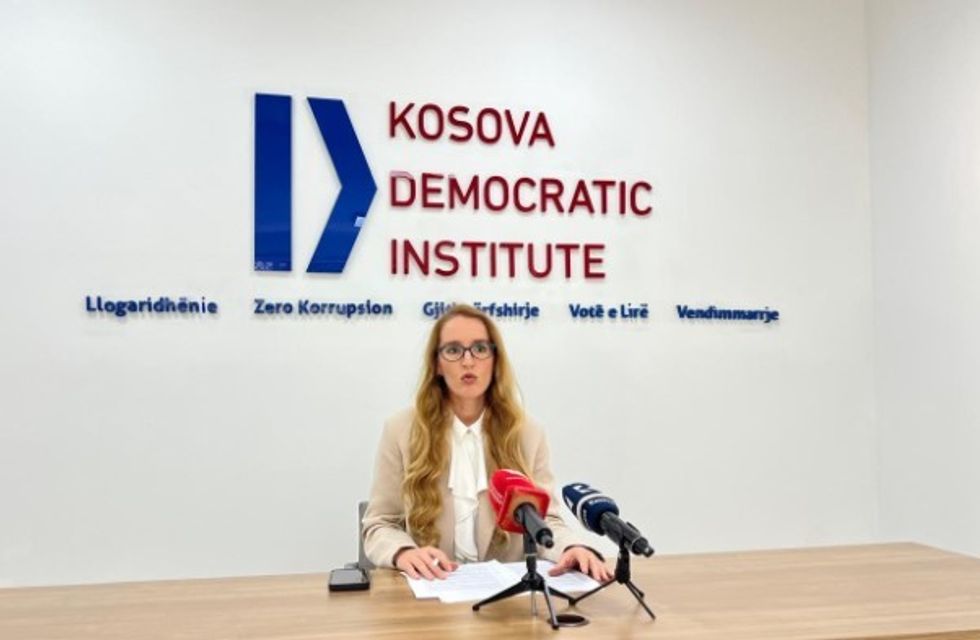
The Kosovo Democratic Institute (KDI) has assessed that the first month of work of the 11th Legislature of the Assembly of Kosovo was characterized by the lack of an integrated plan and weak coordination among parliamentary bodies. At a press conference, KDI presented the report “Assembly without an agenda!
Organization and planning of the Assembly’s work in the new Legislature”, which analyzes the Assembly’s monthly work, focusing on the planning and organization of parliamentary activities. According to KDI, the lack of an integrated plan that would determine priorities, deadlines and coordination of activities has affected the overall organization of parliamentary work and accountability to the citizens of Kosovo.
The report highlights that the start of the work of the 11th Legislature has not begun with proper organization. It describes it as chaotic in planning and organization. Violeta Haxholli of KDI stressed that after nearly two years of institutional crises and without a functional Assembly, citizens expect that the Legislature’s agenda should follow a different dynamic.

This would make it possible to catch up with the fulfillment of obligations and reforms that have been waiting for a long time. “Therefore, the Assembly urgently needs an integrated work plan, setting clear priorities, measurable deadlines and better coordination of parliamentary activities.
In this regard, the reorganization of work should be seriously considered, also by making use of the advantages offered by information technology and AI,” she said. KDI’s monitoring shows that the Legislative Agenda submitted by the Government is decisive in the Assembly’s planning. Parliamentary committees, without analyzing and challenging the complexity or volume of this agenda, which for these three months alone includes 65 draft laws, are transferring this agenda almost entirely into their own work plans, according to the areas they cover.
“No committee has included a single initiative originating from the deputies themselves for new laws,” Haxholli said. This burden from the very beginning of the committees’ work, without analyzing whether the committees have the capacity to review this volume of laws effectively, will not only result in poor-quality laws that are insufficiently consulted with stakeholders, but will also limit the committees’ time to deal with oversight of law implementation, which in Kosovo is the most acute problem.
“This is also seen in the committees’ work plans, where only 5 of 16 committees have planned activities for oversight of law implementation,” was said at the conference. The lack of an integrated work plan, through which every parliamentary activity could be tracked, also shows anomalies in the uneven distribution of work among deputies.
According to the report, some deputies, mainly from smaller parties, are simultaneously members of two, three or four committees, while 10 deputies of the Assembly are not part of any committee. “In October alone, three cases were identified where committee meeting schedules were set at the same time, and in 20 other cases where they were set within very short intervals, causing deputies to move to their next commitment before finishing the meeting.
The lack of coordination with the Assembly administration not only causes technical problems in organization, but also seriously undermines the quality of the deputies’ engagement in committee work,” the report noted. The organization of the committees has also been made difficult by the incomplete composition of their membership.
Throughout the monitoring period, deputies proposed by the Serb List were not appointed to committees. This has undermined the representation of the Serb community and the participation of its deputies in parliamentary processes. Administrative support remains limited: five officials cover two committees each, while seven committees have coordinators who are acting in their roles.
Regarding the Assembly’s work during October, Haxholli said that six sessions were held, three plenary and three extraordinary. In them, 10 draft laws were reviewed in first reading, eight were approved in second reading, and four international agreements were adopted. Parliamentary committees held 59 meetings, three of which were not held due to lack of quorum, and organized only one public hearing.
Parliamentary oversight remained limited: of 42 parliamentary questions, only 18 received answers, and no interpellation was held. In some cases, ministers and representatives of other institutions did not positively respond to committee invitations to report. Transparency also remains a challenge, as meeting schedules are mainly published only one day in advance.
Of the 59 meetings held, only 21 minutes had been published on the Assembly’s website. KDI assesses that the Assembly urgently needs an integrated work plan, with clear priorities, measurable deadlines and better coordination of parliamentary activities. It should also seriously consider reorganizing its work with the help of information technology and AI.