







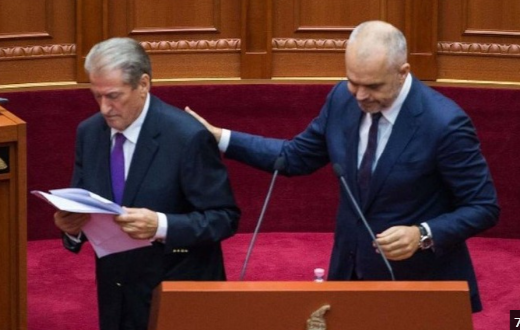
Today’s debate about Elisa Spiropali and Plarent Ndreca brings back a question that has accompanied Albanian politics for decades: how much room is there to oppose the leader without losing one’s place in the party? The comparison between Sali Berisha and Edi Rama should be made precisely here: in how they treat people who call their authority into question.
In the history of the PD, Berisha created an early and harsh precedent. The 1992 clash with the motion supporters ended with the exclusion of figures such as Gramoz Pashko, Arben Imami, Preç Zogaj, Arben Demeti, Ridvan Peshkëpia and others. They were people who had contributed to the party’s founding and intellectual profile. Their opposition did not produce coexistence between currents; instead, Berisha excluded and harassed them. The facts remain public that they were persecuted and attacked by the power of the time.
The political consequence of that decision went beyond the names that were removed. It entrenched the conviction that opposing the leader could end with losing one’s political affiliation. The party that was born seeking pluralism for Albania found it difficult to accept pluralism within itself.

The case of Ervin Salianji brings the same problem back in another form. In May 2026, the PD Presidency approved the decision that left Berisha as the sole candidate for the party leadership. Salianji was excluded from the race on the grounds that he was no longer considered a member, citing claims of statutory and Code of Ethics violations. These were the arguments of the PD structures; the political consequence was the removal of a declared rival from the competition for leader. But this time the PD and Berisha used “self-exclusion” while Salianji declared that he had not left his membership in the PD. But they cast him out of the PD.
Here lies one of the strongest indicators of party authoritarianism: when the opponent loses the right to compete before the membership has a chance to choose between him and the leader. A race with one candidate may confirm the leader’s control, but it does not prove his ability to win an open contest.
Today’s case with Edi Rama, however, shows a significant difference. The PS Assembly did not put the exclusion of Spiropali and Ndreca to a vote, while Blendi Klosi confirmed that Spiropali remains a member. According to Klosi’s subsequent clarification, they cannot be part of the party’s fora but retain their membership. This is a punitive political measure, but it is not expulsion from the party.
Rama deserves credit because the clash did not end with exclusion from membership. But this result alone is not enough to present the PS as a model of internal democracy. If a member can stay in the party but is excluded from any opportunity for representation in its fora, his room to influence remains limited. Tolerating membership is a threshold; accepting competition and dissenting opinion is the harder test.
Today Fatmir Xhafaj and several others opposed the punitive measure, and the outcome was more limited than the initially reported request; this shows that debate can influence the result. There is no reason to deny this difference, nor to elevate one episode into a general certificate of democracy.
In relation to the exclusion of opponents and the closing of the race for leadership, Berisha’s record provides stronger arguments for an authoritarian model of party leadership. From the motion supporters to Salianji, the recurring problem of coexistence with people seeking a different direction emerges. While Edi Rama, in today’s case, stopped short of expulsion from the party, although the political punishment remained.