







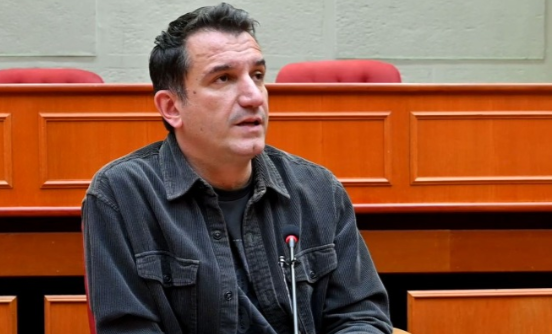
By Erion Veliaj
THE SOCIALIST PARTY IS BIGGER THAN ITS CHAIRMAN!
Today, from the cell where they have locked up only my body, I addressed the National Assembly of the Socialist Party with a speech about what we were, what we have become and what we must do.
Quo Vadis, PS?
Why have we replaced debate with silence, solidarity with fear and meritocracy with personal loyalty?
In my speech I call for open debate, accountability for the way the party is led and activation of the statutory procedure of a motion of no confidence against the chairman of the Socialist Party, Edi Rama.
“The true test of a leader is not how long he manages to hold on to power, but what institutions he leaves behind, for the state and its people.”
The speech Erion Veliaj had prepared:
THE SOCIALIST PARTY IS BIGGER THAN ITS CHAIRMAN
Dear comrades,
Honored members of the National Assembly,
Today I address you in circumstances I would never have imagined in my political journey. For 21 months I have been deprived of liberty. I am physically far from my family, far from my office, far from the streets of
Tirana, far from the citizens who entrusted me with the leadership of the capital and far from the socialists with whom I have shared for years the work, efforts, victories and difficulties. But I am not far from my responsibilities. I am not far from my convictions and I am not far from the Socialist Party. Today I do not want to speak to you only about what has happened to me, but also about what I believe is happening to the Socialist Party and our country. Because these 21 months have given me time to think not only about my personal fate, but also about the responsibilities we have had and continue to have towards the citizens.
1. MY JOURNEY WITH THE SOCIALISTS
I came to the Socialist Party as a man of protest, of the citizen’s voice and of the belief that Albania could be modernized and Europeanized. I began cooperation with Edi Rama at a time when doors were being closed to him within the Socialist Party itself. Not even the Lezha Assembly allowed him to enter the Palace of Culture, with the direct contribution of those who again today open and close the doors of the chairman. It was the time when we were united by the conviction that politics could change people’s lives, that a progressive party had to create opportunities for those who had not had them and that young people could take on responsibilities without needing well-known surnames, privileged connections or support from powerful people. In this party I have learned that trust is not won through appointments or personal authority, but by working, listening, standing by people and taking responsibility for what one promises.

I have had the honor of co-leading a campaign in the Gjirokastra Region and after doing the groundwork from 2009 to 2013, without a deputy’s mandate, but at the front of every opposition battle, I won in six campaigns in Tirana. I have received the trust of citizens for three terms at the head of the largest Albanian municipality. Throughout this journey I have worked with thousands of socialists who have never asked anything for themselves, except the opportunity to contribute.
I am deeply indebted to them. I bow in gratitude to the socialists who knocked on doors, who defended our ideas in neighborhoods and communities, and who sacrificed their time without seeking reward. I am indebted to the young people who believed that the PS was the place where talent and work could open paths. I am indebted to my collaborators at Tirana Municipality, with whom we have worked to turn the capital into a European metropolis, and I am indebted to the citizens of Tirana, including those who did not vote for me, because I have become a better mayor thanks to them too.
1. OUR ACHIEVEMENTS AND RESPONSIBILITIES
Dear friends,
We have many reasons to speak about the achievements of our governance. Today’s Albania is not the Albania we took on to govern. Roads, schools, hospitals, infrastructure and services have been built. The economy has changed. Our cities have changed. Albania has taken important steps toward Europe. Tirana has been, year after year, the European Capital of Youth, Sport and Culture. The socialist government, its prime minister, the mayors, MPs, the administration and thousands of people who worked with dedication have contributed to this transformation. I do not intend to deny any of these achievements. But today we must have the political courage to ask ourselves another question: Are achievements still enough to justify the way our power is being exercised today? We have built a lot. But have we built as justly? We have modernized the administration. But have we made it more honest and more accountable? We have developed the economy. But have we created equal opportunities? We have won many elections. But have we been “fair”, and have they made us more trustworthy? These questions do not devalue our achievements. On the contrary, they are the questions a responsible political force must ask, precisely because it has governed for a long time and has had the opportunity to change the country.
III. QUO VADIS, PS?
When I joined the Socialist Party 17 years ago, we were the party of hope. Today we have become a party of concealment, fear and intimidation. Back then we raised our voice about everything. Today we are silent about many things. We demanded justice for Gërdec and 21 January. Today we coexist with injustice. There was enthusiasm and optimism in assemblies and congresses. Today silence and fear prevail, as in “Squid Game”: who will be “eaten” next? Once our challenge was how to include all the people who approached us. Today we have the problem of those who move away from us. We made alliances with teachers, doctors and professionals. Today we make alliances with the powerful of the cities.
Quo Vadis, PS?
We were a party of solidarity with one another. Today we have knives in our backs. We invested in facts and the truth. Today in rumors and intrigues. We spent energy finding friends. Today we spend energy uncovering enemies. We competed over who opened more schools, not who opened more bars. We were a team. Today one or two individuals decide. We were all of the Socialist Party. Today we are divided into his people or her people. We stayed among people, in streets, cafes and markets. Today we avoid them, because we cannot face their dissatisfaction.
We had the European Capital of Youth, Sport and Culture. Today we face images of violence, tear gas and fire. We were outraged by injustice. Today we settle for injustice not falling on us.
Once we had fewer mandates but great support. Today we have more mandates but less support. We planted trees and built together. Today we cut each other’s branches and sow division. We called for unity. Today we seek internal enemies.
We had the motto “One for all, all for one”. Today “Every man for himself, God for all”. Where are we going? We were left-wing reformers, determined to leave the Party of Labour. Today we bring back anonymous denunciations and leaflets. We were hunters of ideas, not of each other. Once we could hardly wait for TV debates to defend our ideas. Today we avoid confrontations so as not to answer for our decisions.
Once we awakened imagination. Today we frighten it. We saw Generation Z as the future of the state, not as the enemy of power. We were tolerant and cooperative. Today suspicious and vengeful. We used to mock conspiracy theories. Today we produce them and believe them ourselves. Once we lit dreams. Today we produce nightmares. We were the party of Dritëroi. Today of “Nesti Angoni”.
The great Gramoz has left us, Sali’s little Dashi has come to us. Quo Vadis, Socialist Party? Will we continue changing places on the “Titanic” heading toward the iceberg, or will we find
the courage to change direction and avoid it?
Dear comrades,
These are not simply memories of another time, nor nostalgia for the Socialist Party that has been. They are what we have lost during the exercise of power and about how our political organization functions today. The most worrying change is not only in the people who have left or in the debates that no longer take place. It is in how decisions are made and in the role left to the party’s institutions. Are our socialist organizations still places where discussion and decisions happen, or have they turned mainly into structures activated during campaigns? Are socialists who think differently heard? Are people with integrity and authority in their communities promoted, or is closeness to the leader enough?
These issues involve all of us. Me too. I do not want to speak from the position of a man who has done everything right. For years I led a large administration, made thousands of decisions and held responsibilities that affected the lives of hundreds of thousands of citizens. On this journey I have made mistakes. There are decisions I would consider differently today, people I may not have listened to enough, and situations where I could have shown more care and sensitivity. For my political and human responsibilities I am ready to account.
But the individual responsibility of each of us cannot be used to avoid scrutiny of Edi Rama’s responsibility for the political leadership of the Socialist Party. Long tenure in power creates a known risk for any political organization. At first, people come close because they believe in your ideas. Later, when you gain power, people also come close who seek opportunities, favors, influence and benefits, all kinds of “strongmen,” who are more willing to serve you. If the organization does not preserve control mechanisms, one day you may discover that the people who always say “yes” to you have become more numerous than those who have the courage to tell you the truth. This does not remain merely a matter of relations between people. It determines how the government is formed, how representatives are selected, and how institutions function.
Government and political responsibility
Let us start with how the government is formed. Who proposes the ministers? On what political and professional criteria are they selected? What representation do they have in the Socialist Party? What debate takes place in its bodies about the composition and political direction of the government? The answer we often hear is that the government is the responsibility of the Prime Minister. The Constitution recognizes the Prime Minister’s competence to propose the appointment and dismissal of ministers. This competence is clear and is not in dispute. But the constitutional competence to form the government does not exclude political responsibility toward the party that has received the mandate to govern. Constitutional competence and political responsibility are not the same thing. The Prime Minister exercises the competences recognized by the Constitution. The Socialist Party, for its part, has its bodies, rules and responsibility to discuss, guide and evaluate the political direction of governance. Therefore,
the question is not whether the Prime Minister should receive the party’s authorization for every appointment. The question
is whether the Assembly and the Presidency are actually exercising their political responsibility.
Do they discuss the direction of governance? Do they examine the criteria of political representation? Do
they demand accountability for decisions and results? Or are they mainly convened to be informed of decisions that
have already been made? If the leadership bodies do not genuinely participate in the formation of political will,
but are only informed of the leader’s decision-making, then they do not exercise
the function for which they exist.
Parliamentary Group and political representation
The same issue arises for the Parliamentary Group of the Socialist Party. Who selects the candidates
for MPs? On what political, professional and representational criteria? What weight do contribution
to the party, integrity, experience and the trust they enjoy in their communities have? What influence do
membership and socialist structures have in this process? Does the Parliamentary Group today represent the plurality
of political opinion within the Socialist Party, or do its composition and direction depend increasingly
on the will of one individual?
Is this the Parliamentary Group that truly represents the Socialist Party, its history, values,
the tradition of debate and the contribution of generations of socialists? Or has it turned into a
a group of people gathered to vote on decisions made elsewhere, without discussing, without
objecting and without exercising the political responsibility that stems from their mandate?
The Socialist Party has never been merely a vote machine. It has been a political community
of ideas, personalities and convictions. A parliamentary group that loses the ability to debate
risks losing the ability to represent as well. MPs are not employees appointed by
the party leader or the prime minister. They are representatives of the people, elected through a
constitutional and electoral process, with a representative mandate and responsibility to citizens.
Loyalty to the political program cannot require the surrender of freedom of thought and
independent judgment. Political discipline is necessary for the functioning of a parliamentary
majority. But it cannot turn into unconditional personal obedience. When an
MP does not dare to object, when dissent is treated as disobedience and when a public
stance regarding a colleague becomes grounds for pressure from the political leadership, then the actual
exercise of the representative mandate is called into question. An MP must exercise the mandate in accordance with the Constitution,
conscience and responsibility to citizens, not under fear that an independent stance could
cost them their political future.
When the Parliamentary Group loses the ability to discuss, scrutinize and seek
accountability, it is not only the party’s internal democracy that is weakened. The constitutional
function of Parliament as a representative institution and overseer of executive power is also weakened. The consequences of
this way of governing do not remain only within the party or Parliament. They also appear in
the relationship between central government and local government.
Local government and institutional autonomy
Developments in local government make this discussion even more important. In July 2025,
sweeping changes were announced in the leadership of the Vlora Municipality administration, including resignations of
directors and the opening of vacant positions. These resignations were requested by Prime Minister Edi Rama
and his political pressure caused some of the directors to leave, even though they enjoyed legal
protection in the performance of their duties.
The same behavior appeared in the Tirana Municipality. During my pre-trial detention, the daily running
of the municipality continued under extraordinary circumstances. I am now convinced that personnel
changes and the manner of administration were used, more than for the city, to weaken
my political influence and to remove collaborators with whom we had worked for years. The Prime Minister’s
intervention in municipal dismissals made the administration less functional and distanced it
from the vision of the mayor elected directly by vote, expanding political influence and
clientelist relations.
But the most serious interference with my mandate was not limited to changes in the administration. In September
2025, the Municipal Council, under direct pressure from Edi Rama, proposed my dismissal.
Then, the Council of Ministers, under his leadership, approved the decision to dismiss me from office.
I consider this an attempt to terminate my mandate for political purposes, through
unconstitutional use of state institutions. I challenged this decision in
the Constitutional Court. By decision no. 66, dated 3 November 2025, the Constitutional Court annulled
the Council of Ministers’ decision as incompatible with the Constitution.
This is a clear legal fact.
But it also requires examination of institutional and political responsibility: why was a
procedure undertaken that ended with the constitutional annulment of the dismissal of a mayor elected
directly? I have expressed the conviction, now also in Strasbourg, that behind the attempt to
remove me there existed an aim to neutralize me politically. I link this conviction to a series of
developments: the opposition protests in front of the municipality, anonymous reports, violations by the prosecution and
judicial decisions to continue pre-trial detention even after 21 months, their intertwining with
political actions that have attempted to remove me from exercising my functions and limit my
political relations, fueling the public perception of the political demise of an innocent person,
as our constitution presumes.
These political actions culminated immediately after my public statements and my refusal to
hand over the citizens’ mandate to a man who did not receive it by vote, with what I consider
my abduction from Durrës to Fier, without making available to me any written document. Then came
the meeting with the Minister of Justice, during which, as I have declared, threats were conveyed to me in the name of Edi
Rama to aggravate my criminal position and worsen the conditions of pre-trial detention,
if I did not resign from the office for which the citizens elected me. What makes this situation even
more serious is that, after these threats, they are being tested through concrete actions
where I am obstructed from receiving medical care: I am not allowed the necessary examination to
assess the condition of my broken leg and, consequently, nor the surgical intervention that may
prove necessary. This is not a complaint, but a political observation. If the conditions of
pre-trial detention and the right to health care are used to impose a political resignation,
then we are dealing with a political inquisition.
These are extremely serious allegations, which I have submitted for review and verification
to our Parliamentary Group, also requesting the establishment of a parliamentary investigative committee. I have not
asked the Socialist Party to replace the justice bodies. But it cannot avoid
political responsibility for examining actions that affect the mandate of one of its elected officials and
the way power is exercised in its name.
Dissent and political solidarity
Are we today more democratic and do we have more solidarity? Internal democracy and
solidarity are not merely moral values, but two fundamental sources of the strength of a political
organization. Democracy gives the party the ability to listen, debate and correct mistakes, while
solidarity creates the trust and cohesion needed to act together.
When dissent is treated as disobedience and criticism as a threat, the party loses the ability to reflect. An MP must be free to express his opinion. A member of the Presidency must have the courage to object. A member of the Assembly must have the authority to demand accountability. A socialist must be judged by his contribution and convictions, not by the degree of loyalty to the leader. Solidarity is not unconditional protection of individuals, but fidelity to principles and responsibility for one another. A party in which everyone is silent to protect themselves gradually loses the ability to protect the common interest.
A party without internal democracy loses the ability to correct itself; a party without solidarity loses the strength to remain united. When both are missing, power remains, but the political organization does not.
1. RESPONSIBILITY FOR THE STATE OF THE SOCIALIST PARTY
All the issues I have raised lead to a question that cannot be avoided: who bears responsibility for the way the Socialist Party is led today?
Political responsibility cannot be distributed in such a way that, in the end, no one remains responsible. Edi Rama is both prime minister and chairman of the Socialist Party. He has led its main political and organizational processes for many years. For this reason, the main political responsibility for the party’s model of leadership, for the functioning of its bodies and for accountability mechanisms belongs to him. This does not exclude anyone else’s responsibility. I too have my responsibility for the decisions I have made, for the mistakes I may have made and for the way I have exercised the functions entrusted to me. I do not seek an exemption from this standard. But my responsibility and that of other leaders cannot serve as a reason to avoid examining the responsibility of the party chairman.
He has the right to take credit for the achievements of his leadership. But this right is accompanied by the obligation to account also for the consequences of decisions, for the weakening of internal control and for the way political dissent has been treated. In this context, I consider my case the culmination of the degradation of political relations within the Socialist Party.
In my submissions before the European Court of Human Rights, I have raised the claim that after pre-trial detention and other developments that have removed me from the exercise of my functions, there is also a political aim to neutralize me. I am not asking the Assembly to take on the role of a judicial forum. But I am asking it to consider the institutional significance of a situation in which an elected leader, a member of the party’s highest bodies, raises such serious claims of political interference and of efforts to remove him from public life.
For me, a historical question also arises here. The Socialist Party was created in a period when Albania sought to break away from the practices of a system in which political opposition was treated as hostility and in which power was concentrated without democratic control. Have we returned to this political culture that is emergingagain in our relations with power and with each other?
The history of the Socialist Party is longer than the leadership of any chairperson. It cannot
be identified with the political interest of an individual, nor with anyone’s personal continuity in
power. Therefore, the debate on Edi Rama’s responsibility should not be limited to his relationship
with me, however heavy it may be. It should include the way the Presidency functions, the real role
of the Assembly, freedom of thought in the Parliamentary Group, the selection of leaders, the relationship
with the membership and respect for the autonomy of institutions.
Because the consequences of a leadership model do not remain only within the party. When meritocracy weakens,
the administration weakens. When decision-making is centralized, control weakens. When critical thought
is not heard, mistakes are not corrected. When institutions are perceived as dependent on
personal relationships, citizens’ trust in the state weakens. When the membership does not take part
genuinely in decision-making, the link between the party and society weakens.
For this reason, the pursuit of political responsibility should not be considered an attack on the party but
on the disease that has been injected into it. No leader can be exempt from accountability
because of his historical contribution. No past achievement extinguishes the obligation to
examine the problems of the present. No personal conflict should prevent a debate
necessary on how the Socialist Party functions.
Respecting the history of the Socialist Party does not require silence in the face of its problems. It requires
the ability to identify them, examine them and correct them through its
democratic institutions.
1. DO WE STILL HAVE A CHANCE TO CHANGE?
I believe that the Socialist Party has the potential to change. It has the people, the history, the experience
and the energy to rise again. But, in my judgment, this change cannot be achieved without
first changing the leadership model and the chairperson who built it.
Edi Rama has been an important reformer of the Socialist Party. But I believe that today he is
turned into the main obstacle to its reform. We cannot expect a system centered
on the will of one individual to be corrected only by the will of that same individual. We cannot seek
internal democracy from a model that has weakened it; meritocracy from a way of leading
that has favored personal loyalty; or independent institutions from a practice that has
centralized decision-making.
The most recent example is “Prania Besnike.” In the face of citizens’ dissatisfaction and the
urgent need for change, the response was again an initiative drafted by the chairperson, not by the forums of
the Socialist Party, without debate, without a vote and without real approval from its bodies. An instrument that
places on the Socialist Party the responsibility for solving a problem for which it is not
responsible, because it has not been heard. A problem that has been caused by state institutions
that do not respond to citizens. Because the leaders of these institutions have not been selected
through a political process that reflects the sensitivity, values and will of socialists, but
through clientelist appointments, outside the decision-making of the party’s forums and within a system
of relationships that serves the preservation of power.
So, the party is not consulted when decisions are made, but is called upon to bear responsibility when they fail. It does not
decide on the people who govern, but must come before citizens to defend the consequences of
their governance. This is the use of the Socialist Party’s fist and rose for interests
that have nothing in common either with the fist, as a symbol of our collective strength, or with the rose,
as a symbol of our socialist values.
My answer is no. Without a change of the chairman and of the model of leadership that he
represents, I do not believe there can be a true reform of the Socialist Party.
1. RESPONSIBILITY OF THE NATIONAL ASSEMBLY
Political responsibility cannot remain a discussion without conclusion and without institutional consequences.
For this reason, in my capacity as a member of the National Assembly and of the Presidency of the Socialist
Party, I request that this Assembly formally examine the political responsibility of the party
chairman, Edi Rama, for the manner of its leadership, the functioning of collective bodies and
respect for the principles of internal democracy.
I request that the necessary actions be taken to activate the statutory procedure of the motion
of no confidence against the chairman of the Socialist Party, in accordance with the Statute and the relevant rules
for its implementation. I request that the responsible bodies make known the procedure, deadlines and manner
of exercising this right, so that members of the Socialist Party have the opportunity to express themselves
according to the Statute.
Confidence in the party chairman cannot be considered unlimited only because he has
led important electoral victories. It is a relationship of political responsibility, which
must be subject to the democratic control mechanisms provided for by the Statute itself.
I do not ask that such a matter be resolved through expulsions, pressure or predetermined decisions.
I ask that it be examined through the regular statutory procedure, with open debate, with respect
for dissenting opinion and with equal opportunities for all members who have the right to take
part. Decision-making on confidence in the chairman must be the result of a democratic process, not
of the personal authority to which accountability is demanded. The Socialist Party has institutions, rules and
membership. It is precisely these that should be trusted with resolving issues related to its leadership.
Dear colleagues,
I have had 21 months to think about politics, power, friendship, loyalty and
responsibility. I have thought about everything we have built together. About the victories, about the mistakes and about
the people who have trusted us. I have also thought about a truth that power often makes it
difficult for us to accept: no one is irreplaceable.
Not me. Not Edi Rama. No one. We are temporary in the duties we hold. But institutions,
values and responsibility to citizens must remain.
I request that no one give up the right to think, to speak and to judge
independently. I remain responsible for my decisions and will demand that every leader
face the same standard of responsibility.
A democratic party is not the property of its chairman today. Nor is it the property of those who aspire
to lead it tomorrow. It belongs to the people who have built it, who have trusted it and who have the right
to demand accountability from it.
The history of the Socialist Party is longer than the mandate of any chairman. Its future cannot
be based on anyone’s inviolability.
If we want Albania’s institutions to be stronger than the people who lead them, we must
start by applying the same principle within our party.
The true test of a leader is not how long he manages to hold on to power, but what
institutions he leaves behind, for the state and its people.
Erion VELIAJ
IEVP FIER, 13/11/2026