







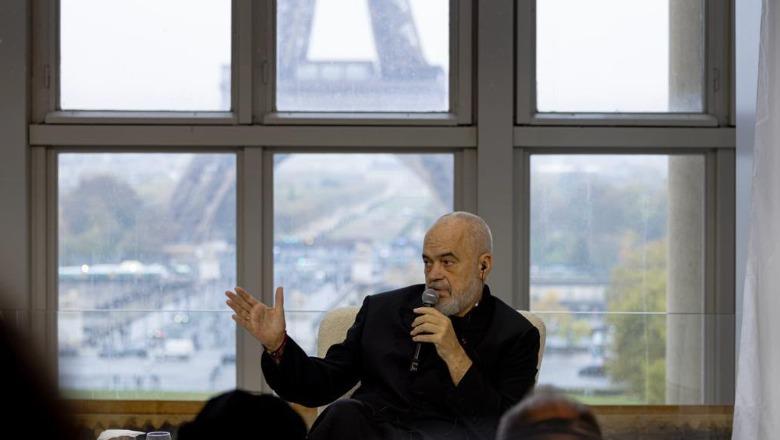
Prime Minister Edi Rama spoke about the protests in Albania, the European integration process, youth emigration and the challenges facing the European Union during a discussion at the Paris Peace Forum. He said Albania aims to conclude EU accession negotiations by the end of next year, if the process proceeds according to projections.
Rama also addressed the youth protests, describing them as a complex phenomenon influenced by social concerns, social networks and political developments. On emigration, the prime minister said the rise in departures should not necessarily be seen as an upward trend, but as part of a process in which economic development is accompanied by rising citizen expectations.
Another important topic was artificial intelligence. Rama said Albania is using it to speed up the alignment of legislation with the EU and to transform the public procurement system. Finally, he stressed that the greatest challenge is not only Albania’s membership, but also Europe’s own ability to confront political polarization and the influence of social media.

Full
First, Mr. Prime Minister, in Albania, as in other European countries, young people are demonstrating in the streets. What do these protests have in common with what is happening, for example, in Italy and France, and what is unique about those that began a bit earlier and with a specific motivation, so please, the floor is yours.
Prime Minister Edi Rama: Thank you. Thank you very much for inviting me here. It is a pleasure to return to this Peace Forum every year. It is also a pleasure to speak with you, knowing that you represent a research institute that is one of the most renowned sources of knowledge and inspiration for the European project. To answer your question, I would say that in our case the protests have their own specificities. At the same time, I would make a distinction between what happened at the beginning, namely the massive demonstrations in early June, where a very large number of people from all walks of life gathered and expressed concerns, which arose as a consequence of the well-known or infamous project, call it what you like, linked to Jared Kushner, the son-in-law of Donald Trump, which acted as a kind of red cloth or flag that fueled this anger, if I may say so, in quotation marks, in our city. From this, a very small number of protesters remained, who later escalated into violence, which is certainly unacceptable and has nothing to do with what the protest was at the very beginning. It is a complex situation across all of Europe, which I would in fact define as a clash between the real world and the world of social media, from which many young people get their information, or even disinformation, or both, and likewise their inspiration to escalate in ways that are unacceptable in a democratic society. Thank you very much!
-As I said, the accession process is considered one of the most advanced in the Balkans. However, there are chapters related to democracy and human rights. Do these protests show weaknesses in these areas, and could they hinder progress in this direction?
Prime Minister Edi Rama: Listen, I think that wherever and whenever there is a protest, there are reasons that must be reflected upon, and reasons that must be considered in an effort to find out what lies in the background. The background of this protest is very complex, as I said, and very diverse. There is a whole range of things, like a pot where everything boils, from general concern about the environment, to anti-Semitic hatred nourished or ignited by the enemies of our country, specifically the Khomeinist Republic of Iran, as well as major and minor opposition parties. Finally, not hiding much behind children or radicalized young people with these illusions of Antifa, and further on, people who have their own concerns, legitimate concerns about the cost of living, to people who have been brought in and paid by organized crime. So it is very complex. It is a whole very complex matter that in the end should not be treated in one way, but should be treated in several ways with different rules. On one hand, to listen, to try to create dialogue, to reflect on various things that we do all the time and that are also reflected in the new budget, with many measures that will help ease the pressure of the cost of living a little; on the other hand, the rules of the rule of law, the work of the police, the prosecution and the courts against persons who have committed violations. So it is very complex.
-I see it because I see how complex it is in France too, although the context is different as you also mentioned. The accession process generally takes several years, according to your view, do young people still believe in accession, or are they being discouraged?
Prime Minister Edi Rama: Listen, Albanians are very special about this, about everything, because unlike other countries in the Western Balkans we have a different history. We were never part of the former Yugoslavia. We were not part of the former Eastern bloc like the others. We broke with the Eastern bloc as early as the 1960s. Then we entered a very special and unique relationship with Mao’s China, and we were all along North Korea of Europe, and then when we came out of this hell, we came out completely transformed into Western Taliban in a sense, that is, into fanatics of the West, for good reasons, because we have the highest rate of euro-optimism in Europe, and we remain so because for Albanians and for us in Albania, the European Union is what it was for the founding fathers: not a cash machine, but a space of freedom, security, peace and cooperation. So there is absolutely no doubt that despite internal conflicts, polarisation, political views, or protests, absolutely everyone agrees that Europe is our common goal and destination. There is no doubt about this. We have no other alternative and we do not seek one. We are not influenced by anyone other than the European project. So we are truly the best Europeans you can find in Europe today. Thank you.
-Well, that is at least a very beautiful ambition.
Prime Minister Edi Rama: It is not an ambition, it is a fact. It is a fact.
-Alright. You certainly know this better than I do. There is a growing trend among young people to emigrate. Will it be stopped?
Prime Minister Edi Rama: I don’t think it is, and I would not say it is a growing trend. I would say it is part of this journey. It goes in parallel with it. The country is developing, wages are rising, the economy is growing, tourism is growing, exports are growing, but at the same time, people’s ambitions and expectations are rising as well. So what we are facing is what Tocqueville would call the evolution of higher expectations, because we are no longer the country of 10 years ago. We are a completely different country, and you can see this from the news in the French press. Ten years ago we would appear in the French press very rarely, for very negative reasons, whereas today we are very often present in the French press for very good reasons, such as beaches, hospitality, wonderful mountains, or as a wonderful place to visit. It is a different country.
-What can you promise young people regarding the timeline for accession, and what do you ask of Europe?
Prime Minister Edi Rama: You know it better because you have been dealing with Europe for a long time, and as you were just telling me, you have accompanied the European legend Jacques Delors, and in recent days, so you know much better than anyone that no one can promise anything regarding Europe because it is not known. Moreover, I cannot promise things that do not depend on me, but what is very clear, also based on the latest progress report of the European Commission, is that the Commission has stated that next year will be the year when we must begin working on the accession treaty, which means we are in the very final phase of negotiations, and if everything goes well, we will close the negotiations at the end of next year and will be ready to take the last step. But of course this will also depend on what the European Union will look like in two or three years, where will France be? You have elections next year, as far as I understand. No one knows what kind of France will emerge from these elections. So you know, that is how it is. However, what we do know is that we must do our work and must complete the work we are doing.
-So, returning to the completion of the work, is the chapter on democracy a clear one? What do you think has been achieved in this regard?
Prime Minister Edi Rama: Democracy is a chapter that never ends. By its very definition it is never perfect, and it must always be taken care of and perfected. So we have a lot of work to do in this regard. But I do not think France, for example, has finished this work, and France must also do things in this regard. Every country must do things in this regard. It is work that never ends.
-Now we have time for questions. Please do not hesitate. Thank you very much, Mr. Prime Minister. I have a question about Artificial Intelligence. The country is getting closer to EU membership, but I want to talk about artificial intelligence because everyone is talking about it here inside and outside this forum. What do you think: can the regulation of artificial intelligence affect EU accession, because it can affect technology and the negotiations?
Prime Minister Edi Rama: Listen, so far we have divided the work. It is not Albania that regulates; the European Union makes the rules and regulations. So it is not our job to deal with these regulations. Our job is to develop as much as we can in the area of artificial intelligence. As you may know, we have the first minister of artificial intelligence and we are very pleased with her. It is improving day by day. We transformed the old process of transposing the acquis, that is, European legislation, through artificial intelligence. A volume of work that took many years for others before us. Croatia was an excellent example; it still took them seven years to complete this transposition, mobilizing an entire army of translators, drafters and lawyers.
Yes, we are doing it now, finally, very quickly. We are also working on something that I hope will be very successful: a public procurement process fully carried out with artificial intelligence. It will be a complete game-changer not only for us, but for everyone else, because it will help with many of the problems related to public procurement. So artificial intelligence is a blessing for countries like ours. Just as new technologies are a blessing for countries like ours, which come from far behind, and with which artificial intelligence and such technologies help us do things we otherwise could not do. We have 95% of our public services online, and we have already created what is the digital mirror that will serve all citizens and transforms the relationship between citizens and institutions, just like someone using DHL. So everyone asks the state for something, for example, and it is exactly like a DHL package that you can track at every point to see whether it is being handled, whether someone is dealing with it, and so on. This of course also helps with the accountability of public officials.
For us it is a blessing; for Germany it was not, because as you can see Germany finds it difficult to adapt to this new digital era, since they had the most extraordinary bureaucratic “machine” that worked all the time, and now turning a large ship to take it somewhere else is much harder than for us with our “motorboat”, which can turn around much faster.
-You mentioned earlier that Albania aspires to become part of the European project. However, one of your Albanian professors, Lea Ypi, says “freedom is how we define freedom.” What is freedom? So how do you define freedom at this point within the framework of the European project?
Prime Minister Edi Rama: How do I define freedom? I did not understand the question, but I will try to answer you. I define freedom as the possibility to come here and to speak with you about something that when I was your age, I don’t know how old you are. Precisely, precisely at your age of 26, I had to fight to be able to cross Albania’s border to see the world. That is how I define freedom. To be where I want, to speak with whom I want, to say what I think as much as I can, even though in the position I hold I cannot say everything I want.
-First, I would like to thank you, Prime Minister, because I visited your country a few months ago, and I want to tell you that Albanians are very hospitable, and I agree with you that you are among the best places to offer, meaning the offers. When I last visited, I went to the Bektashi centre; I want to talk about the Bektashi part of the state in Tirana. Do you think this is something Albania will continue to do even after joining the EU?
Prime Minister Edi Rama: Yes, we are working on this, and let’s see where we will arrive.
-In the context of this year’s Paris Peace Forum, how can Albania contribute to fostering cooperation in the Western Balkans to turn it into lasting peace, especially considering the tensions between Serbia and Kosovo?
Prime Minister Edi Rama: On this I can say with pride that Albania has always been a peace-loving country, and over the last 10 years we have tried to be very active in promoting peace and cooperation with everyone in the region. There are some things you can be as free as you want to wish for, but you cannot choose. And what is most difficult is that you cannot choose your relatives or your neighbors. You can choose neither your relatives nor your neighbors. It is a matter of fate. Neighbors are where they are. They will always be there. They are not going anywhere. So it is better to try to get along well with your neighbor, because otherwise you find trouble. My grandmother used to say, a happy neighbor makes a happy house; the opposite is very challenging. We have tried to do everything we could, with a certain degree of success. But as regards the issue of Serbia and Kosovo, it remains a question mark, because even in relation to the EU and Serbia, things do not seem to be any better. Meanwhile, Kosovo is an independent state, a state recognized by many countries, though not yet by all, and there is no going back. There is no way to turn it into a new Serbian fantasy. So, as I have always said, the sooner Serbs understand that they must see it as a fact of life, the better it will be for them, because they will not be pursued by this phantom that keeps them from fully normalizing relations in the region. Thank you very much.
-I have a question regarding Albania’s EU membership. Over the past two months there have been discussions in the EU about Ukraine being an exception or benefiting from an accelerated accession. For a country like Albania, which has made official bureaucratic efforts to do the process properly, what do you think about this exception for Ukraine?
Prime Minister Edi Rama: Listen, first of all, this exception is a lie. Anyone who says it is lying, because it is not happening. Second, I believe that Ukraine should in fact be recognized for all its merits, because it is fighting not only for itself, but also for Europe and for the European way of life. Third, I believe that in the new enlargement package there is clarity regarding four countries considered to be frontrunners: Albania, Montenegro, Ukraine and Moldova. I believe the accession process is the best thing that can happen to countries like ours. We are not France, a state that has existed for a very long time and has had structures for a very long time. We come from a very dark past. We have a very small tradition, if not non-existent, of a state and of institutions that hold a country together.
Therefore the European Union is a blessing, because it gives us the instruments to build our institutions and our state.
I believe the process is long. Yes, it is long, but it is necessary. No one should skip or rush through their chance, because it is the same as getting a driver’s license without knowing how to operate the car, crashing yourself and harming others. So we have seen some such cases in Europe. I believe the only way things could be different is if the European Union finds the courage to reach its own ‘‘Helmut Kohl’’ moment, as I often say. When Helmut Kohl went to the fallen Wall, he did not tell his East German fellow citizens, ‘‘Now you are free, but there are 33 chapters you must pass.’’ No, he said, ‘‘You are free, we are now together,’’ and then the institutions began to connect with one another. So, the European Union must sit these seven negotiating countries around the table, and they should be like Ursula’s children. Ursula has seven children. It is a coincidence. So she did not raise her children in the neighborhood. She raised them with her husband at home, around the table.
So, he did not tell them, ‘‘Go, try to grow up out there in the neighborhood and then come back.’’ Therefore, the merit-based process must continue as it is. Every country must continue to do its ‘‘homework,’’ but every country must sit around the table. If you want to get more from the table, you must give more in the merit-based process. But politically, this is the way to change the paradigm of processes that never end, and of self-inflicted ones, and so on. How long will it take? I don’t know, I’m not sure, but is it the right thing to do? Yes, I believe so. Yes.
-Thank you, Prime Minister, as we are now at the end of the session. It was a quite energetic session with many comments, which shows that Albania’s membership is of great interest to many people. So, your ultimate dream: Albania in the EU within 10 years. How do you envision it?
Prime Minister Edi Rama: Listen, I hope that first of all the European Union will succeed in saving itself from itself. Everything else will then be fine for us. Albania will be fine. But will Europe be fine? That is something the European Union must resolve, because the big challenge is not against Albania, but against the European Union itself in a changing world, and in which—but that is for another forum—Europe must confront the ‘‘devil’’ of social media. The more Europe ‘‘drags its feet’’ without addressing this issue, the less able it will be to pull itself together. Because what is happening is that European politics is losing ground, and the center is collapsing entirely. Things are increasingly moving to the extremes, and the center has become like a massive grave, and in this massive grave, Europe could slip away once and for all if it does not confront this “devil.”