







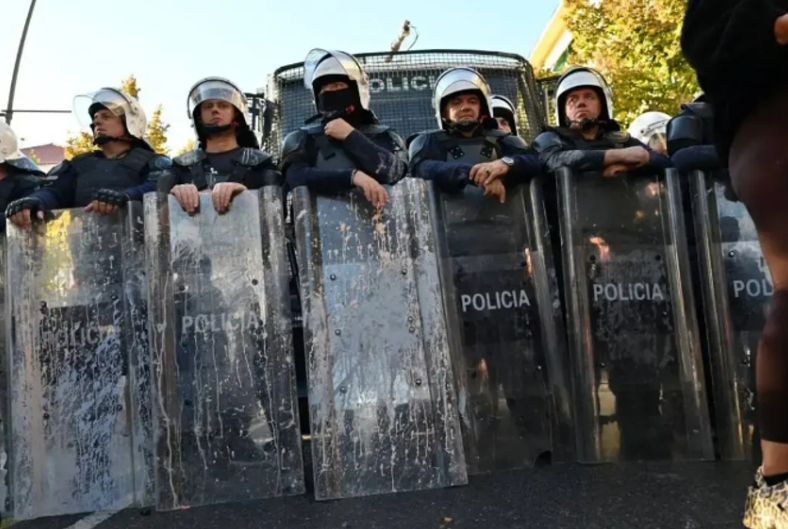
At least 12 journalists and media workers were physically attacked while reporting on protests in Albania between 13 and 19 October. Most of these incidents involved police officers. Reporters Without Borders (RSF) condemns the violence and calls for sanctions against those responsible, enforcement of existing measures to protect journalists’ safety, and a parliamentary review of the authorities’ response.
RSF has documented 28 reports of violence, intimidation and attempts to obstruct news reporting, which affected at least 23 media professionals in Albania between 13 and 19 October. At least 10 incidents involved the direct use of physical force against at least 12 journalists, including punching, kicking, pushing and being forced to leave the areas where they were reporting. Some journalists reported that their phones were seized or that attempts were made to seize them, and that their media equipment was damaged, as well as injuries from police crowd-control equipment.
In addition to threats they face while reporting in the field, journalists also face intimidation from the Prime Minister of Albania, a country that is applying to join the European Union (EU). For example, on 18 October, Prime Minister Edi Rama baselessly accused the owner of News24 of fabricating reports about the students’ rebellion in order to topple the government.

“Although the situation around the student protests is tense, journalists must be able to document police conduct without being beaten, forcibly removed, detained or otherwise obstructed from filming. If media professionals comply with lawful police instructions, police officers must guarantee their equally legitimate right to report. The authorities must implement existing guidelines on journalist safety and sanction any aggressive conduct by police officers and protesters. We also call on Prime Minister Edi Rama to stop intimidating the media over its coverage of the protests, which is his duty. We call on the Albanian parliament to review the violent conduct of the police, and on the EU to assess how the country’s commitments on media freedom, as a candidate country, are being implemented in practice,” said Pavol Szalai, head of the RSF office in Prague.
On 18 October alone, at least eight media workers reported being mistreated by police. According to the Albanian Journalists’ Association (AGSH), police forcibly stopped photojournalist Hameraldi Agolli, who collaborates with AP, while he was working, and News24 journalist Renaldo Salianji was physically struck by police.
Taulant Kopliku told SYRI TV that an officer had struck him on the shoulder and taken his phone, which was returned with his footage deleted.
Meanwhile, SYRI TV reported that two of its journalists were attacked by law enforcement in separate incidents: Marsi Korreshi was struck on the back with a helmet and pushed while reporting live on a fire at Police Station No. 3, and Elkier Bushkolaj was wounded in the leg by a police rubber bullet.
Journalist Juljan Hoxha and photojournalist Felix Bilani were, according to reports, hit in the legs by police officers, who pushed journalists with helmets to remove them from the prime minister’s office. AGSH also announced that Klan News reporter Glidona Daci was struck by stones in an incident attributed to police officers.
Reuters reported that two of its journalists were hit by rubber bullets while covering clashes in Tirana on October 17. Swiss independent photojournalist Raimond Lueppken reported that on the same day he was filming several men dressed in black in the coastal city of Durrës when two other men in civilian clothes approached him and asked him to delete the recording, which he refused to do. According to RSF’s information, the group he had filmed wore vests bearing police insignia. He suspected the two men were connected to that group, but their identity and their status as police employees were not confirmed.
One of the most brutal cases occurred at the start of the protests, on October 13. Izmir Akulli, editor-in-chief of the online media outlet Dosja.al, was taken to hospital after several police officers kicked and punched him near the Bank of Albania while he was filming their interaction with a student. According to his published account, the violence continued even after he identified himself as a journalist.
Attempts to obstruct news coverage continued on the evening of October 19, when police prevented News24 journalist Osman Stafa and other media workers from following and filming police detentions of individuals in the alleys near Rruga e Dibrës in Tirana, according to News24’s reporting.
Commitments to security must be implemented
According to a statement by the SafeJournalists Network, published on October 18, Albania’s Police Oversight Agency had begun reviewing suspected cases of misconduct and seven officers had been suspended from duty. It remains unclear whether these measures are linked to cases involving journalists.
In an open letter, co-signed by RSF on October 14, media freedom organizations and civil society called for full implementation of the Guide on the Safety of Journalists, adopted by the State Police in May 2025, for independent investigations into suspected cases of police violence and obstruction carried out by police oversight bodies, as well as for a dedicated parliamentary hearing on this issue. However, other incidents were reported after this call.
Albania ranks 83rd out of 180 countries and territories in RSF’s 2026 World Press Freedom Index.