







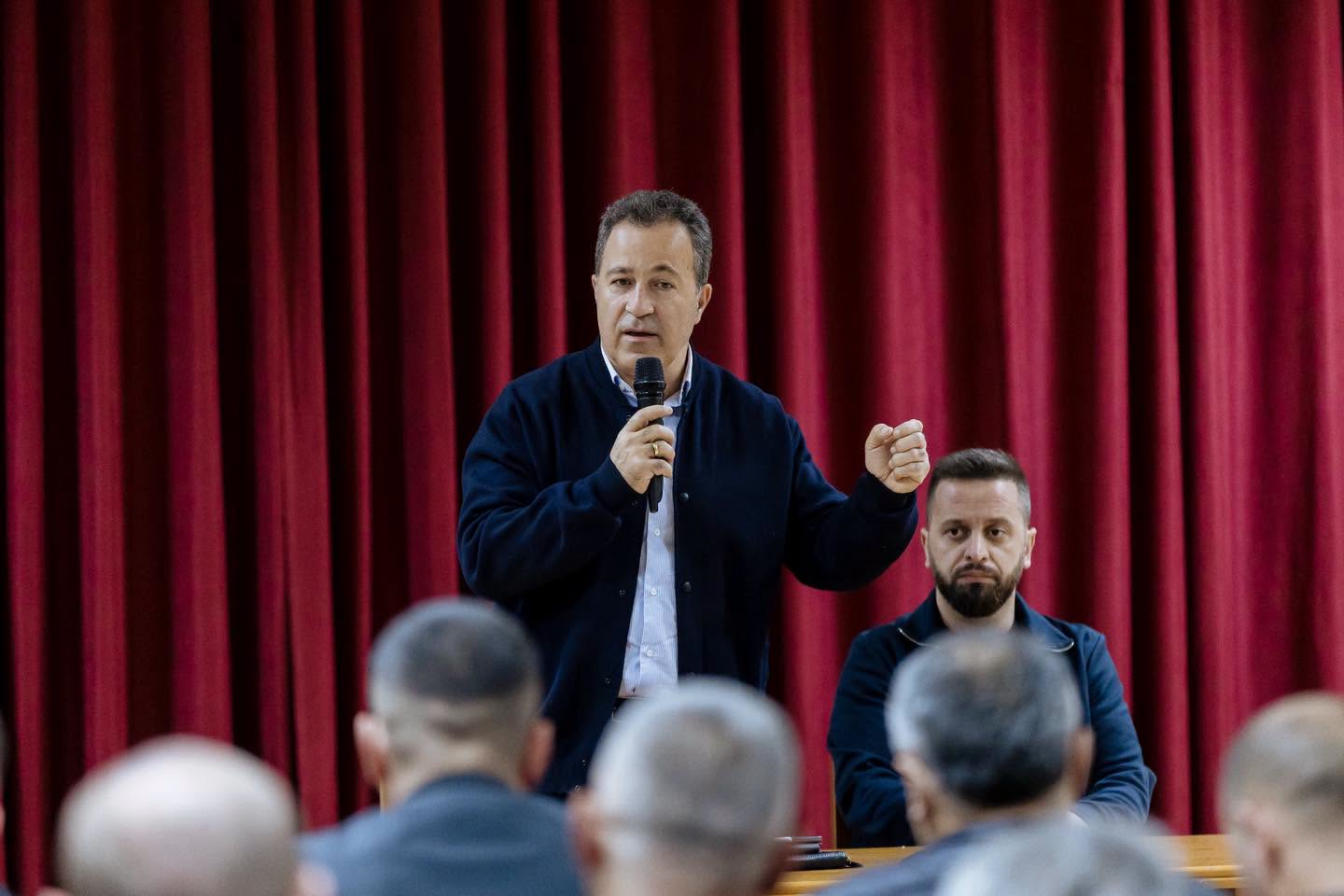
Speaker of Parliament Niko Peleshi accepts the European Commission’s criticisms in the progress report on Albania regarding political polarization, the lack of dialogue between the majority and the opposition, and weaknesses in parliamentary oversight of the government. From Korçë, he stated that Brussels’ criticisms should serve as working material, while he assessed the recommendation to start drafting Albania’s accession treaty to the European Union as a historic step.
Excerpt from the speech
It is true that polarization is a problem, I would say, for Albanian politics; it has always been like this. Perhaps at this stage we are in now, also because of other developments outside parliament, we must admit it: politics, the temperature of politics has risen. It is normal for the opposition in parliament to try to act in a more oppositional manner to be compatible also with the protest outside parliament. So, I am making a somewhat more, more daring comment, because in the position I hold, of course, we should not point fingers at one side or the other; polarization is two-way.
We are also in the pre-election period; you know that whenever elections approach, the sides move away from each other, political language becomes harsher. There is one thing on which the progress report is right and for which we should all blush. In the Albanian parliament and in all other parliaments, at least those I know, there are strong debates, and these are normal. But in the Albanian parliament, unlike many parliaments I have visited, politics becomes personal.

Names are mentioned, family names, of course directly those of MPs but also of their family members, their relatives. This must end, but it is not enough with an order from above or below, it is not enough to say it; it requires its own time of emancipation and maturity. The progress report is very right on this point, and for us it is also working material. Just as I cannot fail to say that beyond the criticisms, remarks, kind words and encouragement, there is a very positive sentence for all Albanians; it transcends the importance concerning a government or a mandate—the sentence recommending that the Commission begin writing the accession treaty. This is the final phase of Albania’s most historic project, which is European integration.
The coming year is the year when we technically close the chapters. So at the end of 2027, the homework, as we have always said, is completed for Albania. And all together we must go to the doors of all Europe’s parliaments for what is the political phase, which does not depend much on us but depends on the internal dynamics of states and parliaments. It is not easy because winds of extremes left and right are blowing across Europe, so a very difficult political period awaits us, but first we must do our homework, which is closing the chapters.
Of course there are many truths; everything the progress report notes is true, I would say. We should not read only the good things; we must also read the criticisms and turn them into, into working material. There is room to do better, of course. In this legislature, we have taken a big step forward with a new parliamentary committee that did not exist before, namely the Committee on Citizens’ Initiatives and Institutional Oversight, which addresses precisely this need to make parliament healthier in terms of exercising the parliamentary oversight function, which is one of its three main functions. There is room to do better.