







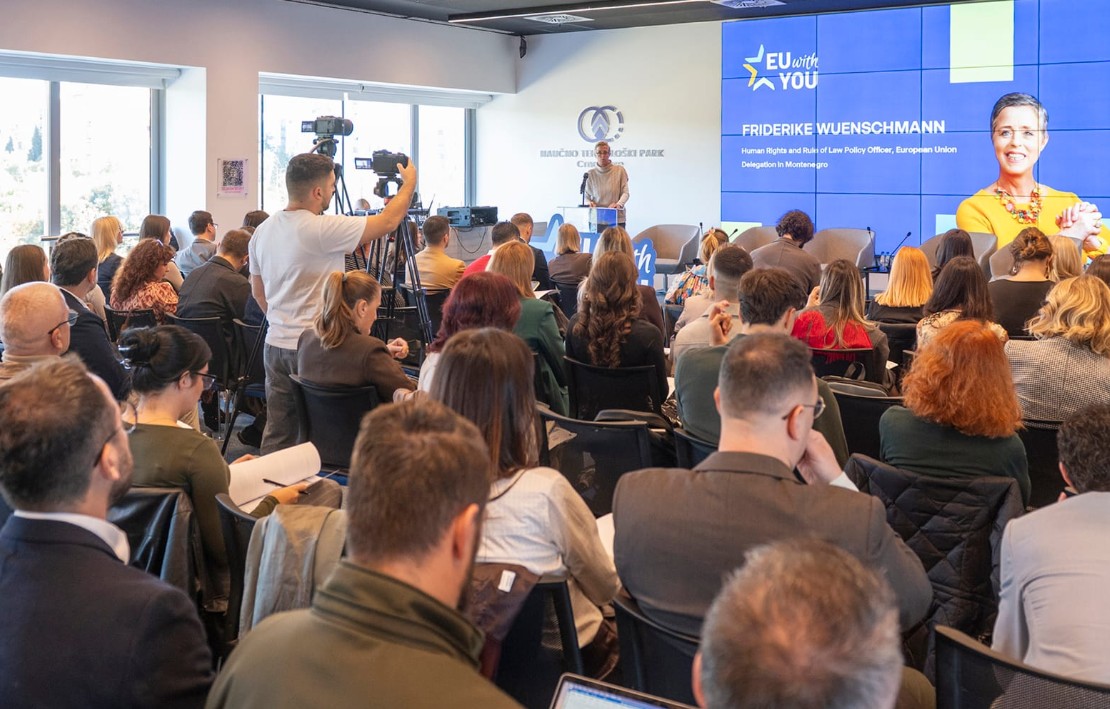
The second edition of the “EU With YOU Creative Hub”, organized by the regional WeBalkans communication project and the Delegation of the European Union to Montenegro, was held on 5 and 6 November at the Science and Technology Park in Podgorica. Over the two days, through personal stories and experiences from different countries in the region, the concrete impact of European Union support on citizens’ lives was presented.
The Creative Hub event in Podgorica gathered human rights defenders, journalists, digital content creators, artists, young activists and representatives of EU delegations from across the region. The aim was to present European values through people’s concrete stories and experiences.
Through this second edition, the EU With YOU campaign (BE me TY), part of the WeBalkans project of the Directorate-General for Enlargement and Eastern Neighbourhood, re-emphasized the importance of human stories and concrete examples in showing how the European Union’s values and support affect the lives of citizens in the Western Balkans.
At the opening of the event, Raluca Costache, WeBalkans programme lead, stressed the importance of presenting the EU’s core values through real stories that put people at the centre. According to her, the aim is not only to inform the public about projects funded by the European Union, but also to show how this support changes everyday life, creates new opportunities and empowers communities.

“The most powerful stories about European Union support arise where fundamental rights intersect with everyday life, showing what has changed, who has benefited and why this matters,” said Costache.
The European Union’s core values, which play an important role in the reform and European integration process, include human dignity, freedom, democracy, equality, the rule of law and respect for human rights.
Montenegrin writer and columnist Brano Mandić addressed these values from a particular perspective, focusing on the importance of freedom of expression.
“Freedom of expression is not something won once and for all. It is not just something written on paper. It changes constantly. At one point we thought history had ended, but that assessment proved premature. I think today we are again in the middle of history,” said Mandić.
The programme continued with panel discussions, where participants shared concrete experiences on human rights protection, social inclusion and the European Union’s contribution to advancing these values in the region.
Suad Skenderi, programme manager at the Romalitico organization from North Macedonia, spoke about the importance of including the Roma community in society. He stressed that the success of policies and projects should be measured through concrete improvements in citizens’ lives, and not only through the number of adopted policies or funded projects.
“In the end, we notice change when we see that our neighbour or our neighbourhood has changed, when the people we love and care for live better, have equal opportunities and are treated with dignity,” said Skenderi.
Anja Basha, from the Albanian Human Rights Group in Albania, emphasized that her organization has worked for years not only to represent citizens in the judicial system, but also to build bridges of communication between citizens and institutions.
“EU funding should be oriented more towards organizations that work directly with communities, better understanding how projects connect to the reality on the ground,” said Basha.
Speaking about financial support, Bulza Capriqi, from the Kosovo Civil Society Foundation (KCSF), emphasized that the perception that civil society organizations need only financial resources is wrong.
“They also need skills and capacities to use these resources meaningfully and with impact,” said Capriqi.
Branko Čečen, journalist and former director of the Center for Investigative Journalism in Serbia, spoke about new generations of journalists building their careers in the media, as well as young people in the region, who are increasingly organizing and expressing their political and social demands more openly.
“Through many years of work and thousands of projects, which the European Union not only financed but also helped develop through ideas, the EU has contributed to creating a generation of young people who have taken responsibility for shaping public debate, orienting it toward social justice and the inclusion of all,” said Čečen.
This stance was also supported by Slobodan Blagovčanin from Bosnia and Herzegovina, who emphasized that young people today have better skills to verify information.
“We should not underestimate their ability to critically assess what they see,” he said.
Speaking about EU support for civil society and the media, Blagovčanin added: “We must support young people who have the courage to speak openly and offer even greater support to journalists who dare to investigate and uncover abuses.”
Together with Ilir Gashi, journalist and media consultant, Čečen led the workshop on the topic “Media of the Future: An Intensive Course on Reinventing Communication.” During this workshop, participants were encouraged to think about new and creative approaches to communication, as well as new forms of media development.
The second day of Creative Hub was dedicated to the development of stories and media content by journalists, media professionals and digital content creators from the region. Also participating in this process were
Young European Ambassadors from Albania, Bosnia and Herzegovina, Montenegro, Kosovo, North Macedonia and Serbia.
The event in Podgorica followed the first edition of Creative Hub, held in Belgrade in April.
In the coming days, traditional and digital media across the region will publish stories, interviews and other materials produced during these two days, as part of the EU With YOU campaign. These contents aim to bring people’s stories closer to the public and show the concrete impact of European Union support on daily life and on the development of communities in the Western Balkans.