







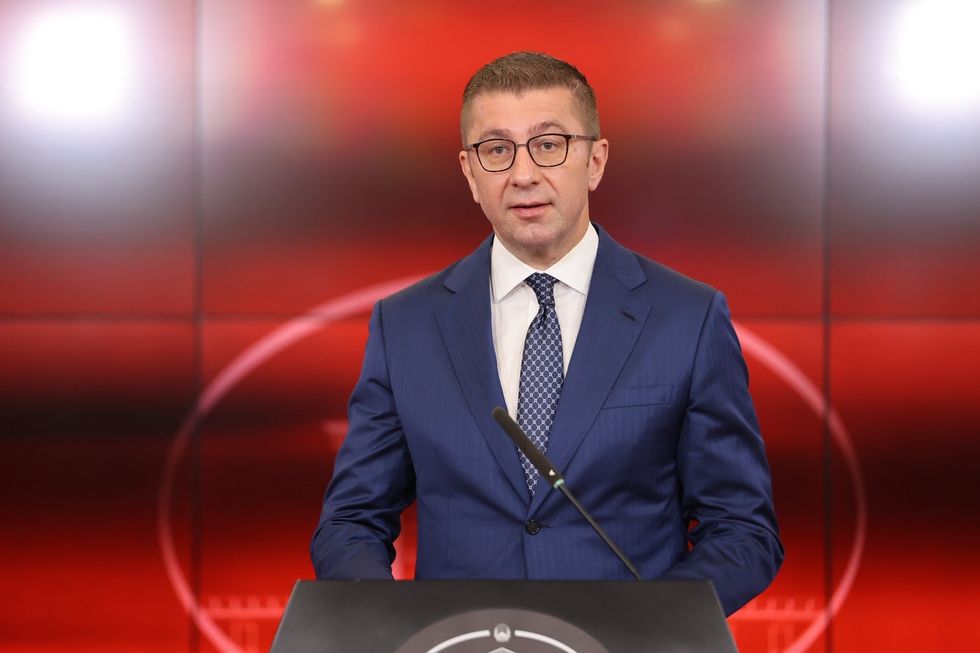
North Macedonia’s Prime Minister Hristijan Mickoski said today that the Government’s position on constitutional changes remains unchanged. This comes despite the assessment that the country has made considerable progress in the European Commission’s report. Asked by journalists, Mickoski said that EU Ambassador Michalis Rokas has also acknowledged this progress.
Thus, Mickoski linked the EU report’s progress to the unchanged position on constitutional changes. This is the essence of his stance today, according to him, on this report of the European Commission. He described it as considerable at the press conference held yesterday.
This is the essence of his stance today, according to him, on this report of the European Commission. The rule of law remains a key area in this context, he added. He linked it to the expected reforms and to the accession negotiations that the country aims to start.

Constitutional changes, according to him, remain a political condition. North Macedonia continues to face this requirement on its European path. Accession negotiations are at the center of this discussion.
They determine the pace of the process and expectations for future reports. In this context, the rule of law and the fight against corruption are among the areas that Mickoski mentioned as part of the reforms expected to be completed by the end of the year. These are not included in the reporting period of this report.
Thus, he presented the European Commission’s report as a moment that confirms progress, but not a change in the position on constitutional changes. They remain unchanged according to his government. This link between the EU report and accession negotiations was emphasized by Mickoski.
He reiterated that the stance on constitutional changes does not change, despite the progress assessed in the report. At this point, he linked the political condition for constitutional changes to the decisions of the previous government. He described it as a consequence of the political adventures and anti-state policy of the SDSM and the Democratic Union for Integration.
Thus, according to Mickoski, North Macedonia faces political conditions in addition to essential reforms. He mentioned this as an element specific to the country. He added that a dialogue is under way with the eastern neighbour and expressed hope that this dialogue will eventually yield results.
This would enable the start of the negotiation process, 21 years after the country received candidate status and 26 years after the signing of the Stabilisation and Association Agreement. Thus, for Mickoski, the EU report marks considerable progress, but the position on constitutional changes remains unchanged.
This remains the main point of his statement today. According to the prime minister, compared with last year’s report, the country has made considerable progress this year. He stressed that the reporting period does not include the reforms that have been carried out in the meantime and those expected to be completed by the end of the year.
This applies especially to the fight against corruption and the rule of law. Mickoski said he expects next year to bring an even stronger report. This report will confirm the efforts of this Government and its ambition to be essentially a reformist Government.
He reiterated that the Government’s position on constitutional changes is clear and unchanged. He attributed the political condition for these changes, as he put it, to the political adventures and anti-state policy of the previous LSDM and Democratic Union for Integration government.
According to Mickoski, North Macedonia is perhaps the only example of a country that, in addition to the essential reforms it must implement, also faces political conditions. He added that a dialogue is under way with the eastern neighbour and expressed hope that this dialogue will eventually yield results. This would enable the start of the negotiation process, 21 years after the country received candidate status and 26 years after the signing of the Stabilisation and Association Agreement.