







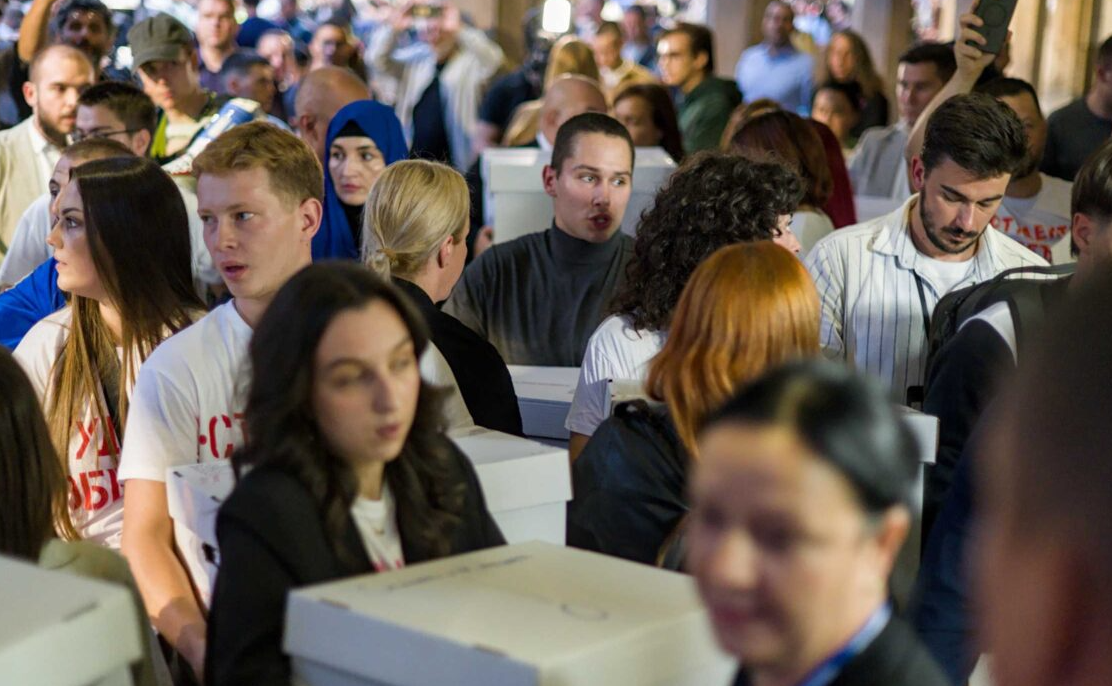
Serbia has closed a election day marked by long voter queues, attacks on student supporters and increased police presence in Belgrade. At 20:00, polling stations closed for the snap parliamentary elections, in which Aleksandar Vučić’s party faces the Student List, which emerged from protests against the government.
One hour before polling stations closed, turnout had surpassed the record registered since 2006, while turnout among Albanians in the Preševo Valley was significantly lower. Polling stations have closed across Serbia, but citizens who were in line at 20:00 are entitled to vote even after this time.
By 19:00, according to the organization CRTA, 67.8% of voters had cast their ballots. At the same hour in the 2023 elections, turnout had been 55.5%. CeSID also reported a similar figure, 67.6%. This means that even before voting ended, turnout had surpassed the 61.35% recorded in 2008, the highest in Serbian parliamentary elections since 2006.

Attacks with metal rods on student supporters
In Niš, supporters of the Student List riding motorcycles were attacked by people dressed in black. According to witnesses quoted by the newspaper Danas, some of the attackers were carrying metal rods. The attacks began during the day and injuries were reported. In the evening, one of the motorcyclists said that around 40 people had been taken to the police station for questioning about the incidents. A similar incident was reported in Hrtkovci. According to one of the victims, several people with sticks got out of two vehicles and struck the motorcyclists supporting the students. He said there were also seriously injured people, while police went to the scene.
In Leskovac, a conflict occurred inside a polling station. A member of the electoral commission broke the ballot box and struck a student representative, causing the process to be interrupted after 15:00. An attack on several young people near a polling station in Pančevo was also reported. In Vranje, two journalists, Mihajlo Stojković and Jelena Stojković, were physically attacked. One of them said the police had not intervened.
Numerous police forces and armored vehicles in Belgrade
While attacks were reported in other cities, gendarmerie armored vehicles and large numbers of police forces were seen in central Belgrade. Some of the vehicles were positioned near the Presidency, in the area of Pioneers’ Park. A police presence was also reported in front of the Old Palace. Shortly before voting closed, a group of men dressed in black moving toward the Parliament was filmed in Nikola Pašić Square. Incidents during the voting also prompted a reaction from the European Union. The head of the EU Delegation to Serbia, Andreas von Beckerath, expressed concern over reports of violence near several polling stations.
Suspicions of vote buying and obstruction of observers
Throughout the day there were also reports of irregularities. In Novi Sad, citizens claimed they had seen people carrying sacks and envelopes, while some said they had been threatened. Police detained two people. In Kostolac, footage was published that is suspected to show parallel voter registers being kept in a sports hall. CeSID announced that by 17:00 it had received 260 reports of possible irregularities. CRTA, meanwhile, said that by 16:00 it had recorded irregularities in 29% of the monitored polling stations, including pressure on voters, election commission members and observers.
Claims of vote buying also came from Kosovo. According to anonymous testimonies published by KosovaPress, some citizens were allegedly offered up to 100 euros to vote for Vučić’s Serbian Progressive Party. These claims have not been independently verified.
What happened with the vote of Albanians in the Preševo Valley?
For Albanians in Preševo, Bujanovac and Medveđa, these elections are of particular importance. Albanian parties entered the race united, through the “Albanian Coalition”, with number 17, aiming to secure greater representation in the Serbian Parliament. However, high turnout across Serbia could make it harder for them to secure a second mandate. The list leader, Shaip Kamberi, told RTK that Albanians are still competing for two deputies, but the higher the turnout nationwide, the more votes they will need.
“If it reaches 70%, as is being discussed, then more votes will certainly be required. With a result of 61–65%, we have a very real chance of holding the second seat,” he stated. Kamberi also said that the deactivation of Albanians’ addresses had made it impossible for them to claim a third mandate, as those affected by this process were also removed from the voter lists.
“This has put us in a situation where we will lose the third mandate we had claimed,” he said. By 19:00, according to Kamberi’s data, 16,600 citizens had voted at 37 polling stations in Preševo, while 10,853 had voted at the Albanian polling stations in Bujanovac.
Why are these elections different for Serbia?
The elections of 25 October are taking place after two years of protests against the government and corruption, which escalated after the collapse of the railway station canopy in Novi Sad in November 2024, where 16 people lost their lives. These protests also gave rise to the Student List, which is facing Aleksandar Vučić’s Serbian Progressive Party. Vučić, who resigned as president at the end of September, aims to return to the head of government as prime minister. Over 6.4 million citizens were eligible to vote, while 18 lists competed for the 250 seats in Parliament. After the polling stations close, attention shifts to the counting of votes and the result of the race between Vučić’s party and the Student List, as well as to the number of mandates that Albanians of the Preševo Valley will secure.
“”