







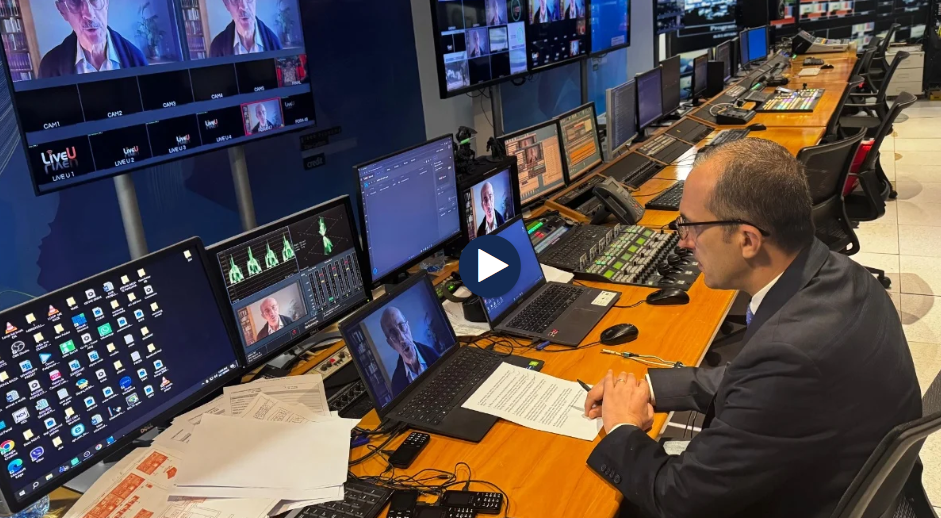
Gabriel Partos, former BBC analyst for Central and Southeastern Europe and later an analyst at The Economist Intelligence Unit, in an interview with Top Channel journalist Muhamed Veliu, answers several questions about the current situation in Albania as a result of the protests.
I do not believe, says Gabriel Partos, that foreign actors from other countries should be blamed for what has caused the protest.
Muhamed Veliu- Gabriel Partos, how do you assess the protests that have taken place across Albania, mainly in the capital Tirana, over the past five days?
Gabriel Partos- Clearly these protests are the greatest challenge to Edi Rama’s leadership in the 13 years he has been prime minister, both in the scale of these demonstrations and in the violence displayed, which is unprecedented in recent decades in Albania’s history. It is a continuation of a long resistance by a series of protests known as the “Flamingo Revolution”, which has been ongoing for several months. The current protests are very serious for Mr. Rama’s leadership.
Muhamed Veliu- In your view, what are the main factors fueling this wave of discontent and unrest?
Gabriel Partos- This is an interesting question because on the one hand there have been many positive developments in recent years, or even decades, such as the improvement of living standards, as well as efforts toward full EU membership within the next few years. That said, there is certainly a lot of dissatisfaction, not only with corruption, which is an issue that persists, but also in this specific case with students, who face a high cost of education. Especially the lack of a future for them once they graduate.
This is also why thousands are leaving, causing what is known as the brain drain of the best and brightest, who go to find work and continue their studies across Europe or the world. So it is a combination of specific concerns, ranging from the cost of education and the cost of living to the lack of prospects, as well as the issue of corruption, a chronic disease of Albanian society, despite the work of the justice system that has been trying to fight it over the years.

Muhamed Veliu- Prime Minister Edi Rama has blamed what he describes as “foreign hands” for the current unrest. Do you think foreign actors or external factors are playing a role in the protests which, according to him, aim to destabilize Albania?
Gabriel Partos- There is no simple answer to this. I do not believe that foreign actors from other countries should be blamed for what has caused it. But, as we have seen here in the United Kingdom in recent days regarding the 2016 Brexit referendum, which was influenced by Russia, the general view is that Russia tried to interfere, but it was not in general a decisive factor. Again, when we talk about Albania today, there may be specific Russian interference. There may also be accusations against Serbia. In general, whether or not there is foreign interference, you cannot blame these serious protests on foreign forces.
Muhamed Veliu- Which foreign actors, if any, have an interest in influencing the current political situation in Albania, and what might their objectives be?
Gabriel Partos- I think the most serious potential foreign actor that interferes or tries to do so is Russia, which has tried to weaken the European Union and the Euro-Atlantic Alliance, including its European members. Since Albania and Montenegro are in line for membership, trying to weaken and hinder EU enlargement is a Russian objective. This is the most likely scenario when we talk about interference or attempts at interference. Accusations against Serbia over jealousy of Albania’s success in European integration, I think, are few, since Serbia has many internal problems of its own. Naturally, Iran, given the poor relations and frequent cyberattacks, may in some way be involved.
Muhamed Veliu- Protesters are demanding the resignation of Prime Minister Edi Rama, while he has made it clear that he has no intention of leaving office. How do you assess his decision to remain in power?
Gabriel Partos- Prime Minister Rama has said he was elected democratically, and last year was his fourth re-election. That said, Mr Rama has become a victim of his own personal success. As with many politicians around the world, if you are repeatedly re-elected to govern and remain in office by being successful, the chances are that you will face more dissatisfaction and the problems of society. This becomes even more serious when high-level colleagues have left and now face serious corruption charges. This makes Mr Rama’s position more difficult, because he is the person whom a large part of Albanian society blames for the problems they face. On the other hand, they do not give him credit for what belongs to him for the successes of his leadership. I think his position is now under tension, and he is clearly trying to send the message that avoiding violence is now the priority. On the other hand, he needs to engage more fundamentally, or in a more serious way, in listening to complaints and dissatisfaction, unlike the tendency he has shown in recent months not to take the complaints and concerns arising from the Flamingo Revolution protest as seriously as they deserve.
Muhamed Veliu- Opposition leader Sali Berisha has supported the protests, but he has not distanced himself from the Democratic Party regarding the acts of violence that occurred during the protests. How much influence does the opposition’s stance have on escalating or reducing tensions in the current situation?
Gabriel Partos- Many protesters have expressed equal dissatisfaction with the governing party and the largest opposition party. They have made it clear that they do not want to be associated with the Democratic Party. This is seen as a protest against the entire political class that has governed the country since the end of one-party rule. For the moment, the opposition does not play an important role in supporting the protest or in adopting a negotiating approach with the government on how this broad issue in Albanian society should be resolved. Of course, the opposition is caught up in internal issues and disagreements, and as a result Mr Rama has been able to remain in power successfully during these 13 years.
For the moment, the opposition is not convincing in presenting a new alternative, or in creating a united front with a broad part of society opposed to the government, or in calling for a solution through a technocratic government. The opposition is currently not in a position to provide any kind of leadership, and as a result the protest remains without a leader. This makes it weak and potentially easier for Rama to ride out the storm, as he has done over the past four months, but now he is facing more challenges.
Muhamed Veliu- Albania, as a NATO member state, has enjoyed relatively stable security compared with some other countries in the Western Balkans. Could the current protests turn into a longer period of political instability, and what would be the main risks?
Gabriel Partos- I agree with Prime Minister Rama, who has said that there could be complications across the Western Balkans. I would like to take this a little further by mentioning the violent protest in France of students and school pupils for a number of reasons. Across the whole Western world we are seeing a wave of dissatisfaction, including in the Western Balkans, where conditions are far from those of the Western world. I think we will see more polarisation and more nationalism, and that is why it is dangerous. For Albania in particular, which has had a stable society despite economic problems, violent protests like these could cause problems across the entire region.
Muhamed Veliu- Prime Minister Edi Rama has set an ambitious objective of Albania’s accession to the European Union by 2030. Could the current unrest affect Albania’s European integration process?
Gabriel Partos- Absolutely. The EU delegation made it clear that law and order must be enforced proportionately, so as not to use more force than is required, but of course this is difficult when protesters engage in acts of violence. Yes, Albania needs to present a consensual society in which the government must continue with reforms, many of which need to be consolidated, especially those relating to the rule of law, without forgetting the fight against corruption. There is a risk that Albania’s path to the EU could be obstructed or delayed, and this is certainly against the interest of the majority of Albanians.