







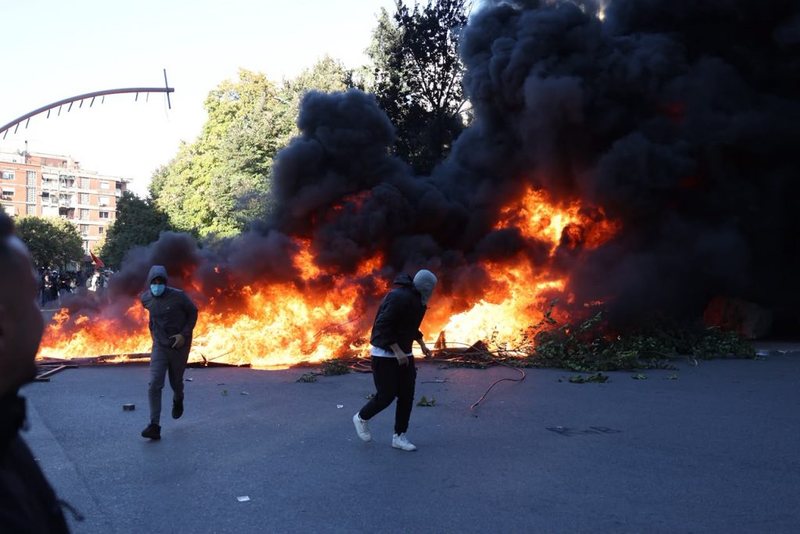
The police are drafting a new strategy that deepens surveillance and control of persons who have been caught committing acts of vandalism in Tirana in the name of students. So far, about 200 detained persons are mostly citizens who came from the districts, mainly from the North and Kosovo, as well as adolescents. Students account for about 5 percent of those detained, while those who came from Kosovo are slightly more.
Sources from the Prime Minister’s Office say that among the measures the government plans to take is the creation of a blacklist of violators of the city, who will be penalized by not being allowed to enter European Union countries.
A source from the working group told the newspaper that “all those who commit acts of violence will be included in a blacklist in the TIMS system and will be there so that they are not allowed to enter EU countries”.
The measures aim to create a database of persons with criminal tendencies who have been involved in acts of vandalism, in which European Union countries are also interested, due to similar phenomena they are experiencing.
Tirana may pass on information and ask its partners for their assessment, while the decision to deny entry would remain within the competence of the relevant authorities of the receiving states.
According to the Schengen Borders Code, Article 6 of Regulation 2016/399, among the conditions for entry of third-country nationals for short stays is that they are not considered a threat to public order, internal security or the international relations of one of the member states. Therefore, the exemption from the visa requirement does not imply an unconditional right to cross the border. A risk assessment may justify refusing entry, respecting the procedures and guarantees provided for. In this case, the territorial scope of application is the Schengen area, which does not fully coincide with the European Union.
The second instrument is the Schengen Information System, SIS, which makes available to participating countries alerts entered by national authorities. These include alerts for refusal of entry and stay of third-country nationals. Article 24 of Regulation 2018/1861 provides for the entry of an alert when a state, after an individual assessment, has established a threat to public order or security and has taken the appropriate measure in accordance with its own legislation.
Beyond this, the police are also studying the sources of funding of persons involved in acts of violence. Almost all of those detained state that someone paid for their travel and hotels. Police are investigating the hotels where they say they stayed, mainly on the outskirts of Tirana, as well as the sponsors of the combat materials or pyrotechnic devices they use.
Creating a blacklist will meanwhile also help the police as a basis for investigating other criminal acts in the future.
So far, police are regularly detaining an average of about 50 to 60 people per day, who clearly prove they are not students, but young people engaged for pay.