







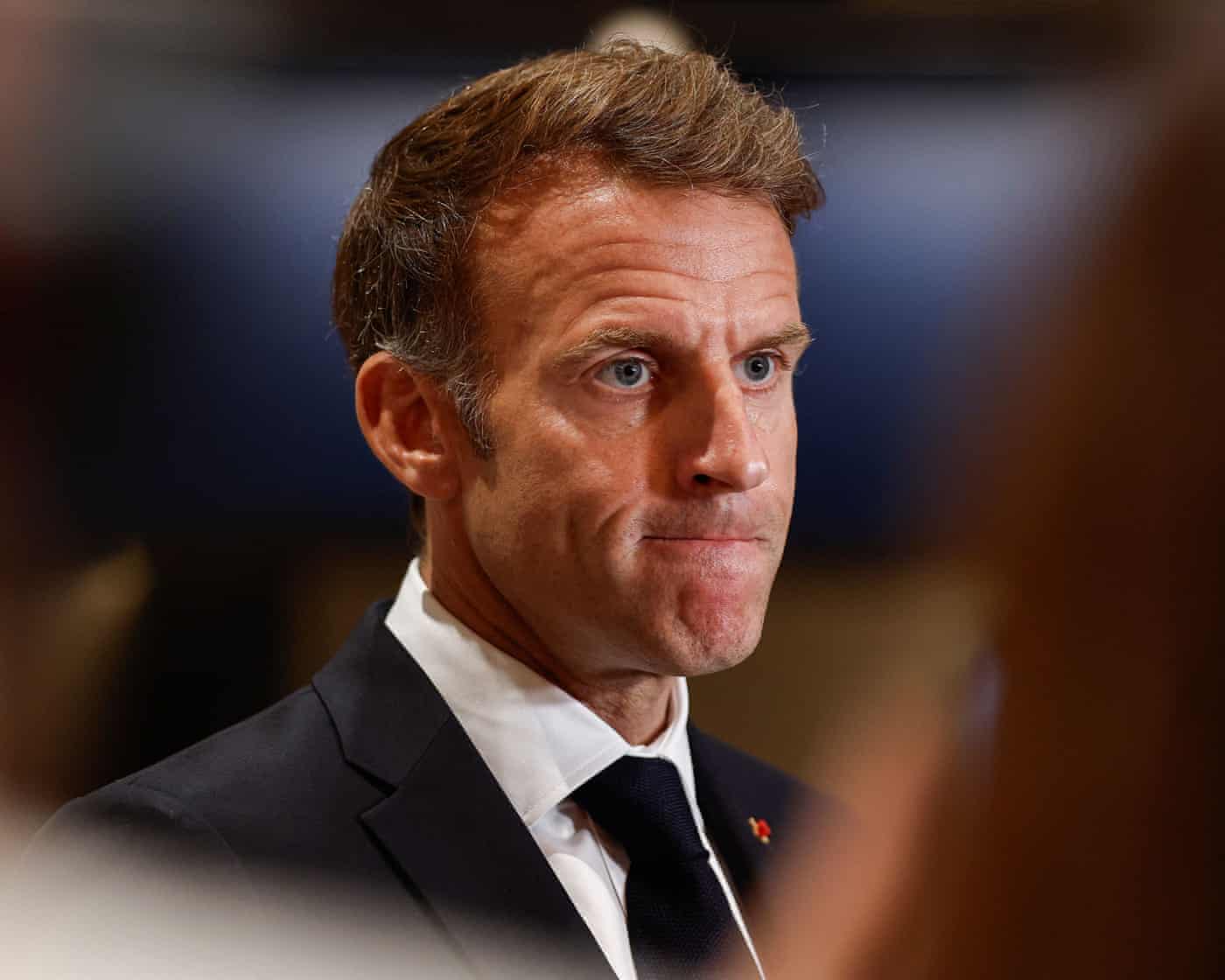
French President Emmanuel Macron has accused Donald Trump and other foreign leaders of making “idiotic comments” about the unrest on the streets of France, stressing that they are made for political gain, as the country prepared for more protests this weekend. During a visit to Qatar, Macron did not name specific individuals, but emphasized that the “manipulation of information” after Saturday’s unrest had led to “comments that are just as unacceptable as they are idiotic, from many people, including foreign leaders”. Asked whether he was referring to Donald Trump, Macron replied: “Among others.” The American president had blamed the violence in France on “immigrants, jihadists and communists” as part of his campaign ahead of the midterm elections. Israeli Prime Minister Benjamin Netanyahu, who faces elections, had also declared that France was being hit by an “invasion of radical Islam”, claims which analysts have dismissed.
Macron told reporters in Doha that some leaders “in the middle of election campaigns, whether here in the region or on the other side of the Atlantic” were “naively spreading narratives that some circles are clearly trying to promote”, exploiting France for their political campaigns. He also mentioned the circulation of AI-generated images that “depict scenes that never happened in France”, as well as false claims about “hordes of immigrants and Islamists”. The French government has admitted that it “lost control” over the widespread unrest on Saturday, which began as mostly peaceful demonstrations over the cost of living but quickly degenerated into unbridled violence and widespread looting, particularly in Paris, Marseille, Lyon and Limoges.
In response, police announced a ban on protests in parts of Paris on Thursday, including key sites such as the Elysee Presidential Palace, both chambers of parliament, and tourist areas such as the Louvre museum and the Champs-Elysees. The ban will also apply in the Bastille and République squares, as well as the Châtelet-Les Halles shopping area, which was heavily targeted by looters. These disturbances have prompted some countries to issue travel warnings for France and have shaken financial markets, with the yield on the French government’s 10-year bonds exceeding 5% on Wednesday, its highest level since 2002.

Macron pledged to prevent any repetition of last weekend’s unrest, while the “yellow vest” (gilets jaunes) protest movement officially presented plans for a march in central Paris on Saturday, which is expected to be the government’s next major test. Student groups have also called for protests on the same day to demand greater investment in education. Government ministers have promised a “massive” and significantly reinforced security operation, acknowledging shortcomings in the initial response. Meanwhile, France’s main trade unions have separately called for a nationwide mobilization on 5 November, with CGT union leader Sophie Binet stressing that “there is great and legitimate anger, and the response to this situation is not repression, but a political response”.
Macron insisted that France “does not need a state of emergency”, saying it “has the means” to control any further unrest. Justice Minister Gérald Darmanin announced on Wednesday that of 2,500 people detained during and after the protests, 174 had been jailed and another 917 had been prosecuted. Violent protests in other European countries, such as Italy and Belgium, have heightened concerns that anger over living standards risks spreading across the continent, where many nations, including France, face budgetary problems. Italy has ordered the deployment of 500 troops to Milan to curb street violence there.
Taken from The Guardian