







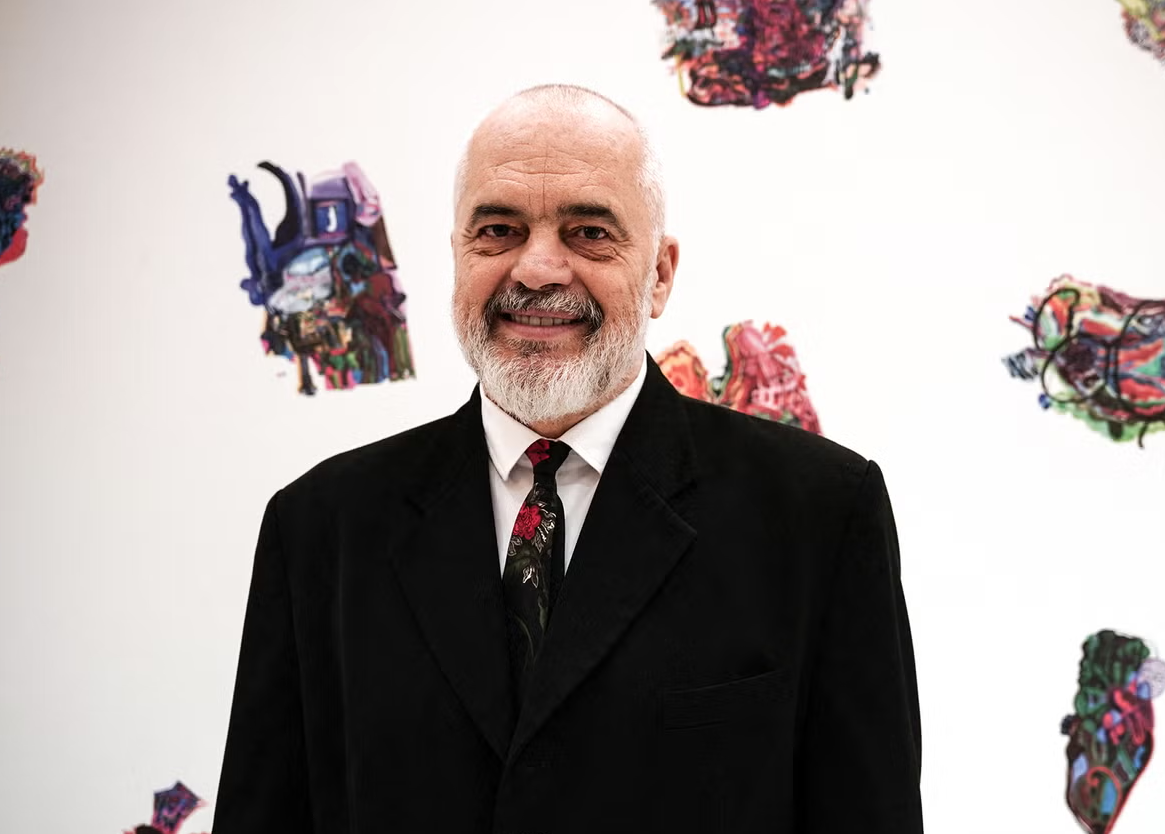
Prime Minister Edi Rama mocks Reform UK leader Nigel Farage over his statements against Albanian immigrants in the United Kingdom, claiming that his fall in the polls is a consequence of what he called the “Albanian curse.” In an interview with the British newspaper “The Independent”, Rama addressed Farage’s statements about Albanians living in the United Kingdom, recalling his claim that one in 50 Albanians in Britain is in prison. On the other hand, Rama also spoke about developments in Albania, the protests against the government and the controversy over the investment project on Sazan Island, in which Ivanka Trump and her husband, Jared Kushner, are involved.
The full interview
Question: Mr. Rama, you have stated that Nigel Farage should beware of the “Albanian curse.” What do you mean by this?
Edi Rama: It is something you should beware of, because anyone who attacks Albanians does not end well politically. Suella Braverman, for example, is nowhere politically today. Several others have ended up in the same situation. I have told my friend Nigel Farage to be careful, because there is an Albanian curse.
Question: Do you think Farage’s statements against Albanians are racist?
Edi Rama: It may be racism, it may not be racism, but it is shameful in both cases. It is shameful to single out communities, ethnicities, different skin colors, languages and cultures for political purposes.

Question: Farage had stated that one in 50 Albanians in Britain was in prison. You had invited him to visit Albania. Has he kept the promise?
Edi Rama: He accepted the invitation to visit Albania, but he has not carried it out. He is very good at making promises, but he does not seem as good at keeping them.
Question: How do you see the current situation in the United Kingdom after Brexit?
Edi Rama: Britain is in an even more desperate state than the rest of Europe. I hope that the new prime minister will be able to change this path of self-destruction that began with Brexit.
Question: What do you think of Andy Burnham?
Edi Rama: He is a great natural force. He has a special appeal, because he comes from the experience of local government, which is the real field of political battle. I told him that I admire what he is doing, but I am too old to be suitable for Instagram.
Question: You have spoken about the negative impact of social media on democracy. What concerns you most?
Edi Rama: Our democracies are being eaten alive by the evil of social media. We have allowed freedom of speech to be replaced by freedom of distribution and reach to the public. Today, Nazis, conspiracy theorists and extremists are connected to one another and can spread their ideas throughout the world.
Question: You were yourself the victim of a violent attack in 1997. What happened?
Edi Rama: Two people attacked me as I was returning home with my girlfriend. They used metal pipes and nail-studded batons. They fractured my skull and nose in five places. I believe they were sent by the regime of the time and that the aim was to kill me. After this event I thought I would never return to Albania.
Question: Why did you decide to return to Albania and engage in politics?
Edi Rama: At that time I was not interested in party politics. I was a liberal and independent intellectual. I believed intellectuals had a duty to speak freely about society. However, my journey led me towards politics and public service.
Question: The recent protests in Albania have put your government, corruption and the Sazan project at the centre of attention. How do you comment?
Edi Rama: What happened was disturbing, because I saw up close what a catastrophe social networks can be. Albania became the stage for an anger that spread to every computer screen in the world. I think social networks have greatly influenced the way developments in the country are perceived.
Question: The Sazan project involves Jared Kushner and Ivanka Trump. Is there a conflict of interest because of their family ties to Donald Trump?
Edi Rama: When I met Jared Kushner and he asked me whether he could examine the possibility of an investment in Albania, Donald Trump was not president of the United States. At that time, he was facing the American justice system and seemed more likely to end up in prison than in the White House. I told Jared Kushner he was welcome. Why should it worry me who his father-in-law is? He is an American investor, accompanied by other important investors, and I look at my country’s interests.
Question: Has a final agreement been reached for the development of Sazan?
Edi Rama: There is no final agreement. Negotiations continue and the Albanian state is negotiating its part in the project. Environmental assessments must also be carried out to determine whether the project can be realised. It is not right to think that protecting a natural area and economic development are necessarily incompatible. Bad development can be harmful, but good development can help regenerate a protected area.
Question: How do you assess Albania’s economic development in recent years?
Edi Rama: When I came to power, fewer than two million tourists crossed Albania’s borders every year. Today that figure is more than 12 million. Gross Domestic Product has grown from less than 10 billion euros to around 30 billion euros over a decade. But today people no longer ask whether Albania has changed. They ask: Where am I in this change? What do I gain from it?
Question: Is your objective for Albania to join the European Union by 2030?
Edi Rama: We want to be part of the European Union. We want to join as soon as possible, but we will never change our mind about this objective, even if the European Union were to disappear. We would build it in Tirana.
Question: Which British politician has had the greatest influence on your political formation?
Edi Rama: Tony Blair and his New Labour government have had a great influence on me. If Tony Blair and New Labour did not exist, I most likely would not have been inspired to become a party leader. I was inspired by their pragmatic approach, the effort to go beyond the traditional divisions between left and right and to overcome ideologies.
Question: What about Margaret Thatcher?
Edi Rama: I admire her. The political transformations that took place in Britain during that period were important. Although I am a socialist, this does not prevent me from appreciating other political figures.
Question: You are prime minister, but you continue to work in art. How do you see yourself in this respect?
Edi Rama: I am the best artist among prime ministers and no one can take that from me. I am also the best prime minister among artists and no one can tell me otherwise.