







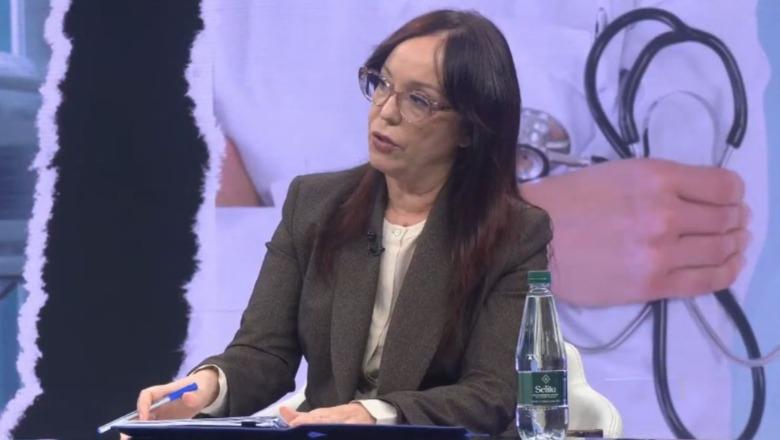
The Minister of Health and Social Welfare, Klodiana Spahiu, says that the creation of a state-owned company for the supply of medicines, medical devices and support services aims to guarantee the supply of public health institutions and prevent shortages in hospitals. In a television interview, Spahiu acknowledged that the reported problems regarding the lack of medicines and medical devices in health institutions are real, stressing that responsibility for guaranteeing supply should lie with the state.
“The only solution will come when the state assumes the guarantee for supplying the public sector. If today I lack a medicine for which I have signed a contract, it will be the responsibility of the state and of this company to guarantee that there is no shortage in the public health system,” the minister said. Responding to a question on whether the new model implies privatization of health tenders or the creation of joint ventures with private operators, Spahiu described this interpretation as incorrect. According to her, the company will start with a budget determined by the state, while the revenues it generates will be reinvested to strengthen it and improve services.
During the interview, Spahiu also touched on the expansion of treatments in oncology, saying that the possibility of including new biological therapies for certain diagnoses is being examined, where their effectiveness is backed by scientific evaluation. She stressed that decision-making will rely on the recommendations of the scientific board and the professors of the oncology service, with the aim that treatments be directed toward patients who benefit most from them.

“We will have to focus on cases where patients benefit the most. Why? Because we must treat everyone. And our approach will be that where the need is greatest, investments should go there too,” Spahiu declared. Spahiu underlined that no health system, regardless of budgetary capacities, can afford all new biological therapies for every diagnosis, so selection must be made on scientific grounds and according to the expected effect on patients. Speaking about her responsibility in leading the sector, the minister said she feels responsible also for decisions over the years, having been part of health policymaking for 16 years as an MP.
Spahiu stated that her aim is for every decision to have a positive impact on citizens, while not neglecting the needs of health personnel, including salaries, medical equipment and working conditions. In this regard, the minister also touched on basic health check-ups, where, as she stressed, removing the age limit has brought about 100,000 more examinations. She said work is underway on new prevention policies and on making better use of data collected through this service. Spahiu stressed that the Ministry’s approach will be patient-oriented, while at the same time addressing the growing demand for health services and the needs of medical personnel.