







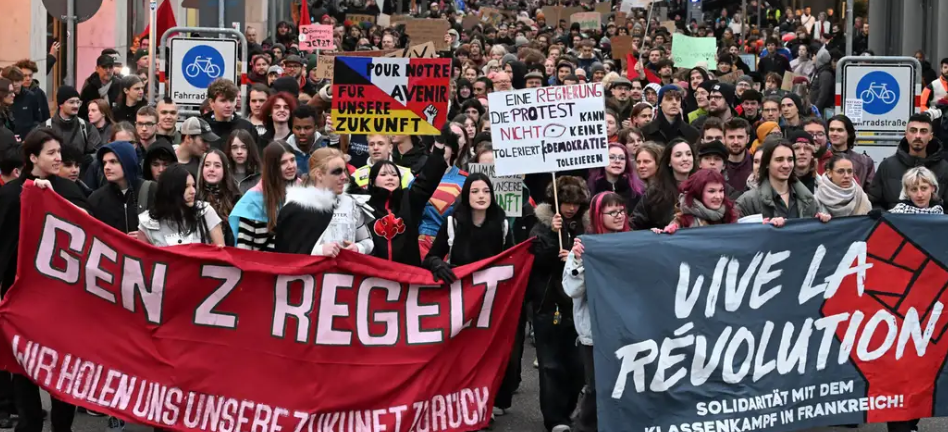
Across the world, young people are taking to the streets because they are dissatisfied with their lives and their prospects for the future. It all began in Nepal, Madagascar and Morocco, and then young people in France and Albania joined the protests. At the end of October, protests were held across Germany for the first time. In more than 30 cities, tens of thousands of young people from the so-called “Gen Z”, i.e. Generation Z, took to the streets in mostly peaceful protests. Today they are roughly between 14 and 29 years old.
Their demands in Germany differ somewhat from those of young people in other countries. Here, Generation Z seeks to draw attention to the state of the school and education system, the high cost of living and rising rents, and also protests against the reintroduction of compulsory military service. According to the latest ARD-Deutschlandtrend poll, nearly three in four German citizens express understanding for these demands, albeit with some reservations.
Participation in demonstrations is considered by most to be a legitimate means of expressing political views. While the use of violence against objects or people during demonstrations is rejected almost unanimously, including by people under 35 (93 percent). For blocking roads and traffic, as well as occupying public institutions, as has happened in France, the assessment is sharper. Most German citizens oppose these forms of protest. Among younger voters, however, support and opposition are roughly balanced.

The polling institute infratest-dimap interviewed 1,297 German voters from 2 to 4 November for ARD-Deutschlandtrend. The survey is representative.
Are young people disadvantaged? Most think they are
82 percent of respondents believe that the interests and concerns of young people in Germany are taken little or no account of by politics. Looking at party preferences, notable differences emerge: 30 percent of voters for the conservative parties CDU/CSU believe young people’s demands are taken well or very well into account. Among supporters of the Left Party, only four percent think so.
If age is also taken into account, fewer than one in ten people under 35 is satisfied with the way politics addresses young people’s problems.
Yet young people have almost no confidence that the governing parties, the Union CDU/CSU and the Social Democrats, are able to solve their problems. Among those under 35, only five percent consider the Union competent and only three percent the SPD. The Left Party reaches 29 percent, while Alternative for Germany (AfD) reaches 21 percent.
CDU/CSU and SPD: Little competence on rents, education and climate
Even in policy areas that are important to young people, the governing parties receive poor ratings from people under 35. On environmental and climate policy, nine percent consider the Union CDU/CSU competent, while the SPD reaches only two percent. On commitment to social justice, the Union gets four percent and the SPD 17 percent. Only seven percent believe the Union can do something about rising rents, and 11 percent have this confidence in the SPD. On school and education policy, ten percent consider the Union competent and 12 percent the SPD.
Most German citizens believe that today’s young generation has a harder time than previous generations in building prosperity