







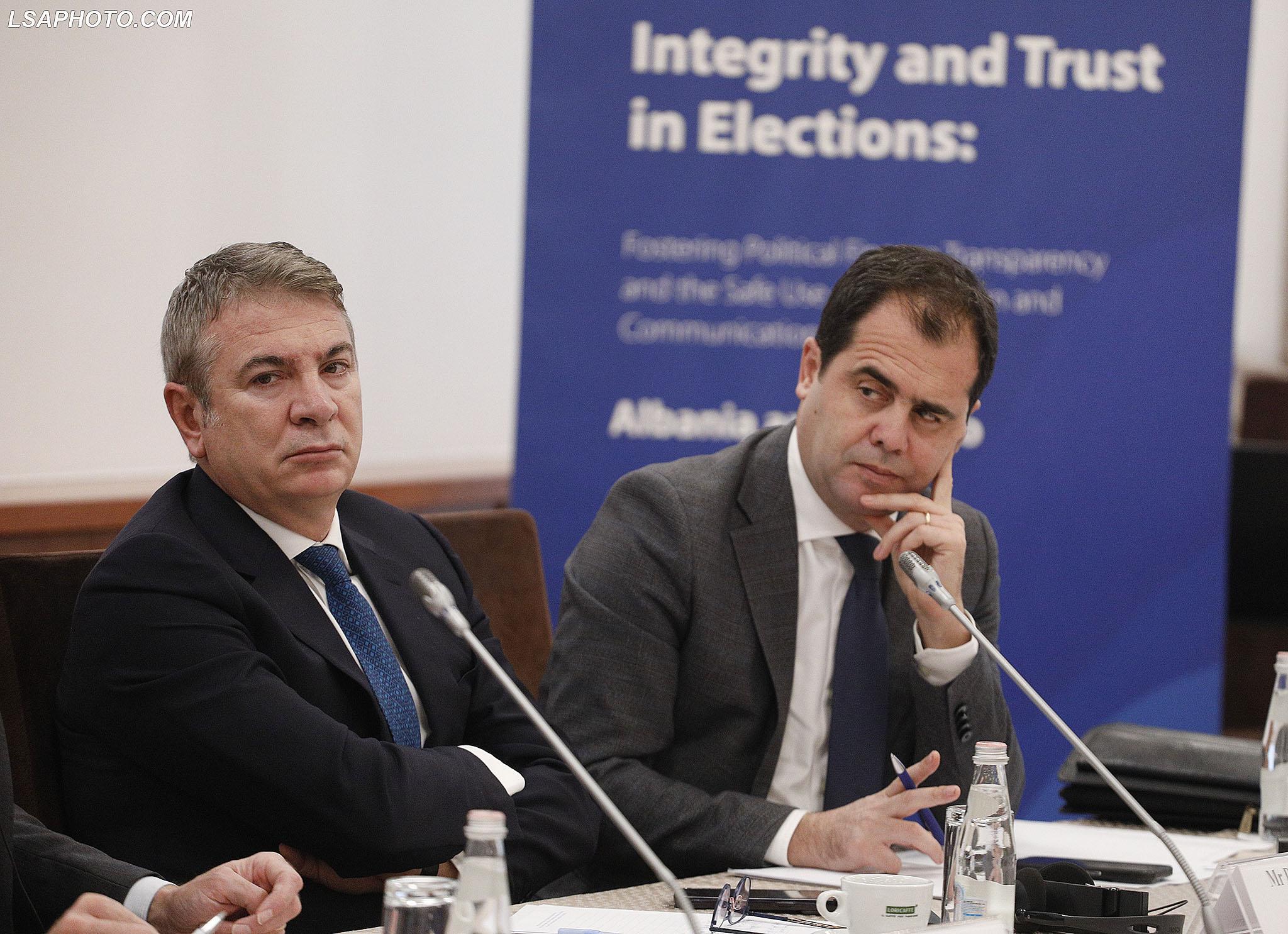
After several months of dysfunction, MPs from the majority and the opposition sat down in mid-November at the table of the Special Parliamentary Committee on Electoral Reform, where they set out their positions on the reform. Co-chair Oerd Bylykbashi of the Democratic Party said the party was seeking a comprehensive reform, proposing a change to the electoral system to a national proportional system with open lists and the permitting of pre-election coalitions.
His socialist counterpart, Damian Gjiknuri, presented a political counteroffer, expressing the majority’s readiness to negotiate a proportional system with fully open lists, on condition that the Democratic Party accepts a reduction in the number of MPs from 140 to 100. Although a near-term compromise between the parties is not expected because of the short time the committee has available, political compromises between the two major parties are not new.
For more than two decades, electoral reforms and constitutional changes have been determined mainly by political agreements between the Socialist Party (PS) and the Democratic Party (PD), leaving other political forces out of the process. The 2008 reform, which changed the electoral system from a mixed majoritarian system to a regional proportional system with closed lists, and a one-sided intervention by the PS in 2020 that removed the possibility of pre-election coalitions, are assessed as having contributed to the polarization of the political scene and to limiting the space for new movements to create political impact.

Therefore, every new possibility of compromise between the two major parties is viewed with skepticism by other political factors. The leader of the Movement for National Development, Dashamir Shehi, who found himself outside parliament in 2025 after two decades as an MP, denounced what he calls domination of the reform by the interests of the two major parties.
At a media conference, Shehi said the PS and PD are seeking to preserve their monopoly over the administration and counting of votes, excluding other parties. He calls for an inclusive process, with international mediation and representation of protesters in the negotiations, while proposing a single electoral zone in Albania, with open lists and a two-round voting system.
In the last parliamentary elections, three new forces—the Opportunity Party, the Together Movement and Albania Becomes—entered parliament with difficulty even though they received a considerable number of votes. These parties needed more than 24,000 votes to secure a parliamentary mandate, while candidates of the two major parties needed on average around 10,000 votes. The most extreme case was that of the “Albania Becomes” movement, which received 64,000 votes nationwide and only one MP mandate.
This inequality in the effective weight of the vote is seen as one of the reasons the current system favors the drafters of the Electoral Code in force, and new parties fear a new political ‘market’ that would narrow even further the space for equal competition in elections. Representatives of these parties are critical of a new bipartisan reform.
“It is the same script, even the same people for 20 years, who patch the Electoral Code, and every time Albanians again face elections that are not free and not at all fair,” Erald Kapri, an MP from the Mundësia Party, told BIRN, calling the commission a “farce.”
Kapri, on the other hand, believes that the discussion on the electoral system should not be limited to the mandate formula, while the main problems of political competition remain outside the negotiating table, such as party financing, the use of the administration and state resources for electoral purposes, and the lack of media space. “These are the elephant in the room,” Kapri stressed.
Redi Muçi, an MP from the Bashkë Movement, considers the process of the Electoral Reform Commission so far to be delayed and lacking concrete substance. According to him, although the commission was established more than a year ago, PS and PD have not yet presented clear platforms for the changes they propose to the Electoral Code. Muçi suspects that this delay is intentional and aims to give the two parties the opportunity, at the end of the process, to blame each other for the lack of consensus.
Muçi believes that the 2008 agreement between Edi Rama and Sali Berisha continues to favor the two major parties and that changing it would require political and civic pressure. “There is no doubt that the 2008 Rama-Berisha agreement advantages the two major parties. From this aspect, they have no reason to change the Code, except under pressure created by the protests of recent months,” Muçi told BIRN.
Adriatik Lapaj, leader of Albania Becomes, also says that this political force’s position has been unchanged in its demand for an electoral system that guarantees equal competition and freedom of the vote. “PD and PS, whether they want to or not, must listen to the square and the citizens, who have the Electoral Code, the national proportional system with open lists, as a non-negotiable demand,” he told BIRN.
Conditions for equal competition
Representatives of the three new parliamentary forces are seeking legal changes that guarantee equal competition and limit the advantage built up over the years by the two major parties. They see their demand not only as positions linked to their parties’ political ambitions to grow, but also in resonance with the stance of a large part of society expressed through six months of civic protests.
They support the transition to a national proportional system with open lists and a low threshold, but also raise concerns about party financing, the use of public administration in election campaigns and the concentration of power in the hands of party leaders. “Any Albanian you ask will say they want a national system, open lists and an acceptable threshold to enter Parliament. Why is it not done? Because PS and PD want to preserve the political oligopoly,” Kapri argues.
But he expresses doubt that negotiations between PS and PD will produce real changes and warns that an agreement between them could change the Constitution to reduce the number of MPs, which would bring another political compromise like the one in 2008. Redi Muçi, an MP from the Bashkë Movement, also supports the transition to a national proportional system with a low threshold, arguing that this would expand opportunities for the representation of other political forces in Parliament.
However, he considers party financing one of the main problems that the reform must address. “The changes we are seeking in relation to the Law on Financing of Parties concern the criminal liability that certain individuals must bear and the administrative consequences for political parties whenever campaign financing is abused,” Muçi says.
According to him, illegal financing of campaigns by oligarchs and organized crime creates a considerable advantage for the two major parties, while low fines for refusing financial audits by the CEC do not serve as an effective control mechanism. The party he represents has officially submitted these proposals to the commission and they have been made public, although Muçi says he is skeptical that they will be taken into consideration by the major parties that control this reform. The current Electoral Code in force is seen by the leader of Albania Becomes as one of the sources of the concentration of political power and inequality of the vote.
“This Code has turned party leaders into lords of the country and MPs into mere numbers who vote for whatever the leader wants, and it has produced theft and misery everywhere, because power stems from the inequality of the vote,” Lapaj says. He adds that the party he leads has forwarded to the opposition forces proposals for changing the system to a national proportional system with open lists and allowing pre-election coalitions, as he sees this system as “essential for the democratization of political representation.” /BIRN/