







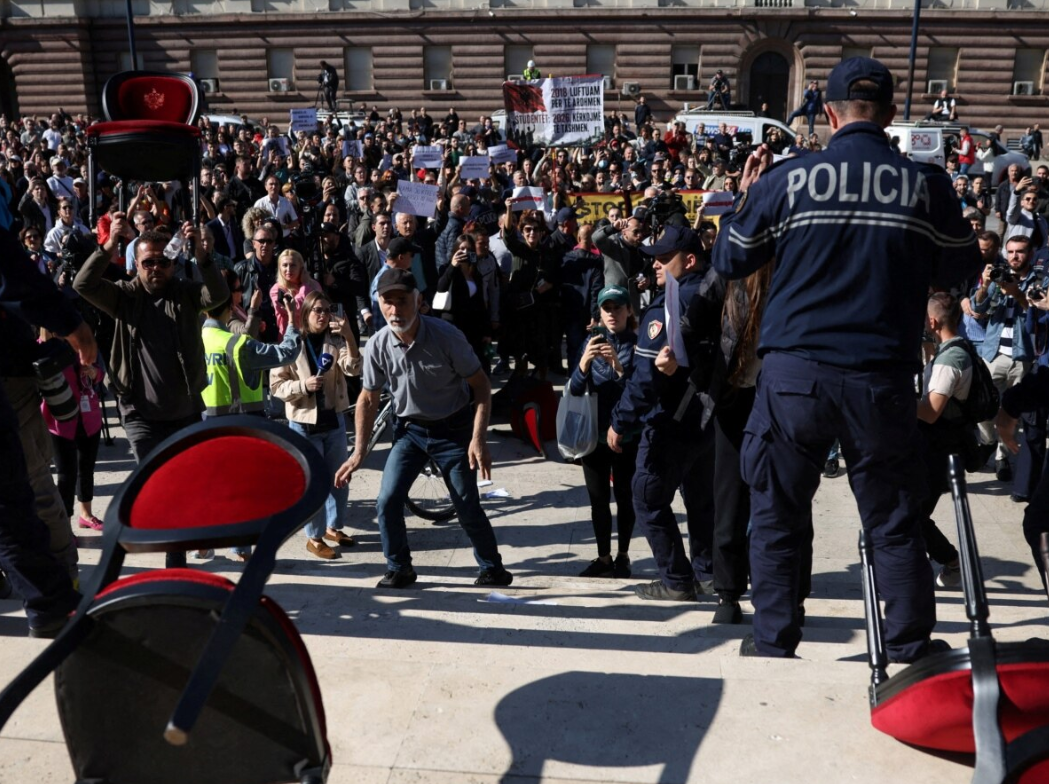
“Rama, resign!” is the chant that has been echoing in Tirana for about five months. But who do the young protesters want to replace him?
Three young people interviewed by Radio Free Europe do not name a candidate for prime minister. Instead, they demand greater accountability and better political representation, supporting the protest demands for a technocratic government and reform of the Electoral Code, which would allow more equal electoral competition. For nine days, protests demanding the resignation of Prime Minister Edi Rama have escalated and been accompanied by episodes of violence. Rama has offered dialogue, but his invitation to a meeting has been rejected.
No name, but clear demands

Emir Leçini, a first-year master’s student at the Faculty of Natural Sciences, says Rama’s departure is a non-negotiable demand. However, according to him, the protest also aims to create a political culture in which citizens can remove leaders who do not perform their duties properly. He says the protest brings together citizens with different beliefs and interests, who share dissatisfaction with how the country is governed, without backing a specific successor to Rama.
“The protest has not articulated anything like that, that we remove Rama in order to bring this or that individual. There may be individuals who inspire, but this protest does not promote a specific name or party. I think there is room to fix political representation, since many citizens do not feel represented. And this will not be solved even if Rama leaves tomorrow,” he told REL. This position has also been expressed by speakers at the peaceful protests called the “Flamingo Revolution,” which began at the end of May: opposition to the Rama government does not mean support for the current opposition.
Hana Spahia, who completed her higher education in the United States and returned to Tirana, also places accountability before the name of the next prime minister. “The most important thing is to have a person who will fear the people and respect them. After 13 years in power, Rama has neither transparency nor accountability. He has grown accustomed to the chair and thinks he can act as he pleases. This cannot happen,” she says.
Hana supports a small party, but believes the electoral system prevents such parties from securing the representation they deserve. “Personally, I have voted for a small party and will vote again, but Albania has over 120 parties, and people should be able to choose whom they want, through truly free and democratic elections.”
Technocratic government and fairer elections
For Hana, the first step after Rama’s departure should be a transitional technocratic government, which would prepare the conditions for fairer elections. She says names can be discussed later; first, conditions must be created so that citizens can choose freely and parties can compete on an equal footing.
Albania has a regional proportional electoral system, with 140 deputies elected in 12 constituencies. According to amendments to the Electoral Code approved in 2024, with the support of the Socialist Party and the Democratic Party, one third of the candidate list is closed, while two thirds are open. In the closed part, parties determine the order, while in the open part citizens can vote for their preferred candidates.
Emir also calls for changing the way power is won and exercised. “The Electoral Code is one of the main reasons we have the current politics. This Code suppresses any option that is not a big party and allows the party in power to have an unfair advantage over any other party,” he says to REL. In its report on the May 11, 2025 elections, the OSCE/ODIHR assessed them as competitive, but found that contestants did not have equal conditions and recommended comprehensive electoral reform. However, young people expect changes beyond electoral reform. Livia Dedej, a clinical psychology student, says her distrust of the political class leads her to support a technocratic government made up of experts, which would launch reforms in agriculture, education, health and justice.
These expectations reflect the dissatisfaction expressed by protesters over the cost of living, the quality of education and health services, the lack of employment opportunities, and what they describe as the concentration of economic benefits in the hands of a minority. “Democracy knows no other path,” says journalist and analyst Bledar Zaganjori, explaining that if Rama leaves, there are two options: the Socialist Party chooses another prime minister to complete the mandate, or a caretaker government takes the country to elections. During this period, the government has approved financial bonuses for families in need and doubled payments for children with disabilities and their caregivers. It has also promised to improve conditions in student dormitories and raise salaries for police officers. Nevertheless, young people say the protests will continue and that the demand for Rama’s resignation remains non-negotiable. /REL-Jetmira Delia-Kaci/