







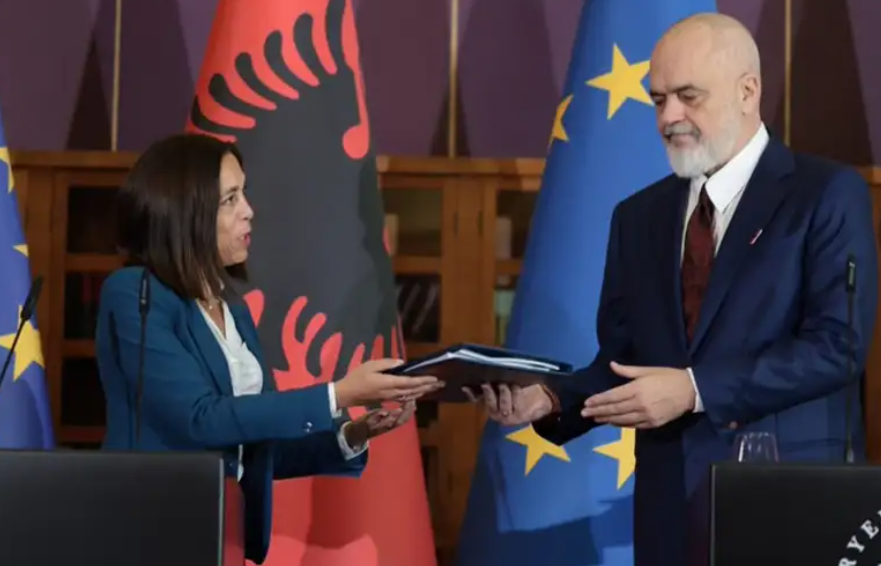
The EU hopes Albania can complete negotiations by 2027. But expert Milan Nič considers 2028 a more realistic and credible target. Because for membership, reforms on paper are not enough.
In the report published on November 4, the European Commission ranks Albania among the most advanced countries in the enlargement process, behind Montenegro. Albania has opened all 33 negotiating chapters and has provisionally closed four of them. Brussels describes the target of concluding negotiations in 2027 as “ambitious but achievable,” provided that reforms and political dialogue continue.
“Although the Albanian government wants to close all chapters by the end of 2027, I think this is an overly ambitious goal,” he tells DW. According to Nič, the end of 2028 would be a more realistic and achievable target. He gives two reasons for this.

First, Albania has moved quickly in opening negotiations, but implementing reforms takes time. Unlike Montenegro, which had years to prepare its administration, Albania must meet many requirements within a shorter period.
“If you want to change the way the state functions and adapt it to the EU’s regulatory framework, you cannot do this simply by rewriting laws.”
Second, a process that is too rushed may raise doubts among member states. They must be convinced that reforms have really been implemented. For Nič, the credibility of the process is just as important as its speed.
SPAK: Proof of success or an alarm about corruption?
Yet precisely this credibility has been called into question. According to DW’s diplomatic sources in Berlin, the Balluku case, the protests and the way the government has handled them are the reasons why Albania’s progress is viewed with more skepticism than in the European Commission’s report.
The Commission praises the justice reform and the investigations of SPAK, the special prosecution against high-level corruption. But “the spirit of the report is much more positive than the actual situation on the ground,” says Arnisa Tepelija, a rule of law researcher at Democracy Reporting International in Berlin.
Tepelija, who has also worked on EU anti-corruption projects in Albania, criticizes precisely this discrepancy. She acknowledges the results of the justice reform and the work of SPAK, but calls on the EU to look beyond individual investigations.
“When these investigations expose systemic corruption within the government, then this must also be addressed systematically by the European Union.”
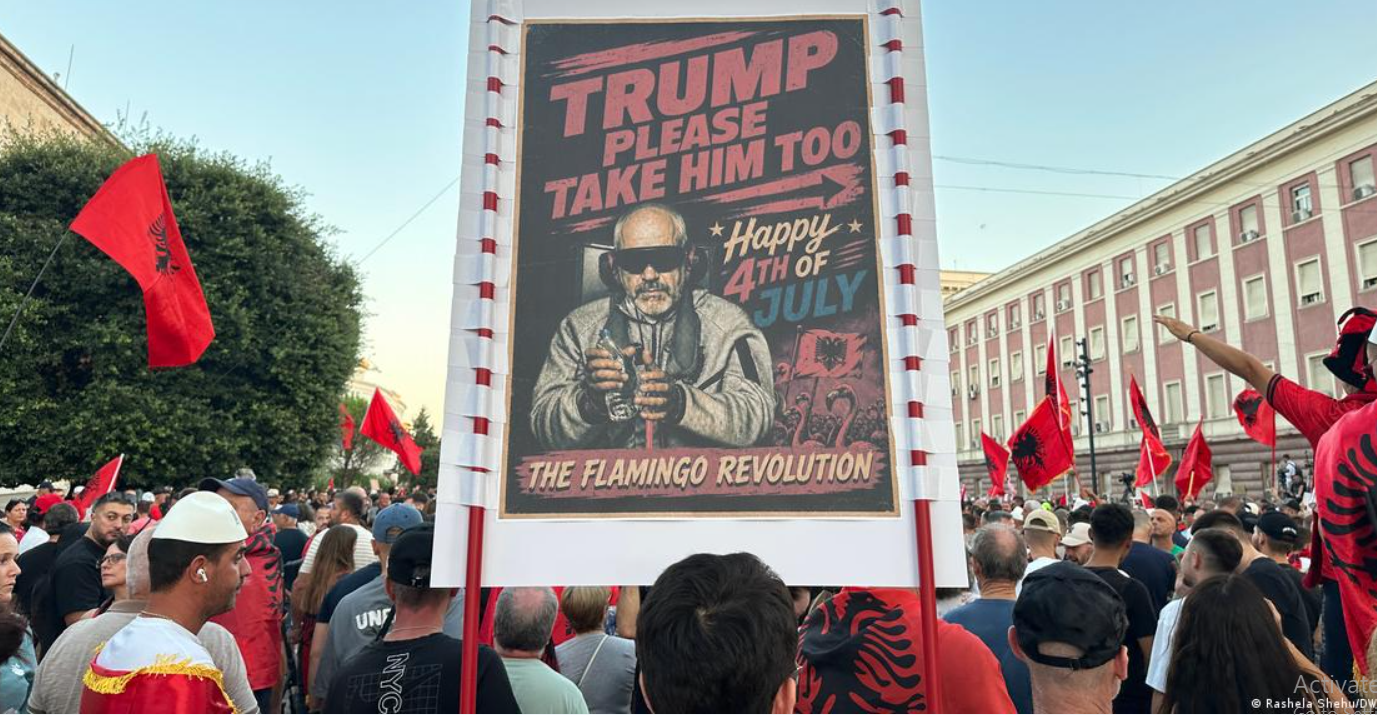
“Civic movements and mobilization in Albania are trying to say something to the government,” says researcher Arnisa Tepelija for DW. Protest against the government in Tirana.Photo: Rashela Shehu/DW
In fact, according to DW sources, in both Berlin and Brussels these problems are being addressed in closed-door talks. But Tepelija questions this approach. According to her, closed-door diplomacy risks serving governments more than citizens.
According to Tepelija, one of the weaknesses of EU policy is the lack of a direct link with the citizens who should benefit from the reforms. When their concerns are not heard, pressure on governments to carry out deep changes also weakens. “Civic movements and mobilisation in Albania are trying to say something to the government, and they would very much like the European Union on their side, so that pressure could be exerted on the government for accountability.”
According to Arnisa Tepelija, this EU approach feeds “stabilocracy” and does not help the country’s genuine democratic transformation. But Milan Nič sees another obstacle to political change in Albania: the lack of a credible opposition.
“Albania’s problem is also the lack of a credible opposition, an opposition that can really run in elections, even early elections. My concern is that early parliamentary elections could end up more or less with the same situation, the same majority in parliament.”
Thus, citizens’ dissatisfaction does not necessarily translate into a political alternative. But this does not reduce the government’s responsibility to respond to the protests.
“How the government handles the protests will be watched in European capitals,” warns Nič.
Commission recommends, member states decide
And it is precisely the position of member states that will be decisive for Albania’s accession to the EU. Even if the European Commission gives a positive assessment, it does not guarantee the country’s admission to the Union. This is shown by the example of Montenegro, the most advanced country in negotiations, whose accession is still not certain. The Commission considers it possible to close Montenegro’s remaining chapters in 2026. However, disagreements with Croatia have shown that a single member state can slow down the process.
Germany wants the process to move as quickly as possible, preferably before the presidential elections in France in 2027. Montenegro could serve as the first test of the EU’s ability to advance enlargement. For Albania, the possibility of gradual integration is increasingly under discussion, an approach supported by Germany and France. It envisages the step-by-step rapprochement of candidate countries with the EU before full membership.
Perhaps this gradual integration could give Albania more time to change not only its laws, but also something that is not written on paper but is felt by the citizens who live and work there: institutional culture. “Institutional culture does not yet accept dissent in Albania,” says Arnisa Tepelija, and calls for more autonomy, critical thinking and responsibility for civil servants, instead of obedience to superiors. According to her, the success of integration is not measured only by closed chapters, but by the changes citizens feel in their everyday lives.
Anila Shuka/DW/