







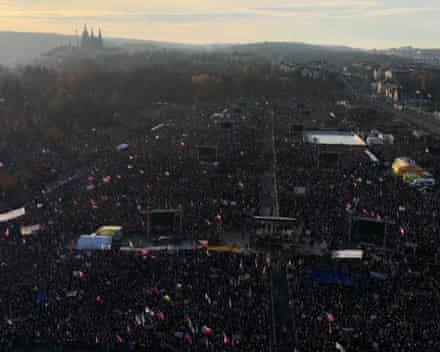
Hundreds of thousands of Czechs have gathered in Prague to protest against what they perceive as a government attempt to suppress media freedom. Sunday’s rally, which aimed to protect the mandatory licence fees that fund the Czech public broadcasters, drew more than 350,000 people, making it one of the largest in the country’s history, according to organisers. Many protesters wore triangular paper hats, similar to the television cartoon character Večerníček, a mascot of children’s bedtime stories, who has become a symbol of the protest. Others held banners reading: “We will not hand over the media”.
The event was held on the capital’s Letná field, the cradle of the 1989 Velvet Revolution, which ended more than 40 years of communist rule in the country. It marked the latest challenge to Prime Minister Andrej Babiš and his coalition of populist, right-wing nationalist and Eurosceptic parties, and comes after weeks of demonstrations in cities and a strike by staff at Czech Television and Czech Radio. Protesters say the plan to abolish licence fees and fund the broadcasters from the state budget would give ministers more influence over newsrooms, following the example of Hungary, Poland, Serbia and Slovakia, where right-wing populist governments have eroded media independence.
A series of protests have been held since the end of October, when the first reading of the bill to abolish licence fees was passed in the middle of the night. The group “A Million Moments for Democracy”, which organised the demonstration, said the authorities would now understand the level of opposition. “We reject the Slovak scenario,” read one protest banner, while another said: “Hands off the media.” Singer Šárka Dumišincová and computer programmer Jan Snasel stressed the importance of independent media and the unacceptability of government control.

The proposed changes, which would cut the budgets of state television and radio by about 15%, have drawn criticism from international media organisations, including the European Broadcasting Union, the European Federation of Journalists, Reporters Without Borders and the International Press Institute, which compared the moves to those of Slovak Prime Minister Robert Fico and former Hungarian Prime Minister Viktor Orbán. Prime Minister Babiš, a billionaire who returned to power last year, called protesters’ claims of threats to media freedom unfounded and “hysterical outbursts”, stressing that the government would not interfere in editorial work. His coalition, despite the protests, still enjoys the support of around 30% in opinion polls.
Taken from The Guardian