







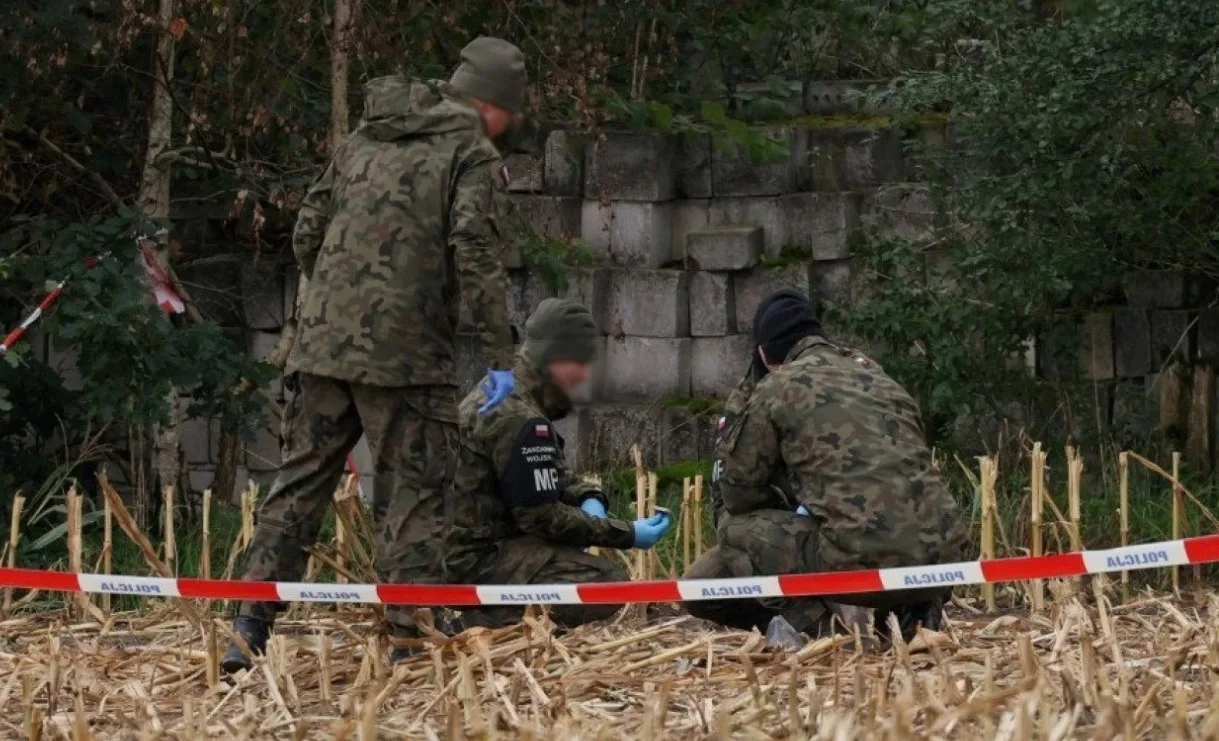
Polish authorities have identified three areas where flying objects fell after the massive Russian attack on Ukraine overnight Thursday into Friday. Among them are two missiles in Poland and, according to preliminary assessments, a jet-powered drone. The news was confirmed by Polish National Defence Minister Władysław Kosiniak-Kamysz at a press conference on Friday.
According to him, Russia’s attack on Ukraine was among the largest since the start of the full-scale invasion in February 2022. It was also accompanied by violations of Polish airspace. The minister gave details on each of the three sites where the objects fell.
In the Nowy Lipowiec area, in the Lublin region, authorities have confirmed that it is a Kh-101 missile. It is a long-range Russian cruise missile used by the Russian armed forces to attack targets in Ukraine. Another missile was found at the second site.

At the third, according to Kosiniak-Kamysz, it is very likely a jet-powered unmanned aerial vehicle. “There are three sites where the objects fell. In Nowy Lipowiec we can already say that it is a Kh-101 missile.
At the second site we are also talking about a missile, while at the third it is very likely a jet-powered unmanned aerial vehicle,” the minister said. Polish authorities are continuing investigations to determine the exact circumstances in which the objects entered the country’s airspace and ended up on its territory.
According to reports published by media and accounts monitoring security developments, an explosion was recorded around 06:35 near Chmielek, in Biłgoraj County, eastern Poland. Security camera footage shows a strong flash and then an explosion.
A flying object fell into a field near Nowy Lipowiec on Friday morning and caught fire after hitting the ground. According to information reported by the authorities, no one was injured. ## Ukrainian minister: Russian aggression threatens all of Europe Ukrainian Foreign Minister Andrii Sybiha described the violation of Polish and NATO airspace as further evidence that the Russian threat is not limited to Ukrainian territory alone.
In a reaction on platform X, he wrote that another violation of Polish airspace, as a result of Russia’s large-scale aggression against Ukraine, shows the danger this aggression poses to all of Europe and the transatlantic community. Sybiha noted the contrast between Moscow’s statements about a new security architecture in Europe and continued missile and drone attacks.
“While Moscow is trying to launch a discussion about a ‘new security architecture in Europe,’ Russian missiles and drones are directly calling into question the existing security order in Europe. The first step toward strengthening it would be stopping such attacks,” the Ukrainian minister said.
He stressed that Ukraine constitutes Europe’s first line of defence and that strengthening its defence capabilities directly helps guarantee the security of citizens in allied countries. According to Sybiha, support for Kyiv is not only about defending Ukraine but also constitutes an investment in overall European security.
In this regard, he identified three priorities: increasing pressure on Russia, further strengthening Ukrainian air defence, and continuing efforts to achieve peace. The Ukrainian foreign minister also expressed his country’s solidarity with Poland. According to him, both sides are cooperating to investigate the incident and prevent similar threats in the future. ## Eight killed in Ukraine, more than 100 missiles and about 400 drones The Russian attack overnight Thursday into Friday was massive.
According to Ukrainian authorities, Russia used more than 100 missiles and about 400 unmanned aerial vehicles, including about 120 jet-powered drones, which in practice function as small cruise missiles. At least eight people were killed in the attacks, while 28 others were injured.
The attack lasted more than eight hours. The Russian Ministry of Defence announced via the Telegram platform that it had carried out a “massive strike with high-precision weapons from land, sea and air,” as well as with unmanned aerial vehicles. According to Moscow, the targets were Ukrainian military and energy facilities, port infrastructure in the Odesa region and transport infrastructure in Kyiv.
Ukrainian authorities reported that the targets hit also included a hospital in Kharkiv, as well as residential buildings in the Dnipropetrovsk, Lviv, Vinnytsia, Sumy and Chernihiv regions. Significant damage was also recorded in the capital, Kyiv, where three bridges connecting the two banks of the Dnieper River were hit, causing major traffic problems.
Kyiv Mayor Vitali Klitschko said that the responsible services had been engaged in dealing with the consequences of the attack. “All emergency services have done and will continue to do everything possible to limit the consequences of the attack as quickly as possible,” he said.
The Russian strikes also caused widespread power outages in several regions of Ukraine, at a time when temperatures have begun to fall below zero. The attack came after previous threats by Russian President Vladimir Putin of a harsh retaliation for Ukrainian strikes on the strategic Crimea Bridge, a multibillion-dollar project linking Russia to the occupied peninsula.
“There will be no negotiations,” the Russian president had warned, adding that Moscow’s response would be far more painful than the strike carried out by the Kyiv regime on the bridge. The attack was recorded just hours after a trilateral meeting between Putin, US President Donald Trump and their Chinese counterpart Xi Jinping in Shenzhen.
The meeting had been accompanied by expectations of progress in diplomatic efforts to end the war in Ukraine, but the talks did not produce concrete results in that regard. Putin described the meeting as historic, stating that the talks had taken place in a calm and friendly atmosphere.
According to him, Russia, China and the United States had common interests in resolving the conflict in Ukraine. However, no official statement with concrete results of the talks was published. After the meeting, Trump contacted the leaders of the so-called “Coalition of the Willing,” who were holding a meeting in Berlin, also attended by US envoys Steve Witkoff and Jared Kushner.
According to a senior European official who was aware of the conversation, Trump’s main message was that “Putin is tired, wants to end this war and is ready for a deal.” The US president, according to the same source, called on European leaders to seize the opportunity to achieve peace.
European leaders reacted constructively but demanded concrete evidence that Moscow was truly ready for a deal. For his part, Jared Kushner stated that Trump had conveyed to both Putin and Xi Jinping a strong message about his desire to achieve peace and his readiness to cooperate intensively with both leaders.