







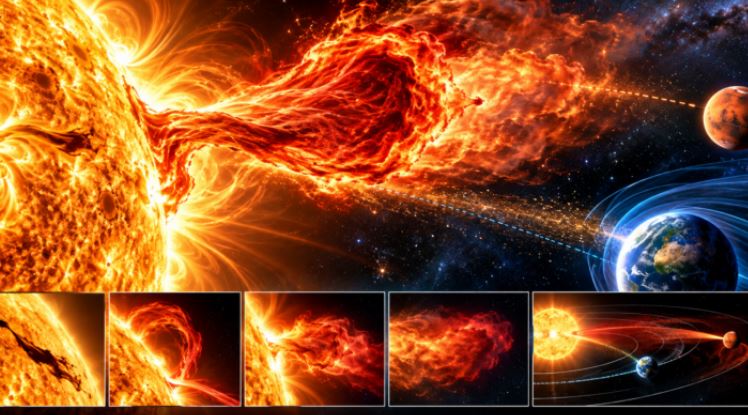
An extraordinary solar phenomenon has been recorded by space telescopes, in which a giant plasma structure about 500,000 kilometers long — roughly 40 times the diameter of Earth — has broken away from the Sun and been ejected at high speed into interplanetary space.
Images of this massive eruption were captured by the SUVI instrument aboard the GOES-R satellite using ultraviolet radiation. According to preliminary estimates by astrophysicists, the plasma mass is not travelling toward our planet; instead, it has taken a trajectory directly toward Mars, so the risk to terrestrial infrastructure and communication networks on Earth is negligible.
The event is linked to a coronal mass ejection (CME), a process in which dense plasma structures lose magnetic equilibrium in the Sun’s outer atmosphere and are released at high speed. While geomagnetic activity near Earth remains completely calm, researchers’ attention is focused on Mars, where the absence of a global magnetic field makes its atmosphere more sensitive to storms of this kind.