







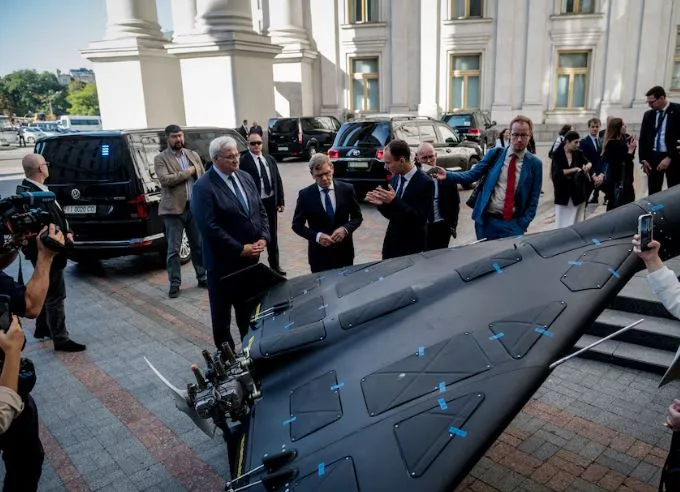
The German army began on Sunday the first tactical tests of kamikaze drones during exercises in Lithuania, at the Rudninkai training area near the border with Belarus. The tests come as an armored brigade of 5,000 German troops is expected to be stationed in the country by the end of 2027.
For Germany, Euronews Albania writes, this is an important step. The country decided only in 2025 to buy loitering munitions, or drones that explode, after years of controversy over arms procurement. According to Euronews Albania, both Russia and Ukraine have deployed one-way drones.
These drones can remain in the air over an area before moving toward the target. They then dive at speed and explode on impact. In Rudninkai, army chief Christian Freuding observed munitions produced by German companies Helsing and Stark.

Equipped with inert nuclear warheads, they fell from the sky and struck main battle tanks. The tests were part of “Shield of Freedom”, Germany’s largest military exercises in Lithuania to date. Days earlier, German troops in Rudninkai conducted their first tests of Helsing’s Clarity targeting software.
This is a tool based on artificial intelligence. It can review large volumes of data from satellites, drones and other sensors faster than any human, analyze them and recommend actions. Lieutenant General Freuding, who oversaw Berlin’s arms supplies to Kyiv before taking his current position, described both types of systems as essential for modern warfare.
He is expected to take the post of defense chief in February. In 2023, German Defense Minister Boris Pistorius pledged to permanently station a combat brigade in Lithuania, a first for Berlin. Germany began an increase in defense spending after Russia’s invasion of Ukraine.
It invested hundreds of billions of euros to improve its condition after decades of neglect. The newly formed 45th Panzer Brigade, based in Rudninkai and Rukla, will consist of around 5,000 troops and 2,000 vehicles, including dozens of tanks, when it is fully operational by the end of 2027.
Around 1,800 of these troops are already in Lithuania. NATO officials have warned for years of a growing threat from Russia. According to them, Moscow could launch a large-scale attack on allied territory as early as 2029. Moscow denies aggressive intentions and accuses the alliance of fueling tensions by expanding into neighboring territory.