







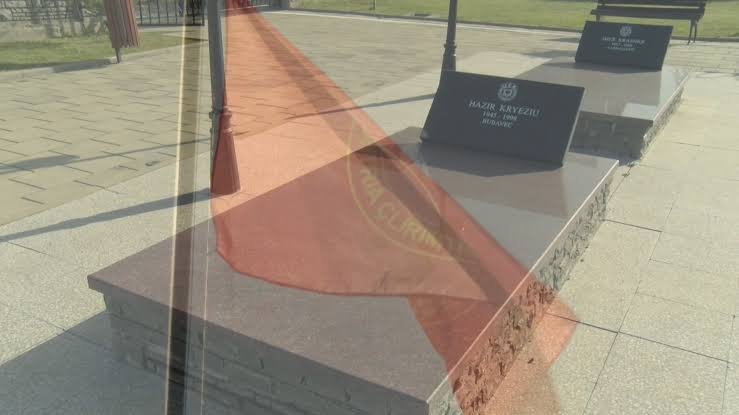
(Gratitude and recognition to the sons of Kryezi who shed their blood for the Homeland in three eras: (1). Fr. Shtjefën Kostandin Gjeçovi-Kryeziu (born 12.07.1874 in Janjevë, Kosovo, but of Kryezi origin; killed 14.10.1929 in Zym of Hasi i Thatë, in the Municipality of Prizren, Kosovo), declared a Martyr of the Homeland by Decision No. 850, dated 21.06.2021; (2). Dodë Mark Lleshi (born 1887 in Kryezi and fell 7.11.1944 in Kryezi, Pukë), declared a Martyr of the Homeland by Decision No. 59, dated 20.11.1969, of the Executive Committee of the People’s Council of the district of Pukë. Dodë Mark Lleshi sacrificed his life on 7.11.1944 to save a wounded partisan of the 22nd Assault Brigade; (3). Nikollë Çun Vorfi (born 1920 in Kryezi and fell 1944 in Kryezi, Pukë), declared a Martyr of the Homeland by Decision No. 35, dated 10.04.1980, of the Executive Committee of the People’s Council of the district of Pukë; (4) Nikollë Memë Çuku (born 1924 in Kryezi and fell 1943 in Kryezi, Pukë), declared a Martyr of the Homeland by Decision No. 03, dated 30.01.1974, of the Executive Committee of the People’s Council of the district of Pukë. Nikollë Memë Çuku (1924–1943), known as the first Martyr of the Homeland of the LANÇ in the region of Pukë, fell in June 1943, at the age of 19; (5). Rasim Selman Kryeziu (1933 Kryezi–7.7.1949 Milot), who fell in a tragic accident while going on a national action, declared a Martyr of the Homeland by Decision No. 56, dated 17.06.2005, of the Central Commission of the Status “Martyr of the Homeland”; (6). Allaman Nuh Dervishi (born 20.09.1969 in the village of Kryezi of Pukë and fell in the line of duty 24.05.2004, at the age of 35), declared a Martyr of the Homeland by Decision No. 40, dated 16.11.2004, of the Central Commission of the Status “Martyr of the Homeland”, as well as (7). Mehmet Brahim Brahimi (Aga) (1834–1880), aged 46, and his son (8) Brahim Mehmet Brahimi (Aga) (1860–1880), aged 20, who fell in Shkodër during the League of Prizren period and whose documentation is in the process of preparation for declaration with the title “Martyr”).
Prof. Asoc. Dr. Zaho GOLEMI, MSC Vlash LEKA & Kujtim BISHAJ
Kryezi proudly stands out for its contribution to national history

Five Martyrs of the Homeland, five stories of sacrifice and patriotic legacy that deserve to be preserved in the regional memory of Fushë Arrëz and Pukë and in the national historical memory. Kryezi is today within the administrative territory of the Municipality of Fushë Arrëz, a village with early historical, cultural and patriotic traditions. Kryezi is situated in a beautiful mountain valley; this place has produced personalities who left their mark on Albanian history and has preserved across generations important values of national identity. Its contribution is not measured only by its traditions, the history of its families or the development of social life, but also by the sacrifices of its sons for the Homeland, for Albania, for the nation. Kryezi has a special reason to be proud, because five of its sons, although they represent different eras of Albanian developments, have been officially declared Martyrs of the Homeland: Fr. Shtjefën Kostandin Gjeçovi-Kryeziu, Dodë Mark Lleshi, Nikollë Çun Vorfi, Nikollë Memë Çuku and Allaman Nuh Dervishi. They belong to several different historical epochs and made their contributions in various circumstances, but they are united by their connection to this region and the place they hold in its patriotic memory.
From the martyrdom of a priest, scholar and activist for the language and national culture, to the sacrifices during the National Antifascist Liberation War and the death in the line of duty of a State Police officer, the history of these five men represents different periods of Albanian efforts for identity, freedom and public security. Many written documentary sources speak of the history of Kryezi, of the link between the village of Kryezi and the legacy of Fr. Shtjefën Gjeçovi, as well as of the other Martyrs of the Homeland Nikollë Çuku, Nikollë Vorfi, Dodë Lleshi and, up to the youngest martyr of the road police, Allaman Dervishi. All these data place the history of the Martyrs of Kryezi within a broader context of the historical traditions of the Fushë Arrëz and Pukë area.
Five Martyrs of Kryezi and their contribution to Albanianness
Fr. Shtjefën Kostandin Gjeçovi-Kryeziu (1874–1929), a towering figure of the Albanian language, literature, culture, national cause and national unity
Father Shtjefën Kostandin Gjeçovi-Kryeziu was born on 12 July 1874 in Janjevë, Kosovo. According to the available information about his origins, he came from a family line with roots in Kryeziu of Puka. He was killed on 14 October 1929 in Zym, in Has Thatë, in today’s territory of Kosovo, near Prizren. He was declared a Martyr of the Homeland by Decision No. 850, dated 21 June 2021. Father Shtjefën Gjeçovi occupies a special place in the history of Albanian culture. He was a Franciscan priest, a researcher of popular tradition, a collector of customary law and an activist of national culture. His work in collecting and documenting the Kanun of Lekë Dukagjini, as well as his interest in customs, folklore and Albanian heritage, helped preserve an important part of the country’s social memory. Gjeçovi’s activity had significance beyond the borders of a single region. Through his research, writings and cultural work, he contributed to documenting Albanian identity at a time when preserving the language, traditions and national consciousness was of particular importance. His murder in Zym was a grievous loss for Albanian culture. The connection of his lineage with Kryeziu gives this village one more reason to preserve and study his legacy.
Gjeçovi’s figure shows that contribution to the Homeland does not appear only in the field of war. It is also expressed through knowledge, culture, the preservation of language and the documentation of national heritage. It is highly significant that in the highest representative institution of the Albanian state, the Parliament, the murder of Father Shtjefën Gjeçovi-Kryeziu became a subject of discussion in 1929. A special session was devoted precisely to this tragic event. This fact shows that his national importance and the gravity of the crime against him were understood already at the time it happened. His story was not simply the story of a murdered priest, but the story of an Albanian who became a target because of his dedication to the national language, education and culture. Declaring him a Martyr of the Homeland does not create the greatness of Father Shtjefën Gjeçovi, because that greatness was earned by his works, sacrifices and patriotism to the core. This title officially recognizes what generations have known and kept in memory, and have preserved as a testament for nearly a century. It is a fulfilled duty toward history, an appreciation of a life given in service to the nation, and a message to the generations of all Albanians.
It is a fact that Fr. Shtjefën Gjeçovi said that patriotism is not expressed only in great words, but is proven through work, knowledge, courage, and readiness to serve the people in every kind of situation, even when sublime sacrifice is required. Shtjefën Gjeçovi teaches us that language must be preserved, culture must be studied, history must be conveyed with responsibility, and he reminds us that a nation is built not only by those who fight with weapons, but also by those who defend it with the pen, with schools, with knowledge, with culture, with pride and with dignity. Faik Konica described Fr. Shtjefën Gjeçovi as “one of the greatest men Albania has ever had,” while the Austrian albanologist Norbert Jokli called him “a tireless worker in the field of Albanian letters.” Shtjefën Gjeçovi collaborated with the magazines of his time: “Populli”, “Hylli i Dritës”, “Albania”, “Brezi i ri”, where we find him under the pseudonyms “Komnen Kanina”, “Lkeni i Hasit”, “Zana e Prezës”, “A.Sh.K.Gj”, “O.F.M”, and on the other hand he left some 10,000 pages of manuscripts. He was like an encyclopedic “intellectual machine,” who knew eight foreign languages and who is regarded as the “Gjeçovi Scientific Institute”; and furthermore, through his writings Fr. Shtjefën Gjeçovi shows that he also signed with the name “Kryeziu,” which demonstrates the strong bond with the village of his ancestors’ origin.
Dodë Mark Lleshi (1887–1944), sacrifice to save a wounded partisan
Dodë Mark Lleshi was born in 1887 in Kryezi and fell in his village of birth, Kryezi, on 7 November 1944, in his birthplace. He was proclaimed a Martyr of the Homeland by Decision No. 59, dated 20 November 1969, of the Executive Committee of the People’s Council of the Puka district. The story of Dodë Mark Lleshi is linked to the great events of the National Antifascist Liberation War, at a time when Albania was going through the decisive days of ending the war against the occupiers. According to the historical record of this village, well known in our country, he sacrificed his life on 7 November 1944 to save a wounded partisan of the XXII Assault Brigade.
This sublime act constitutes the essence of his particular memory. In the conditions of an armed conflict between Albanians and the occupiers, the effort to save a wounded partisan was an act that required courage and readiness to put one’s life at risk, a high degree of human solidarity. The fall of Dodë Mark Lleshi links his name to a concrete act of sacrifice and human solidarity. Meanwhile, the distinguished Puka scholar Prof. Xhemal Meçi explicitly mentions this event in his writing about Kryezi, identifying Dodë Mark Lleshi as a martyr who gave his life to save the wounded partisan. For Kryezi, the memory of Dodë Mark Lleshi is part of the history of the LANÇ, but also a testimony to the importance of concrete human actions in extreme and exceptional circumstances, and therefore the remembrance of Dodë Mark Lleshi is entirely legitimate. His blood was shed for the freedom of the Homeland, for the cementing of the foundations of freedom.
Nikollë Çun Vorfi (1920 – 23.10.1944) on the altar of the Homeland’s freedom
Nikollë Çun Vorfi was born in Kryezi in the spring of 1920 and fell in 1944, in his birthplace Kryezi, in a family with patriotic and warrior traditions. Although the data on those who fell for the Homeland are not entirely accurate, it is thought that Nikollë Çun Vorfi was younger in age when he was killed and may have been born after 1920, as is shown by a published list of the martyrs of Puka which records him as 1926 (possibly also inaccurate) and links his fall to 23.10.1944. Nikollë Çun Vorfi was declared a Martyr of the Homeland by Decision No. 35, dated 10 April 1980, of the Executive Committee of the People’s Council of the district of Puka. Nikollë Çun Vorfi belongs to the generation that lived through the years of the Second World War, when the region of Puka and its villages were caught up in the great events that marked the history of the new antifascist Albania, a struggle known internationally against the Italian and German occupiers. His fall in the village of Kryezi makes his name part of the direct history of the country and of the memory of the families who experienced those dark years of occupation.
The exact biography of this martyr lives deep in the memory of his comrades and peers, but also in the accounts passed down from generation to generation as a historical postulate, although it is necessary to consult the documents of the martyr declaration, the relevant registers and the family testimonies, both inherited and written down. This gap in the civil registry records also comes from the practice of the state of that time, which did not precisely determine dates of birth, but also dates of death, as well as from the difficulty of clarifying the historical circumstances of the events of the time. Meanwhile, it is known that Albania did not inherit civil registry records; only on 7.9.1929 was the decree-law “On the General Registration of the Population” issued, with 8 articles, according to which the general registration of the population would take place in April-May 1930, on the “basis of self-declaration” (AQSH, Official Gazette, No. 7, dated 29 January 1930, pages 1–2). Meanwhile, the first real Albanian registers found in practice in Albanian civil registries are those belonging to the period 1945–1948. Nevertheless, even the basic data of his recognition as a martyr attest that the name of Nikollë Çun Vorfi is a powerful part of the patriotic, warrior and historical heritage of Kryezi.
Nikollë Memë Çuku (1924–1943) – The First Martyr of the LANÇ in the Puka Region
Nikollë Memë Çuku was born in 1924 in Kryezi and fell in June 1943, at the age of 19, according to published data on his life. He was declared a Martyr of the Homeland by Decision No. 03, dated 30 January 1974, of the Executive Committee of the People’s Council of the district of Puka. Nikollë Memë Çuku is known in local history as the first martyr of the National Antifascist Liberation War in the Puka region. His fall in 1943 occurred in a period when the struggle against the occupation had intensified and Albanian resistance was taking on ever wider dimensions. Nikollë Çuku, very young in age, represents a generation of Albanians, as well as of the village of Kryezi, who faced a difficult historical reality.
The loss of life at the age of 19 remains a reminder of the human cost that marked that wartime period with so many unexpected events. For his family and for Kryezi, the loss was a great grief, while for local history his name became part of the memory of Albanian antifascist resistance. In many publications and various historiographical sources of the war, Nikollë Memë Çuku is mentioned as the first martyr of the National Liberation War in the region of Puka, who fell in June 1943. Recognizing this martyr together with the other martyrs of Kryezi is of particular importance, because the history of Kryezi cannot be understood without recalling the major wartime events of 1943 and 1944 and the beginnings of this area’s sacrifices during the war. The name of Nikollë Memë Çuku is one of the important points of this historical remembrance.
Rasim Selman Kryeziu, the high school student martyr who set out on an action and sacrificed himself for the Homeland
Rasim Selman Kryeziu (1933–7.7.1949) was one of the young people who tragically lost their lives in the Milot accident, while traveling to take part in voluntary actions for the reconstruction of post-war Albania. He was from Kryezi, but had gone to attend high school in Bicaj, Kukës. He remains part of the historical memory of the martyrs who sacrificed their lives at a young age for the building of the new Albania. At the beginning of July 1949, Rasim was a boarding student in Kukës, where young people from different areas attended classes and prepared for the future. In that period, Albania was only five years out of the war and was trying to recover from the destruction of the Second World War, while the voluntary youth actions were seen as a way to contribute to the building of the country.
In the afternoon of 6 July 1949, a group of boarding students set off from Kukës in a “ZIS” type vehicle toward Tirana to take part in the construction of the Textile Combine. The journey, which was meant to mark the beginning of a new experience for the young people, ended in a severe tragedy. At around 01:30 on 7 July 1949, near Milot, the vehicle overturned and caught fire. In this accident, 20 high school students and two officers lost their lives. The high school students who lost their lives were: Rasim Selman Kryeziu from Kryezi of Puka, Ahmet Gjoni from Tropoja, Benon Voshtina from Vlora, Fatos Narazani from Elbasan, Selim Kurpali from Has, Shaban Boshnjaku from Tropoja, Zenun Batusha from Tropoja, as well as Avni Gjana, Dalip Sapahiu, Et’hem Musallari, Gani Dizdari, Hasan Shehu, Haxhi Qejvani, Halim Sofia, Hazir Onuzi, Haziz Braha, Hasan Hallaçi, Qazim Haxhia, Sherif Kollovozi and Xhemali Shllaku, all from Kukës.The survivors were Dan Doçi from Tropoja, as well as Ali Domi, Halit Cahani, Muhedin Prizreni, Xhemali Kërxhaliu and Zenel Muja from Kukës.
The sacrifice of the young people was immortalized in the community’s memory through a memorial stone erected at the entrance of Milot and the naming of “20 Dëshmorët” given to the Kukës boarding school. These memorial markers, though silent, testify to the importance of preserving their history and honoring the lives that were lost. Rasim Selman Kryeziu was declared a Martyr of the Homeland by Decision No. 56, dated 17.06.2005, together with the other high school students. This official recognition represents evidence of his inclusion in national memory, even though it came with great delay. The story of Rasim Selman Kryeziu remains a call not to forget the young people who lost their lives in Milot and to keep their memory with dignity for all generations in Kryezi, in Fushë Arrëz, in Puka and throughout Albania.
Allaman Nuh Dervishi (1969–2004) – Martyr of the Homeland who fell in the line of duty
Allaman Nuh Dervishi was born on 20 September 1969 in Kryezi of Puka. He lost his life in 2004, at the age of 35, while serving as an employee of the State Police. He was declared a Martyr of the Homeland by Decision No. 40, dated 16 November 2004, of the Central Commission of the “Martyr of the Homeland” Status. Unlike the four other martyrs, the story of Allaman Nuh Dervishi belongs to post-1990 Albania, in the period of democracy and efforts to build democratic institutions and strengthen public order and security. Allaman Dervishi served as an employee of the State Police in the field of road safety. He lost his life in the line of duty, leaving behind his family, colleagues and the community of his birthplace. In many books and commemorative writings (by the researchers Zaho Golemi, Sefer Pasha, etc.), his life, his police service and the decision to declare him a Martyr of the Homeland are documented. His remains rest in the Martyrs’ Cemetery of the Homeland in Tirana following the granting of the status. The fall of Allaman Dervishi shows that sacrifice for the Homeland does not belong only to periods of war, but also to times of peace, when state employees perform their duty to protect life, safety and public order. For Kryezi, he represents the continuity of a patriotic legacy that extends across different historical periods. His name connects the memory of the village with the institutions of the Republic of Albania and with the sacrifice of those who serve for the safety and protection of citizens’ lives.
A legacy that unites different periods of Albanian history
The five martyrs of Kryezi do not belong to the same historical period, nor to the same field of activity. Fr. Shtjefën Gjeçovi-Kryeziu became part of national history through his religious and cultural work, opening schools and teaching the Albanian language, writing the Kanun of Lekë Dukagjini, and numerous other patriotic activities. Dodë Mark Lleshi, Nikollë Çun Vorfi and Nikollë Memë Çuku are linked to the great events of the Antifascist National Liberation War, while Allaman Nuh Dervishi represents the sacrifice of a State Police officer, a traffic police officer in Albania after 1990. This diversity makes their history especially significant, showing that contribution to the Homeland is not confined to a single period and does not take only one form.
It may be expressed through preserving culture and identity, taking part in the struggle for liberation, showing solidarity with people at risk, or fulfilling state duty, even to the point of sacrificing one’s life. For this reason, the names of these five martyrs deserve to be preserved together in the historical memory of Kryezi, as part of the history of their families, their birthplace, and the Albanian national history. Documenting history is a duty toward future generations. Beyond honoring the five officially recognized martyrs, Kryezi has also begun efforts to prepare documentation for two other fallen members of the “Dervishi” lineage: Mehmet Brahim Brahimi (Aga) (1834–1880), decorated by the Presidium of the People’s Assembly, and his 20-year-old son Brahim Mehmet Brahimi (Aga) (1860–1880), whose contribution requires institutional, archival, museum and documentary review. This process must rest on authentic documents, credible evidence and the legal criteria for recognizing the respective status.
At the same time, it is necessary to prepare a complete historical file for each of the five recognized martyrs. It should include the decisions of recognition, biographical data, documents of the time, photographs, family testimonies and published sources. In this way, their history will rest not only on oral memory but also on a documentary basis that can be used by researchers and institutions, and perhaps the songs sung across generations will also be data showing that the people documented this history in heroic songs. Such an initiative could be followed by a special publication on the martyrs of Kryezi, a commemorative event, and an exhibition of documents and photographs. These would be concrete ways to pass this history on to younger generations and to give the village’s contribution the place it deserves in the history of Puka and of Albania. Historical memory requires not only respect but also accuracy. Every name, date and event must be preserved with responsibility, because the history of the martyrs is a heritage that belongs not only to their descendants but to all of Albanian society. And all of this in full compliance with Law No. 109/2018 “On the status of the Martyr of the Homeland”, Article 5, the criteria for declaring someone a Martyr of the Homeland.
Kryezi, pride of regional and national history
Kryezi takes pride in its martyrs from three historical eras. Fr. Shtjefën Kostandin Gjeçovi-Kryezi, Dodë Mark Lleshi, Nikollë Çun Vorfi, Nikollë Memë Çuku and Allaman Nuh Dervishi represent different histories, but they are united by one essential point: their names are part of the patriotic memory of this country and are embodied in the remembrance of other martyrs of the Homeland. They show that national history has also been built by small villages, by families that bore heavy losses, and by people who, in different circumstances, made their contribution to the country. For Kryezi, pride must not remain only in remembering the past. It must become a responsibility to preserve the documents, to study history, and to pass the truth on to future generations. The five officially recognized martyrs are an important part of this heritage. Efforts to document the two other cases show that the work of recognizing the country’s history continues and that every contribution must be examined with the seriousness it deserves.
Kryezi takes pride not only in the history it has inherited, but also in the responsibility it has taken on to preserve and pass it on, including through the erection of a new memorial stone for the martyrs, for the sons of this land with its tradition and history. Remembering the martyrs is an honor for their families, a source of pride for the village of Kryezi, and a valued contribution to regional and Albanian national history. Nevertheless, all eight martyrs of Kryezi, including the two cases still under documentation and recognition, deserve a monumental memorial stone, as well as a bas-relief at its center, representing all the eras in which the sons of the village of Kryezi shed their blood for the Homeland.