







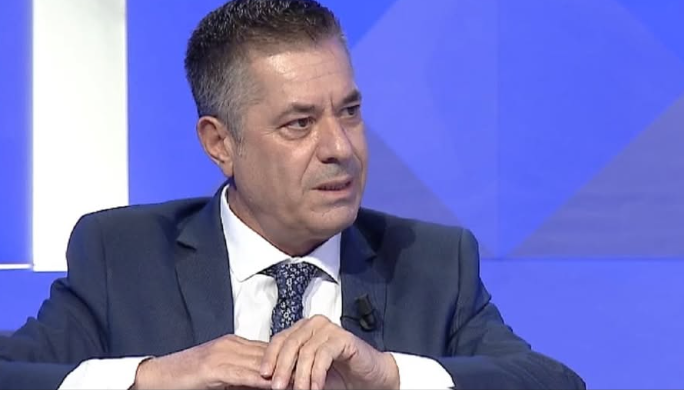
By Lorenc Vangjeli
Maybe it is a coincidence. Maybe not! Maybe it is one of those times when coincidence, by chance and mockery, puts on the costume of necessity to confuse the naive and the foolish. But whatever the truth, within less than 24 hours, Belinda Balluku suffered a double attack. The mayor of Tirana sent her a handwritten letter from prison, while the former speaker of Parliament considered her the worst model of Edi Rama’s governance. The two Socialists join a much longer list of colleagues in the PS who consider Ms. Balluku the cause of their problems. A list headed by another former Socialist deputy prime minister, Arben Ahmetaj, and an impressive number of ministers and other second-tier figures who have left office as suddenly as they were appointed. Coincidence or not, before another 24 hours had passed, since every action brings a reaction, a criminal case was registered at SPAK against Ms. Spiropali’s closest family members, while Veliaj was subjected to a non-routine search in his cell.
In his letter, Veliaj wounded the prime minister’s pride by reminding him of Tirana’s favorite gossip that his former deputy continues to control half the government. Spiropali, while nevertheless protecting the prime minister, considered Balluku the Alpha cell of her party’s disease. However different these positions, they are like two streams that merge into the same river, whose flow is now almost impossible to control. They brought Ms. Balluku exactly where she did not want to see herself, into the spotlight. Until now, unlike all Socialists faced with justice, Ms. Balluku has followed a different strategy. She has chosen to shut herself in the bunker of silence regarding the charges against her. She last spoke on the day she parted from her tearful subordinates at the ministry, swearing that she had neither villas nor 300 apartments. After that, she only listened to others speak little or not at all about her.
Although Ms. Balluku’s troubles with justice began almost three years ago, what was happening with the investigations against her was a public secret in Tirana. Even the opposition itself mentioned it according to the season and mood, but it rarely had her as a political target, until the moment in November 2025 when Sali Berisha hinted that in the protests against Veliaj, Balluku had infiltrated her people.

This is the background of the past, but now something essential has changed in Tirana. For a long time on one television station and for a few months on another, Balluku has turned into a personalized target. With the closure of the investigations, the aggravation of the charges against her and the sending of the file to court, but without a security measure, with the fear that there will be new strands of investigations, Balluku is amid many dilemmas.
The greatest fear is fed by the logical paranoia that Spiropali’s political diagnosis and Veliaj’s spiteful outburst may be coordinated and inspired by Rama and in his interest. The logical chances of this having happened are very modest and perhaps nonexistent, but it has long been clear that the prime minister sees it as an added woe to the troubles of his Bela. An unclear number of MPs she may control in Parliament and a large network of key directors under her thumb are at least some of the causes of Mr. Rama’s headache. His head also aches from the unsettling doubt whether memories of happier times, when someone falls into misfortune, can also turn against him. Arben Ahmetaj has often reminded him of such a thing.
The next fear is caused by the uncertainty over whether she has been caught committing the classic mistake recognized by criminal jurisprudence: someone suspected of a crime leaves the deepest traces not at the crime scene but in the attempt to erase and hide them. The torturous question is whether, if not Balluku herself, her people have been careful enough not to create other incriminating traces. Of the kind of traces that, on the final bill, fall to the Boss herself to pay.
Mrs. Balluku has made many personal enemies in the 6-7 years she governed Albania as Rama’s regent. Two of them, Ergys Agasi and Vlora Hyseni, are her third great fear. It is the fear that they may have used against her the same tool that she herself has not escaped the temptation to use against her opponents. Agasi has been obsessed with wiretapping, while Hyseni had the logistics, the human resources and the motive to turn the radars on Mrs. Balluku. Moreover, the existence of these wiretaps would be like a machine-gun burst into a crowd: although the target may have been Balluku, authoritative sources say, the stray “bullets” may have hit ministers, MPs or even people in the justice system.
Necessity is often capricious. To avoid appearing as such, to mock the naive and the foolish, it often masks itself under the jacket of coincidence and the trousers of conspiracy theories. Perhaps it was coincidence that brought Spiropali and Veliaj together, with Agasi and Hyseni in the background against the same target. Perhaps it was coincidence that Mrs. Spiropali’s name was mentioned in a new SPAK file less than 24 hours after her interview and that Veliaj’s cell was searched at dawn, again less than 24 hours after his letter. But perhaps not! It could also be a chain reaction of causes and effects and the relationship between them. Whatever the truth, this is a game in which Rama himself—the undisputed leader the Socialists still obey, though he can no longer persuade them as he once did—no longer holds all the cards. The great game now sees beyond even his tall frame, his heavy shadow and the broken bottle of the missing angels, the colourless devil-fools, the warning sirens and his witches.