







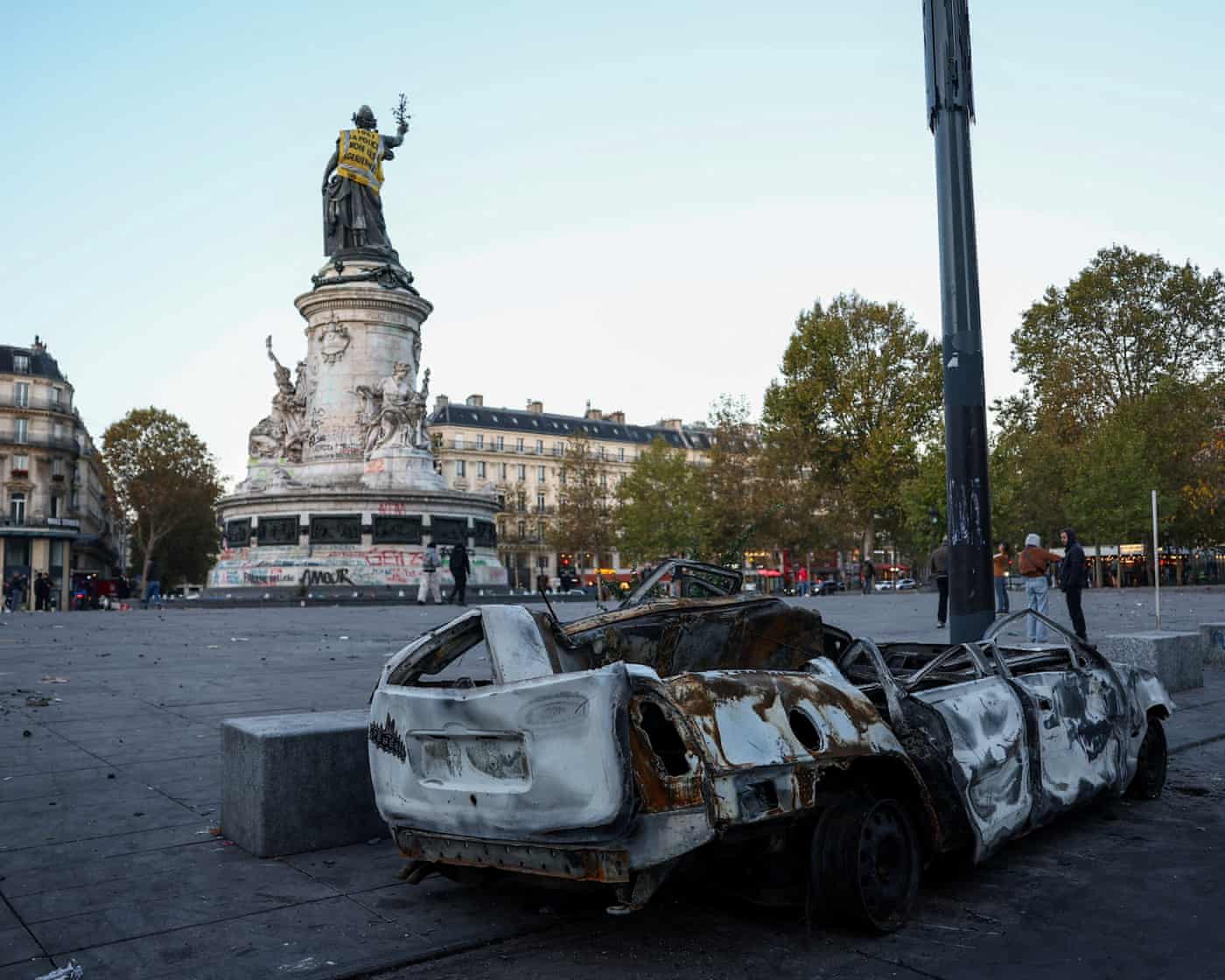
France will deploy around 70,000 police officers across the country on Saturday, in an effort by the government to prevent further civil unrest. The move comes after street violence, among the worst in years, that erupted last weekend on the fringes of protests against the cost of living. Interior Minister Laurent Nuñez said on Friday that security forces would include elite units, normally used for counter-terrorism operations. He added that there had been calls for violence on social media from “ultra-left” groups, stressing that this was not a peaceful demonstration. Nuñez warned that the government would be “extremely determined and would not tolerate anything”.
President Emmanuel Macron and his government are facing a crisis that has caught them off guard, six months before the presidential election. The government has admitted that it “lost control” over the widespread unrest on Saturday. The protests, initially peaceful, were hijacked by groups bent on disorder, degenerating into unbridled violence and widespread looting in Paris, Marseille, Lyon and other cities, as well as the burning of the town hall in Limoges. Nuñez promised that the authorities would be “uncompromising with the unrest, the looters and everyone who commits violence”, adding that the operation would involve 10,000 additional police, water cannons, armoured vehicles, mounted police, helicopters and drones.
Protests are also expected in several other countries this weekend, fuelled by a wider wave of discontent across the continent over declining public services, housing affordability and the spiralling cost of living. Calls for protests on Saturday have been made in cities in Italy, Austria, Spain, Portugal, Ireland and Albania (Tirana). In France, although protests are expected, several cities have banned demonstrations or forced them to change their planned routes. Central Lyon and several other major cities will be off-limits to protesters, while in Paris a trade union march has been authorised along a restricted route east of the capital, avoiding the city centre.

Requests from the main student union UNEF and the “yellow vest” movement to hold gatherings in Paris were rejected, although UNEF said its gatherings would go ahead. Several cultural institutions in Paris, including the Louvre, announced they would close on Saturday. Trade unionists and opposition leaders have criticised the government for refusing to allow more gatherings, a decision that is being challenged in court. Marylise Léon of the CFDT trade union federation accused Macron of abusing his authority, stressing that the bans are “counterproductive” and that “it is not up to the president to decide who may lawfully protest”. The far-left party La France Insoumise said the government had “crossed the boundaries that separate a democracy from an authoritarian and police state”. Adding to the tensions, far-right leader Marine Le Pen is due to address her party’s congress in Orléans. Macron called for “maximum firmness” against “acts of delinquency”, saying the worst violence had been caused by “ultra-left” groups seeking to “overthrow the republic”. One person was killed and four others were wounded in a shooting in Trappes, west of Paris, in an attack that police said may have had racist motives.
Taken from The Guardian