







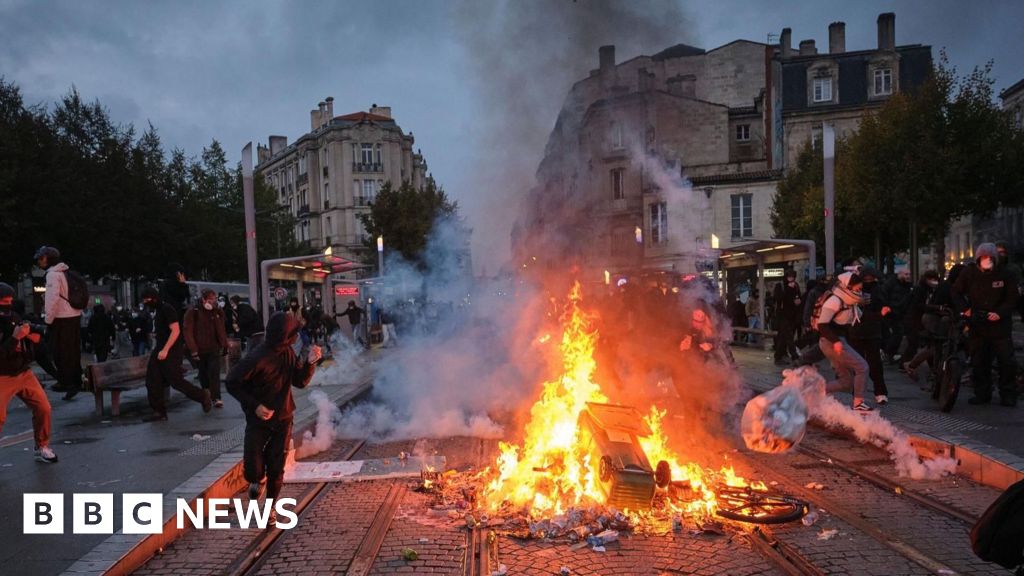
Nearly 1,000 arrests were made as hundreds of thousands of people took part in another day of mass protests across France, which were followed by clashes on Saturday. After mostly peaceful demonstrations, police used tear gas and water cannons to disperse protesters in several cities, including Paris, while barricades were set on fire in Marseille and planks were torn from shops in Bordeaux. Officials stressed that they had managed to avert large-scale unrest and looting last weekend, which caused serious disorder in modern French history.
The Interior Ministry reported around 410,000 protesters, while unions estimated around 800,000. To manage the situation, around 70,000 police officers were deployed and restrictions were imposed in several cities. The measure aimed to prevent the protests from degenerating into chaos over the cost of living and poor conditions in schools, as had happened previously with business looting and building arson. President Emmanuel Macron had earlier decreed that only demonstrations organized by recognized unions would be allowed, while hundreds of people have been jailed for vandalism, arson and looting after fast-track trials.
In Paris, clashes broke out at the end of a peaceful march, where police deployed an elite unit. Protesters erected barricades and threw objects at officers, while police struck groups of masked young people who were smashing the windows of a car dealership with batons. French Interior Minister Laurent Nuñez said that “several thousand radical activists” had gathered, including around 500 identified “troublemakers”. The incidents also included the burning of rubbish bins and the blocking of roads with sheet metal in Marseille, as well as the construction of barricades in Bordeaux. In Lyon, police used tear gas to disperse a crowd in a restricted area. Nuñez confirmed nearly 1,000 arrests and two people seriously injured in Toulouse and Clermont-Ferrand.

Protester Zelie in Paris expressed deep disappointment, saying people were “really frustrated” and had “suffered a lot” under Macron’s governance, adding that “they take our money, tax us a lot, and we can’t say anything. Today we are on the streets because a lot of time has passed, it has been too much”. Masked adolescents stressed the despair of their generation and the feeling of being abandoned by the government, arguing that the looting was a consequence of “poverty and police violence” and that the protests would continue until there was a “response to our demands”. Meanwhile, a peaceful rally of around 13,000 people was held in Orléans against the National Rally party. Similar protests took place in other European cities such as Barcelona, Tirana, Brussels and Milan. These events follow last weekend’s demonstrations, in which around 550,000 people protested against rising fuel prices and the cost of living, with disappointment escalating after weeks of student protests. The chaos at that time resulted in over 2,500 arrests, with damages estimated at “hundreds of millions of euros” and around 1,000 police officers injured. The continuation of the protests, six months before the presidential elections, has prompted leading candidates to blame President Macron.
Taken from BBC News