







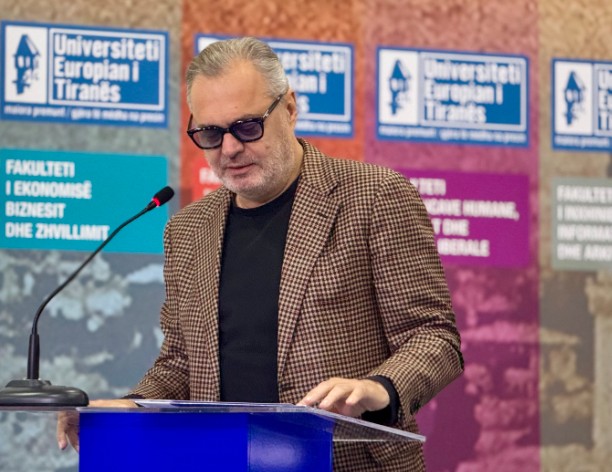
For his contribution to Albanian prose and literature, as well as to the promotion of creative values, the European University of Tirana (UET), on the proposal of the Faculty of Humanities, Education and Liberal Arts, honored the writer Ben Blushi with a Certificate of Appreciation.
This is the second most important recognition awarded by the university, after the title “Doctor Honoris Causa”, to honor distinguished figures in politics, economics, humanities and literature whose work has left a mark on society.
The proposal for this recognition came from the Faculty of Humanities, Education and Liberal Arts. The Dean, Prof. Dr. Belina Budini, read the citation of the certificate: “For pioneering contribution to Albanian prose and essay writing, stylistic finesse and the promotion of creative values that embody the spirit of the Faculty of Humanities, Education and Liberal Arts”.
In her speech, Budini highlighted the organic link between Blushi’s work and the academic and artistic profile of the Faculty, singling out the multimedia dimension of his authorship, the intertwining of literature with journalism and photography, and his ability to stimulate intellectual debate and create audiences that do not remain indifferent to his work.
From “To Live on an Island”, the first book that introduced him as a writer in 2008, to “The Crazy Stories of Tirana”, published recently, Ben Blushi has built a rich literary oeuvre, with dozens of titles, characters and stories, over a career of nearly 20 years. His novels explore historical, political and social themes, up to his latest passion for what he himself calls historical science fiction.
According to Blushi, what distinguishes the writer from the historian is the creative freedom to narrate events connected to historical truth but transformed through imagination, enriched with actions and conversations that never happened.
A journalist and press editor early in his career, Blushi later engaged in politics, where he held important state positions and founded his own party. Alongside his involvement in running several major television stations in Albania, for nearly two decades he has continued to be closely connected to literature. Blushi has thus followed the family tradition in the field of Albanian letters, responding, as he puts it, to “the call of his ancestors”.

The President of UET, Assoc. Prof. Dr. Selami Xhepa, who first knew Blushi as a member of parliament and later as an author, described honoring such a personality of political and literary life as a privilege. He said that politics lost a personality who became an asset to literature, where Blushi stood out as a phenomenon.
“Personally, I am an admirer and reader of his works. ‘To Live on an Island’ was perhaps the most interesting book for me,” Xhepa stressed.
Referring to the latest book, the President of UET said that sometimes cities are better known through literature than through history, just as Istanbul became better known through Orhan Pamuk’s book.
During a discussion with students and faculty of the Faculty of Humanities, Education and Liberal Arts, Blushi answered questions about his latest book, “The Crazy Stories of Tirana”, the 100 personalities included in it, his sources of inspiration and the reasons why he chose to write about certain figures while leaving others out.
“There were two main criteria,” the author stressed. “They had to be crazy and dead.”
Recalling the 1980s, when he was a student, Blushi said that more than half of the students in the lecture hall wanted to become writers. Today, according to him, this inclination has faded, as young people orient themselves toward professions that move in parallel with contemporary developments, innovation and technology.
“This kind of craft seems to be evaporating. The world has changed very quickly, and some crafts that deal with the soul no longer have as much space. The soul is invisible; it does not appear on social media,” Blushi said.
According to him, writers today no longer have the weight they once had, when the world was less influenced by technology. Although statistics show an increase in the number of readers and publications, the role of the writer in society has faded. Influencers have now taken over public attention and space, including the virtual one.
“In 200 years, the number of publications has increased 200-fold. This has come as a result of the spread of education, the influence of universities and the decline in illiteracy. But despite there being more readers, writers have less power and are very far from the colossi and classics of literature of the past,” Blushi said.
However, he expressed optimism that the world will always need writers.