







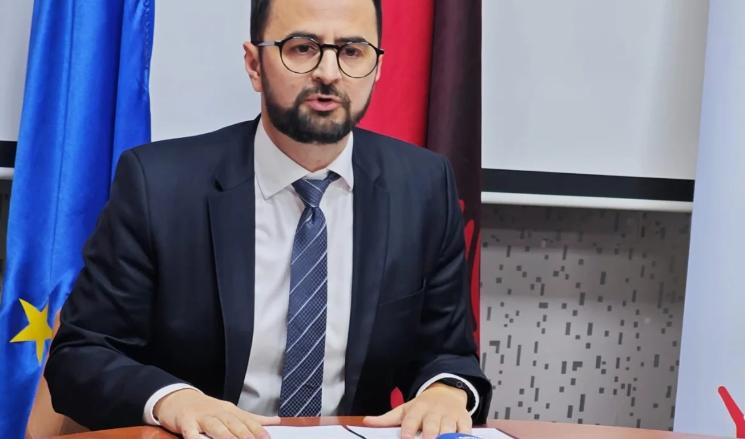
The Ombudsman, Endrit Shabani, has made public the preliminary findings of the National Mechanism for the Prevention of Torture (NMPT), following monitoring carried out over four days of protests. The institution has identified overcrowding in the police stations inspected, inadequate conditions for detained persons, complaints of violence by police officers, and problems in the treatment of minors.
In a statement to the media, Shabani said Ombudsman teams had monitored the premises of police stations No. 1 through No. 6 in Tirana, the Security Block, the Trauma Hospital, as well as police stations in Korçë, Vlorë and Shkodër. According to him, in the last 72 hours alone, 214 persons deprived of their liberty were contacted, with whom confidential conversations were held. The teams also received information from persons escorted, arrested and injured, as well as from doctors and psychologists.
“In the last 72 hours we have contacted 214 persons deprived of their liberty. We have held confidential conversations with those escorted, arrested and injured, with doctors and psychologists,” Shabani stated. He said that on 14 and 15 October, 128 persons received treatment at the Trauma Hospital, among them 86 police officers, 38 protesters and 5 minors, adding that some of them had been interviewed and their complaints recorded.

Complaints of violence and officers in civilian clothing
One of the issues the Ombudsman will examine as a priority concerns complaints about persons in civilian clothing, suspected of being police officers, who allegedly took part in interventions during the protests without identification markings. “During these days we have received complaints about police officers in civilian clothing without identification markings. This issue will be examined as a priority,” Shabani said.
According to him, other complaints concern allegations of violence during escort, lack of medical care and exceeding time limits for the security measure. The head of the institution stressed that the right to peaceful assembly is guaranteed by the Constitution, but condemned any form of violence, regardless of whether the victim is a protester or a police officer. He also condemned damage to public and private property, including businesses.
“The right to peaceful assembly is guaranteed by the Constitution. Protesters must exercise it peacefully. We condemn every act of violence. We condemn violence against police officers. We condemn violence against protesters. We condemn damage to public and private property, including businesses,” he stated.
Shabani stressed that police may use force only when it is necessary and proportionate, while every officer engaged in operations must be identifiable. “Every officer who uses force must be identifiable. Identification protects the citizen from abuse and protects the police officer from unfounded accusations,” Shabani said.
Conditions in police stations: Detainees sleep on the floor
The most important problems identified during the monitoring relate to overcrowding and inadequate conditions in the facilities where detained and escorted persons are held. According to Shabani, in all the police stations inspected, the reception capacities had been exceeded, while the situation in the Security Block was described as unacceptable. “We found detainees sleeping two to a bed, or on mattresses on the floor. Blankets and heating are lacking. Drinking water was being provided by family members. Soap and toilet paper are missing. Medical service is partial in the face of numerous requests,” said the head of the Ombudsperson.
He also stated that during the inspections, persons with visible signs of violence were found. For the 26 persons held in the Security Block, the allegations and the signs found have been recorded in the relevant minutes. Another identified problem concerns deficiencies in recording information in the registers of escorted persons. In this context, the Ombudsperson has requested the Ministry of Internal Affairs to take immediate action to improve conditions in the Security Block, guaranteeing the supply of water and food, beds, heating, hygienic conditions, and the presence of a doctor at all times.
Minors also in the focus of the monitoring
Shabani also addressed the treatment of minors who were escorted or detained during the protests, stressing that their protection is a priority for the institution. According to him, commissioners have taken the statements of minors in the presence of a clinical psychologist at the Trauma Hospital. In parallel, claims concerning about 12 minors who are suspected of having been kept in isolation in the premises of a ministry are being verified. “We are verifying evidence regarding about 12 minors who were kept in isolation in the premises of a ministry. This case is being verified, and we will report the findings of our investigation to you,” Shabani said.
During the monitoring, cases of detained minors were also identified, who are suspected of having been questioned without the presence of a parent or guardian and of a psychologist. “We have identified detained minors who were questioned without the presence of a parent or guardian and of a psychologist. This is not in line with the requirements of the law and international standards for the protection of children,” he stated.
For this reason, the Ombudsperson has asked the State Police to guarantee the separation of minors from adults in every case and at all times. In conclusion, Shabani made an appeal to all persons who claim to have suffered violence or damage during the protests, including citizens, protesters, business owners and police employees, to turn to the institution. “In closing, I would like to repeat the call once more: any person who has suffered violence or damage, whether a citizen, protester, business owner or police employee, may turn to the Ombudsperson. The NPM will continue monitoring in the field,” Shabani concluded.