







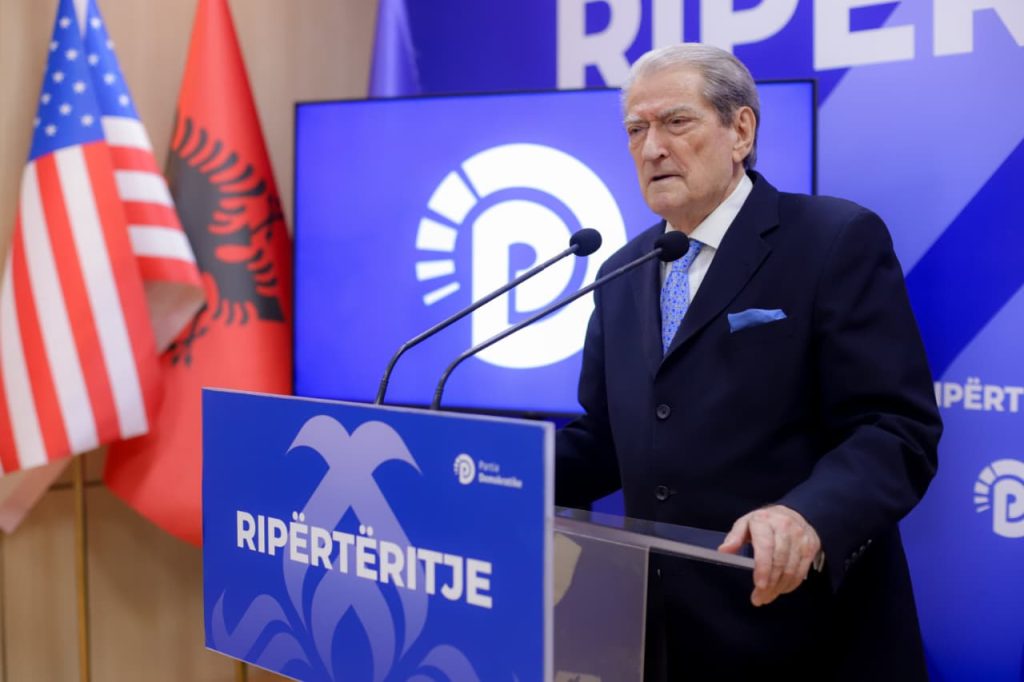
Sali Berisha has published a letter from US congressmen Joe Wilson and Keith Self addressed to US Secretary of State Marco Rubio, expressing concern about the state of democracy, corruption and the rule of law in Albania. In their letter, the two congressmen call on the US State Department to consider punitive measures against Albanian officials involved in significant corruption, as well as against those who, in their view, obstruct investigations and the functioning of justice.
Full reaction:
A very important letter!
Dear friends, the chairman of the Helsinki Commission, Congressman Joe Wilson, and Congressman Keith Self, chairman of the Subcommittee on Europe in the US Congress, have sent a letter to Secretary of State Marco Rubio on developments in Albania, the corruption of Belinda Balluku, the blocking by Edi Rama of the SPAK request for her arrest, and the outbreak of massive protests in Albania since January 2026, following the accusations against Balluku, which demanded Rama’s resignation and early elections.
¹In their letter, these distinguished members of the US Congress ask Secretary of State Marco Rubio to punish, in accordance with US law, corrupt politicians and their protectors who obstruct justice!
Further, the honorable congressmen pose a series of questions, among others: Does the Department support independent investigations into the incidents documented during this summer? Friends, I invite you to thank congressmen Joe Wilson and Keith Self with deep gratitude for their letter, and I invite you to read its text below.
Letter addressed to the Secretary of State
Dear Secretary Rubio,
US Department of State
2201 C Street NW
Washington, DC 20520
We are writing to express our concern regarding the state of democracy and the rule of law in the Republic of Albania, a NATO ally and a candidate country for European Union membership.¹ The United States has invested significantly in justice reform in Albania and has a strong interest in its success. Recent developments suggest that progress is fragile and, in key areas, risks being reversed. We call on you to use the Department’s authority to restrict visas, pursuant to Section 7031(c), against Albanian officials involved in significant corruption.

Independent assessments paint a mixed picture. Freedom House rates Albania as “partly free”, with 69 points out of 100 in 2026
.² Observers described the May 2025 parliamentary elections as “competitive and professionally conducted”.
³ However, Albania received only 39 points out of 100 in the Transparency International Corruption Perceptions Index for 2025.
⁴ The 2026 report of the V-Dem Institute already classifies Albania as an electoral autocracy.
⁵Corruption remains the main problem. The Special Prosecution Against Corruption and Organized Crime (SPAK), created with the support of the United States and Europe, has shown genuine independence. The European Commission has praised its work, while noting that other institutions have fallen behind.
⁶ Officials have also pressured SPAK and the High Inspector of Justice, the body that oversees judges and prosecutors.
⁷SPAK cases have already reached the highest levels of government. SPAK has charged Belinda Balluku, who served as deputy prime minister, with interfering in public procurement for road construction.
⁸ In December 2025, prosecutors asked Parliament to lift her immunity so she could be arrested. Prime Minister Edi Rama described the request as unconstitutional, and Parliament has not allowed the arrest procedure to proceed.
⁹ Rama denies all corruption allegations against him.
¹⁰ SPAK is also investigating former head of the State Intelligence Service of Albania, Vlora Hyseni, over suspicions that she misused her access to information to help a person suspected of criminal activity.
¹¹Public discontent has taken to the streets. The accusations against Balluku helped fuel massive protests in Tirana in January 2026, which demanded Rama’s resignation and early elections.
¹² By summer, protests against a luxury resort near a protected natural area had grown into a broader movement known as the “Flamingo Revolution.”
¹³The crisis has also put pressure on the media. Albanian media are characterized by concentrated ownership, non-transparent financing and owners with political ties.
¹⁴ On 30 July 2026, ten media freedom organizations warned of obstruction, threats and attacks against journalists covering the protests. They documented 15 threats and attacks in June and July alone, and questioned the use of water cannons and tear gas against demonstrators.
¹⁵Albanian anti-corruption institutions cannot succeed when political leaders protect the officials they investigate. For this reason, we urge you to use the Department’s authority under section 7031(c) of the annual appropriations act for the Department of State, Foreign Operations, and Related Programs. Specifically, we ask the Department to publicly designate Albanian officials and, where appropriate, their immediate family members, for whom it has credible information of involvement in significant corruption.
This review should include officials against whom SPAK has brought charges, as well as those who have used their positions to obstruct its investigations. Consistent application of this mechanism, regardless of party affiliation, would advance the Department’s efforts against kleptocracy. It would also show that the United States stands with Albanians seeking accountability.
We also ask you to respond to the following questions by 5 November:
Will the Department consider Albanian officials for ineligibility designation under section 7031(c), and within what timeframe? Will it also consider sanctions under the Global Magnitsky Act where the evidence warrants such a measure?
What assistance is the Department providing to SPAK, the High Inspector of Justice and broader justice reform in Albania? How will it protect these institutions from political pressure?
Has the Department raised with the Albanian government the failure of Parliament to act on SPAK’s request to arrest Ms. Balluku? What was the response?
How is the U.S. Embassy in Tirana engaging Albanian authorities on police management of protests and the safety of journalists? Does the Department support independent investigations into the incidents documented this summer?
We also request a briefing for our staff on these issues.
Thank you for your attention to this matter. We look forward to working with you in support of Albania’s democratic institutions.
Sincerely,
Rep. Joe Wilson
Co-Chairman
Commission on Security and Cooperation in Europe (Helsinki Commission)
Rep. Keith Self
Chairman
Subcommittee on Europe